What if Serena had been a man?

Serena Williams of the U.S. argues with chair umpire Carlos Ramos while playing Naomi Osaka of Japan during their 2018 US Open women's singles final match on Sept. 8 in New York. AFP-Yonhap
By Do Je-hae
The biggest news of the U.S. Open that just ended is Serena Williams' outburst in the final match at the Arthur Ashe Stadium in Flushing Meadows, New York, against Japan's budding star Naomi Osaka.
The 20-year-old's historic achievement of becoming the first Japanese win a Grand Slam event in tennis was overshadowed by Williams' clash with the umpire Carlos Ramos during the final Saturday where she lost 6-2, 6-4. The Portuguese official gave the 23-time Grand Slam champion three code violations. After the match, Williams was fined $17,000 for verbal abuse of the chair umpire, smashing her racket on the court and being warned of illegal coaching.
Their feud reached a climax when Ramos handed down a game penalty to Williams for some more verbal spat from her, giving her opponent a 5-3 lead in the second set. The game penalty at such a critical moment in the match shocked even the most seasoned commentators such as Chris Evert. The 18-time Grand Slam champion declared, “I have never seen anything like this.” Williams' loss ended her campaign this year for the record-tying 24 Grand Slam titles with Margaret Court.
Viewers were divided about the dramatic final, with some blaming the 36-year-old for her behavior, and some criticizing the chair umpire for being too harsh on the tennis legend just because she was a woman. “I've seen other men call other umpires several things,” Williams said during a post-match interview. “He has never taken a game from a man because they said 'thief.'”
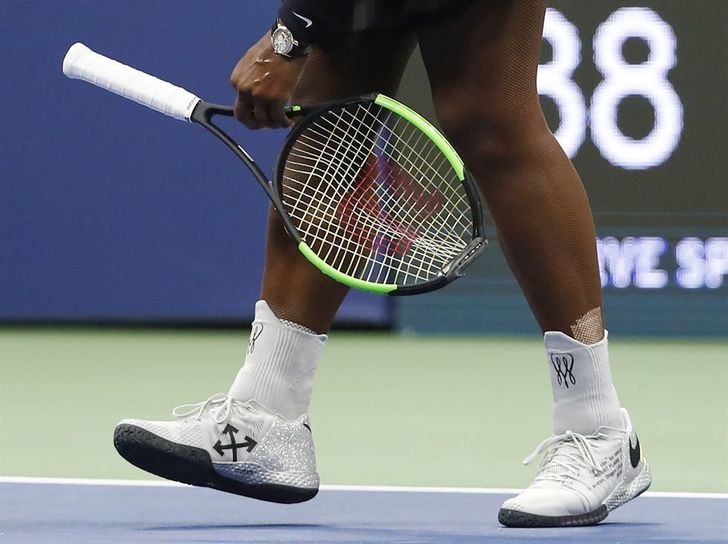
Serena Williams picks up her racket after having her serve broken by Naomi Osaka, of Japan, during the women's final of the U.S. Open tennis tournament, Saturday, Sept. 8 in New York. AP-Yonhap
Williams does not need to rely on on-the-spot coaching or any kind of cheating to win. I firmly trust her to be the one to rather lose than cheat. But when faced with such allegations, one wonders whether she could have dealt with them more gracefully on court out of respect for the fans and especially for the opponent. The former tennis champion Martina Navratilova made a similar point in an opinion piece entitled “What Serena Got Wrong” in the New York Times. “In fact, this is the sort of behavior that no one should be engaging in on the court,” Navratilova wrote. She also made another very good point when she said that we should not “measure ourselves by what we think we should also be able to get away with.”
Some of Williams' wording and behavior could be seen as highly inappropriate. She kept pointing her finger at Ramos during their spat. She forced him to give her an apology and even said “you are never going to be on my court ever again.” That is no way to talk to the umpire or anyone sharing the court with her. Also, offensive words like “liar” and “thief” should not be used on court.
The match re-ignited the controversy about double standards in tennis among male and female players' on-court behavior. Recently, there was also some racket on social media about whether women players should be able to take their shirt off on court like men. What if Serena had been a man? Would that have made a difference in the umpire's decision to take away a point and a game away for verbal offense?
Some were probably asking these questions after a tweet from the U.S. tennis great Billie Jean King. “When a woman is emotional, she's 'hysterical' and she's penalized for it. When a man does the same, he's 'outspoken' & there are no repercussions. Thank you, @serenawilliams, for calling out this double standard. More voices are needed to do the same.”