A gold miner's life in Korea in the 1960s: Part 5 - superstitions
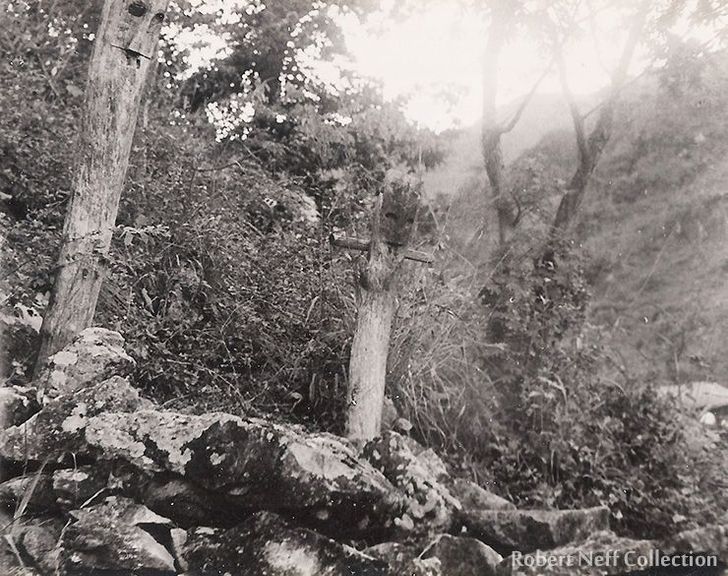
Village guardians. Circa 1961.
By Robert Neff
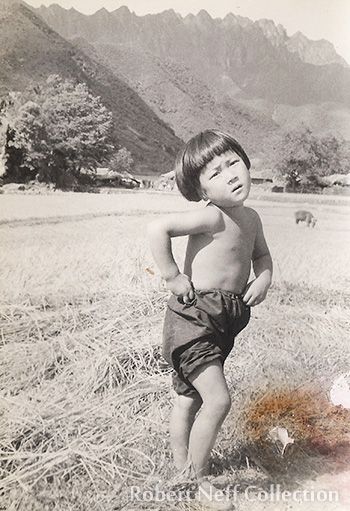
Caught in the act of developing a sty. Circa 1961.
Mining is a hazardous occupation and, unsurprisingly, many miners are superstitious ― the miners at Tongsan were no exception.
According to Fred Dustin, the daily lives of the Korean miners who worked for him were “almost completely dictated by methods of appeasing the many spirits” for their audacity of poaching the earth's minerals.
One person who had an important role at the mine, despite not working for it, was Mr. Yu. He was 72 years old and the village's headman, a role that was handed down to him by his forefathers who had lived in and governed the village for centuries.
“His position guaranteed him the right to negotiate the size of the mill's tailing pond: where the pump would be placed in the stream and even where the trees around the warehouse would be planted!”
It also meant that he was in charge of the ceremony to console the Mountain Spirit whenever a cross-cut, a winze, or a stope was to be started.
Dustin recalled that “Yu [always] drank the first bowl of warm blood that gushed from the hog's cut throat, the same hog whose head would dominate the place of honor on the 'kosa' table surrounded by apples, pears, a dried fish or two, boiled port and wine.”
“In fact,” Dustin somewhat wryly remarked, “it was Mr. Yu's family that usually sold the pig to the mine in the first place!”
Dustin enjoyed roaming about the mountains surrounding the mine and sometimes encountered relics of the past ― things that stimulated his imagination.
“It must have been early April or late March of 1961 (for the azaleas were blooming, their years of uninterrupted growth almost hiding the crumbled remains of my discovery) while on one of my searches for the locally storied fabulous 'Mother Lode' that I came upon, high on a ridge some distance from our mine, what appeared at first to be an ancient altar.
“If memory serves correctly, the 'altar' was some 4 or 5 meters across and higher than the un-mortared stone wall that surrounded it, this encircling wall being some 5 or 6 meters from the 'altar's base' base.”
Excited about his discovery, he asked the Korean miners for more information about the “altar” but they all disclaimed ever hearing about it ― let alone seeing it ― and chalked it up to the wild imaginations of a man who (in his personal writings home) claimed to be the first Westerner to walk the mountain ridges.
It was Yu who dispelled Dustin's excitement. After hearing the description of the “altar,” Yu's response was: “Well, of course! That is a Bonghwadae ― everybody knows that!!”
In an article he submitted to The Korea Times in February 1982, Dustin explained that a Bonghwadae was “one of the many signal-fire sites used across Korea to convey by means of a series of fires to the court in Seoul that the [borders] of the [Yi] Dynasty were free of intruders...”
Not all superstitions at the mine were Korean.
One day, a Western visitor (one of the mining supervisors from another KCMC mine) encountered a small girl urinating on the side of the road near the village and promptly snapped her picture as she quickly adjusted her clothing. On the back of the picture was the annotation: “Caught in the process of developing a sty.”
Nearly a half-century later, Dustin explained: “We were always told at home back in Washington [state] that [urinating] in the middle of the road brings on a sty.” He was quick to add that he was “not superstitious or anything, of course, but I would never do such, even to this day.”
It had to be true. During the many years I knew him, I never saw Dustin with a sty.