The secret weapon of the first Sino-Japanese War (1894-95)

Chan Yuen formerly Chinese captured by Japan circa 1896
By Robert Neff
One of the most interesting but least known stories of the first Sino-Japanese War revolves around a secret weapon ― a weapon of mass destruction ― and Providence, Rhode Island.
John Wilde lived in Providence. He was a frustrated man who had great aspirations and even greater illusions of grandeur. He was convinced that he was a great inventor and chemist (others, including his former business partner, disagreed).
He presented one of his ideas to the American navy but was rejected and so, according to Prof. Jeffery Dorwart, he “brooded in his waterfront laboratory, planning to show the world the power of his terrible secret.”
His opportunity came during the summer of 1894 when war between China and Japan looked imminent. Wilde wrote the Japanese minister in Washington, D.C., and tried to convince him that he possessed a weapon that would destroy the entire Chinese fleet, but the Japanese minister wasn't interested in this “magical ability to sink hostile ships,” and “contemptuously refused” his offer.
So, with his partner, George Cameron ― a 28-year-old former British naval officer and “explosive expert,” contacted the Chinese legation in Washington, D.C., and met the secretary, C.F. Moore (Mo Ching-fan). Wilde managed to convince the Chinese government of his weapon's potential and, in October 1894, Wilde, Cameron and Moore left for China.
Of course, they took the necessary precautions of traveling under assumed names but they were clearly amateurs and did not realize that they were being followed by Japanese agents.
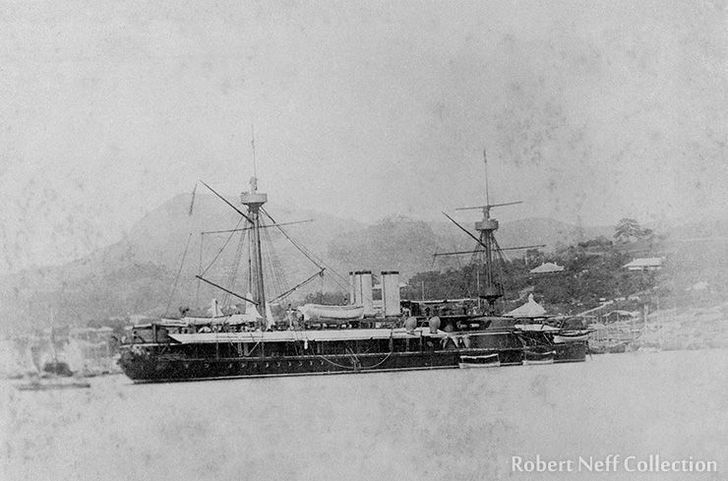
Ting Yuen Chinese circa 1894
At sea, Cameron became drunk and boasted to all who would listen that he and his partners had developed a powerful weapon that would destroy the entire Japanese fleet. Many probably dismissed him but one man paid careful attention to everything he said. This silent observer was Shimamura Hisashi, the consul-general of Mexico (some accounts claim he was the consul of San Francisco) and he quickly sent a message to the Japanese legation in Washington.
When the Gaelic arrived in Yokohama, Japan, on November 4, the Japanese were already aware of the two American “magicians” and their Chinese escort's identities. Orders were given to search the ship, and just before its departure from Yokohama on the Nov. 5, Japanese customs officials boarded the ship and asked permission of Captain Pearn to examine it for contraband arms that were suspected of having been shipped from San Francisco.
The captain officially protested against the search, but otherwise offered no opposition. The search revealed no trace of the Americans or their Chinese escort, nor did it reveal any weapons. It was learned, however, that the suspects had transferred to the French steamship Sydney the previous day and were at this point sailing toward Kobe, and then on to Shanghai.
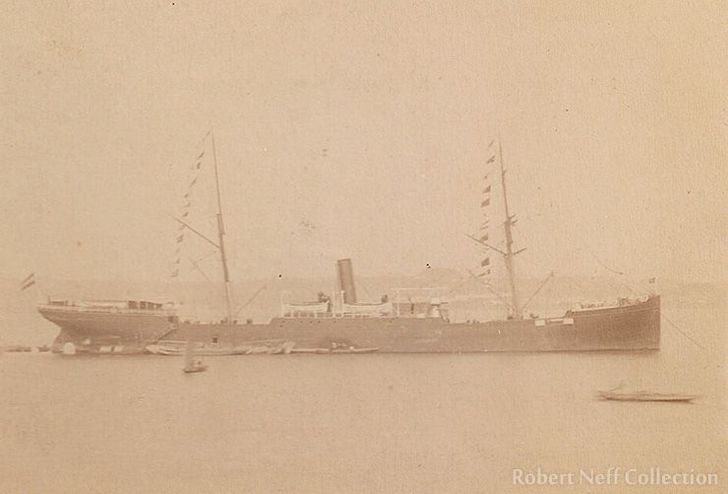
The Secret Weapon of the First Sino-Japanese War submission
The Japanese authorities surrounded the Sydney in Kobe and, according to a newspaper report, the captain was informed that the ship would be detained until Wilde, Cameron and Moore were turned over. The captain refused, “whereupon an armed force boarded the Sydney and despite the protests of the French consul and the steamer's captain, seized the three men and removed them from the vessel.”
Although no weapons were discovered, a document was found in which the Chinese government promised to pay them $1 million for the destruction of the Japanese navy and a specified sum for every merchant ship destroyed.
The three were “charged with conspiracy to destroy the Japanese fleet by the use of torpedoes” and Moore was promptly sent to Hiroshima as a prisoner but the two Americans were “released from custody after taking oaths not to resort to any action tending to assist China during the war.”
Of course, Wilde promptly broke his oath and made his way to China where he attempted to develop his weapon. What was his weapon you ask?
“It appears that Wilde's plan was to throw from a torpedo boat shells filled with chemicals, which, on striking, would explode, creating an impenetrable and suffocating smoke, under cover of which attacks could be made with torpedoes.”
The weapon was never built and China suffered a humiliating defeat. Wilde was captured and there were reports that he faced possible execution but was eventually sent home ― largely forgotten except as a small but amusing footnote in the history of the first Sino-Japanese War.