The women of Fusan in the late 19th century

Korean women circa 1922
By Robert Neff
It was common knowledge in the ports of Japan and China in the 1880s that Korean women were rarely allowed outside their homes, except during the curfew hours at night when they were given free rein of the streets.
It was unthinkable for a woman to be viewed or touched by a male ― especially a foreigner ― unless he was her husband or part of her family. Western visitors often reported that the women would flee their approach ― running off the path into the forest or hiding behind walls and fences.
Thus, when Ensign George C. Foulk and his two traveling companions arrived in Fusan (now part of modern Busan) in the summer of 1882, they were surprised at the number of women they encountered and the status these women apparently enjoyed.
“[We] frequently met women on the street, and others stood in front of their houses looking at us as we passed. We were told that Korean men treat women with much more courtesy and consideration than is common in other parts of the East. The poorest peasant will dismount from his horse when about to pass a woman, and a case was cited in which two strangers who happened to be near a woman, promptly thrashed a third man who was accused by the woman of having been impolite to her.”
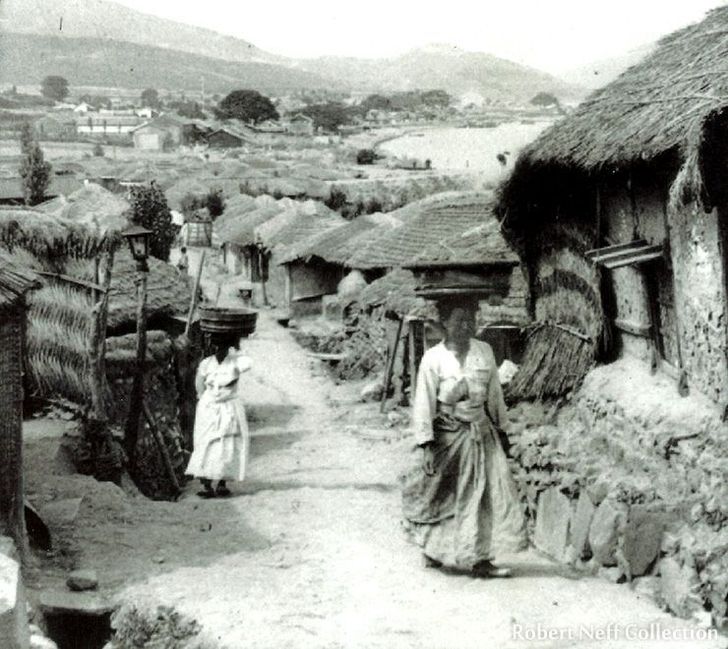
A small street in Fusan circa 1903
Foulk described the Koreans he encountered as “tall and well formed … [and] their hair varied in color from black to light reddish brown, suggesting, with the varying obliquity of the eyes, sometimes straight like those of Europeans, the intermixture of Caucasian and Mongolian races.” He concluded that “in general their personal appearance and manner were more likely to command the respect of foreigners than that of either the Japanese or Chinese in their original conditions.”
When Foulk returned two years later, he was again surprised by the industriousness of the women.
“I was impressed with the endless string of people bound to the chang [market], mostly women, in groups of four, six, ten, and fifteen, almost each one with a tub on her head or back containing seaweed, ducks, chickens, salt, oysters. All were in the middle or latter part of life, and I was struck with their strong physiques.”
Although he was impressed with their “strong physiques,” he was not taken with their physical beauty. He married a Japanese girl after he left Korea.
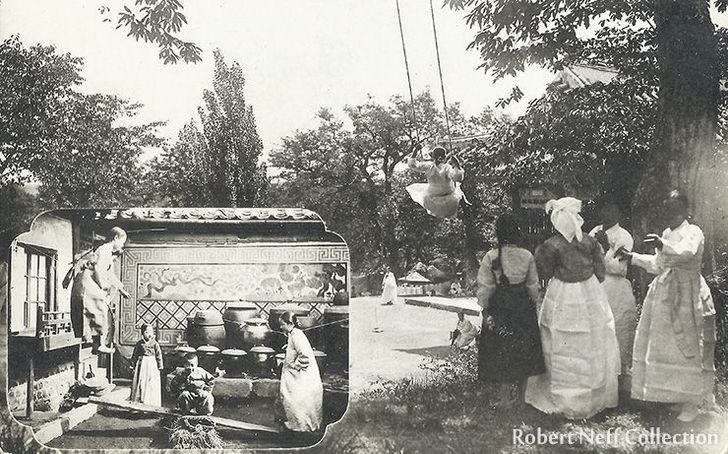
Women and children at play circa 1920s
Harmon Van Slyke Peeke, an American missionary stationed in Japan, traveled to Fusan in the spring of 1891 and his opinion of the women of that port echoed Foulk's observations. In his diary he wrote:
“The Korean women seem superior to the Japanese. The latter are doll-like in so many respects and you rarely see one who impresses you as being possessed of sterling moral sense. The Korean women, on the contrary, resemble Europeans of the lower classes. The Korean men have a distinctly Asiatic cast of feature; but one of the women, fixed up in European costume and transported to the States would very little betray her origin by her appearance. A Japanese woman is Japanese, is Asiatic, attire her as you will.”
Despite a momentary fixation with a young Korean girl with “sparkling dark eyes, smiling, cherry lips and perfect teeth,” Peeke returned to Japan and within two years fell in love with and married a fellow American missionary.
Beauty is in the eye of the beholder but, as we shall discover tomorrow, sometimes the eye is mistaken.