INTERVIEW Chinese reporter's views of Korea's security environment
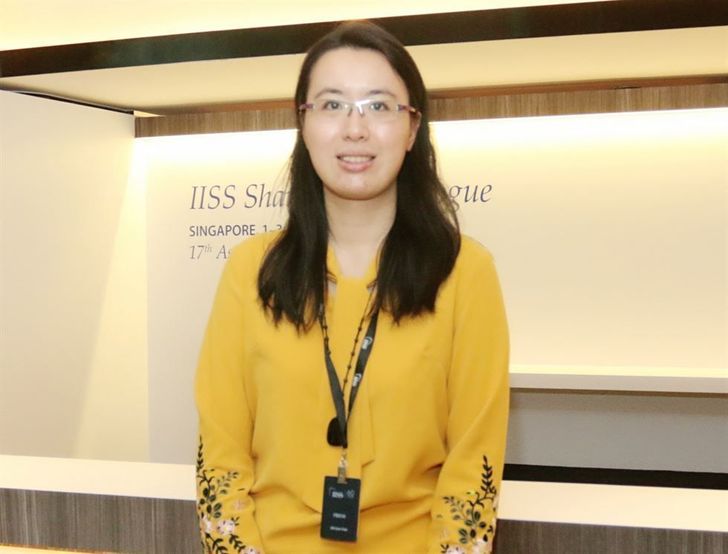
Guo Zhijun, director of the China Review News Agency international news department, smiles at the Shangri-La Dialogue in Singapore early this month. Courtesy of Hwang Jae-ho
By Hwang Jae-ho
The 17th Shangri-la dialogue was held in Singapore early this month; the greatest diplomacy and security discussion banquet in terms of its volume and quality. More than 1,000 professionals, journalists and delegations consisting of heads of government, general staff and bureaucrats from about 40 countries attended.
Indian Prime Minister Narendra Modi delivered the keynote address and U.S. Defense Minister James Mattis continued the first session. Song Young-moo, the Korean Minister of Defense, also attended as part of the Korean delegation to discuss North Korea's denuclearization and inter-Korean relations. The Shangri-La Dialogue focuses on worldwide diplomacy and security issues.
This time more than 100 Chinese journalists attended. Watching them, I wondered what they thought about current issues. So I interviewed Ms. Zhijun Guo, on June 3, who has attended the dialogue for several years. It was a unique occasion with a professor interviewing a journalist.
Guo is a director of the China Review News Agency international news department. She focuses on interviews and East Asia security issues, especially peninsula issues and Sino-U.S. relations. She was a professional associate of Colombia University’s Weatherhead East Asian Institute in New York City from 2015-2016. She also has a master’s degree from the Bristol University and a master’s degree from Hong Kong Baptist University.
Q: What is your feeling about the 17th Shangri-La Dialogue?
Guo: From my perspective, the Shangri-La Dialogue always gives me lots of opportunities to keep in touch with the latest news and ideas about Asia-Pacific security and cooperation among many countries. I always feel that the Shangri-La Dialogue is an open and free platform to listen and learn different views of security and defense policies between Western and Eastern countries.
Although many concepts are not the same, the opportunities supported by the Shangri-La Dialogue are precious. As a journalist, I always feel lucky when I come to Singapore to do interviews at the Shangri-La Dialogue.
Q: What is the most impactful thing from your interviews?
Guo: l looked for several months to premier Modi’s keynote speech at this year’s Shangri-La Dialogue. I wanted to hear his views on the Indo-Pacific and if he would criticize China. In fact, unlike U.S. Secretary of Defense Mattis, his tone is gentle and he emphasizes the importance of relations between India and China.
He said: “A two-day informal summit with President Xi helped us cement our understanding that strong and stable relations between our two nations are an important factor for global peace and progress . . . Asia and the world will have a better future when India and China work together in trust and confidence.”
I think this is the most impactful thing I remember from this year’s dialogue.
Q: How do you view about the Trump-Kim Summit which will be held next week in Singapore?
Guo: I am looking forward to this historic summit. I really hope the summit can be held successfully and achieve some real progress on North Korea denuclearization issue. This problem has threatened East Asia countries for more than 20 years.
I believe no one in these countries want to see bombs and real ‘fire’. North Korea leader and his team should think carefully that do they what to be a part of world or not? I hope the U.S, the DPRK and other related regional countries have wisdom to use this opportunity.
Q: What did you think about the inter-Korean summit in April this year?
Guo: I went to Seoul to cover the inter-Korean summit this April and I highly admire what President Moon did. In my opinion, President Moon Jae-in has consistently appealed for dialogue to defuse tensions surrounding the Korean Peninsula and held the summit with Kim Jong-un successfully on April 27.
This summit is a symbol for opening a path toward peace on the peninsula. I have visited South Korea many times and I always like talking with my Korean friends. Just like the theme “Peace, a new start,” I hope the peninsula can enjoy peace and prosperity forever.
Q: Can you compare cross-strait relations with the two Koreas?
A: This is really a hard question. To some extent, I don’t think these two relations can be compared because of the different national context. However, cross-strait relations are sometimes similar relations macroscopically.
Premier Li said: "No matter how the situation on the island may evolve, the fraternal bond between the mainland and Taiwan will not be severed.” I think there is a kind of similar brotherhood between the ROK and DPRK, although they are two different independent countries acknowledged by many nations. No matter how serious the situation, I believe both sides should communicate peacefully because we can only find a way out through dialogue.
Q: They were heavy questions, here is a light one: What is your impression of the Korean wave?
Guo: I love K-pop and Korean variety shows. I am a big fan of TVXQ and I learn Korean from Korean dramas. In my mind, many Korean variety shows are creative and funny, which make me laugh loudly. K-pop has a huge number of fans in China and I think some Chinese entertainment shows could learn from Korean cultural industries.
Q: Do you have any other comments?
Guo: I'd like to introduce my press. China Review News Agency (CRNA) is the first digital network news agency in the Greater China region, with its extensive news information-gathering networks in Taiwan, Hong Kong, China and the U.S.
CRNA provides readers with around-the-clock coverage of important news, comments and in-depth analysis from the regions. On Jun. 3, 2005, CRNA published its first article via www.CRNTT.com, the official website of CRNA. CRNA also runs a monthly magazine, China Review, and a publishing house.
Through its subsidiary, the China Review Think Tank Foundation, a cooperative network has been formed with more than 200 think tanks and 2000 experts around the globe.
As a professor, it was a very special and rare experience to cover a journalist's views and thoughts on recent dynamic Korean Peninsula diplomacy and the security environment. At the same time, it was a chance to hear how the Korean wave is still viewed on the mainland. We concluded our interview wishing Ms. Guo a bright and vibrant future. Maybe next time we meet, the journalist will interview the professor.
Hwang Jae-ho is a director of the Global Security Cooperation Center, Hankuk University of Foreign Studies, Seoul.