Rush hour through the gates of Seoul

A guard post and several guards can be seen in front of the West Gate (also known as Seodaemun or Donuimun) in the early 1900s. A street gutter can be seen on the right of the picture.
By Robert Neff
In the 19th century, one of the main concerns for Westerners (as well as Koreans) traveling from Chemulpo (Incheon) to Seoul was arriving before the city gates closed for the evening.
One of these early travelers was Arnold Henry Savage Landor, an English writer and artist, who visited the capital in 1891. He recalled that as he neared the city he could “quite plainly” hear the “slow sound of a bell” coming from within and “men and women and children, on foot or riding, were scrambling through the gate in both directions.”
Landor had to throw all dignity aside and rush for the gate:
“The sun was just casting his last glorious rays on the horizon, and the excitement grew greater as the strokes of the bell became fainter and fainter, and with the mad crowd of men and beast mixed together upon it, the road might be compared with the tide entering the mouth of a running river.
I threw myself into the thick of the in-going flow, and with my feet trampled upon by passing ponies; now knocking against a human being, now face to face with a bull, I finally managed to get inside.”
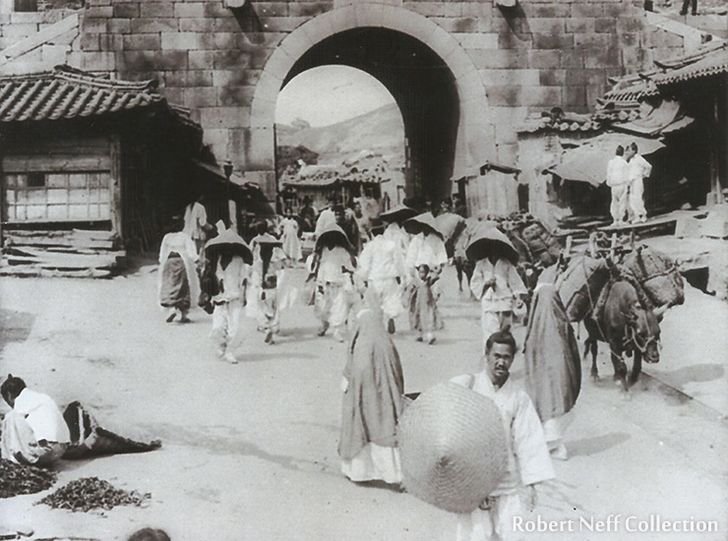
The gate is thronged with men, women and children, as well as several large bulls carrying firewood and other goods. A vendor has laid his goods out on the side of the street in hope of attracting customers.
Those that were slow in getting through the gate were subject to the guards’ wrath. They were “pushed back and ill-treated, with words and kicks,” and when the guards finally lost their patience they closed the huge gates until the following morning.
The “shouts of people, just too late, on the other side, begging to be let in, remained unacknowledged” and they were forced to find shelter from the elements and wild creatures (tigers and leopards still stalked the mountains surrounding Seoul) in the nearby villages.
Westerners had mixed feelings concerning their rush for the gates. Landor obviously felt satisfaction and relief but Annie Ellers, 25, an American missionary-physician, felt apprehensive and alone:
“[The] great iron hasp was pushed through into the lock and the gates were fastened, locked. Shut in! shut in! no way to get out, imprisoned inside with a people to whom we could not speak. Tired, dirty, sweaty ― there was not a spark of enthusiasm left in me.”
It wasn’t until the close of the 19th century that the custom of shutting the gates at night ended. Part of the city walls had to be demolished when tracks were laid for the streetcars that ran from Dongdaemun (East Gate) to Seodaemun (West Gate).
Modernization had opened the gates of Seoul.
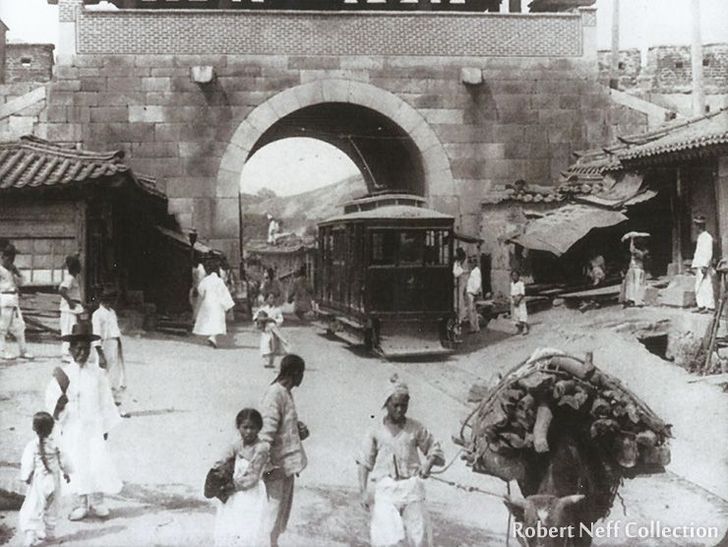
Wary pedestrians watch a streetcar pass slowly through the gate.