American paternalism
By John Burton

The U.S. has been doing itself no favors in its rather paternalistic response to the thawing relations between the two Koreas at the Winter Olympics.
The bottom line message emerging from Washington is that South Koreans cannot be trusted in handling Pyongyang. The U.S. is worried that North Korea is trying to drive a wedge in relations between Seoul and Washington. But the Trump administration’s own behavior is contributing to the possibility of any split.
And if the South Koreans can’t be trusted with their own security, then why should the U.S. be so concerned about defending them unless it is for some ulterior motive such as maintaining a military presence on the Asian mainland to counter China?
The fact is that the Koreans have reached out to each other because of fears that Trump might launch a “bloody nose” preventive attack that could result in appalling destruction across the Korean Peninsula. No wonder why Koreans want to give peace a chance.
But the U.S. has not reacted well to what is happening in PyeongChang. The American media has reported about South Koreans having been seduced by the wily charms of Kim Yo-jong, described as North Korea’s Ivanka Trump, and her accompanying “army of beauties.”
Many predict that her siren song is likely to result in President Moon Jae-in accepting her invitation to travel to Pyongyang and meet her brother, Kim Jong-un, who will trick the South Koreans into undermining the international sanctions regime against North Korea over its nuclear program.
At the same time, the Washington consensus claims that North Korea’s “charm offensive” at the Olympics actually shows that the Trump administration’s policies are working, with its combination of aggressive war talk and economic sanctions forcing Kim to appear more conciliatory. As a result, there is no need to change the current U.S. course on North Korea, it is said.
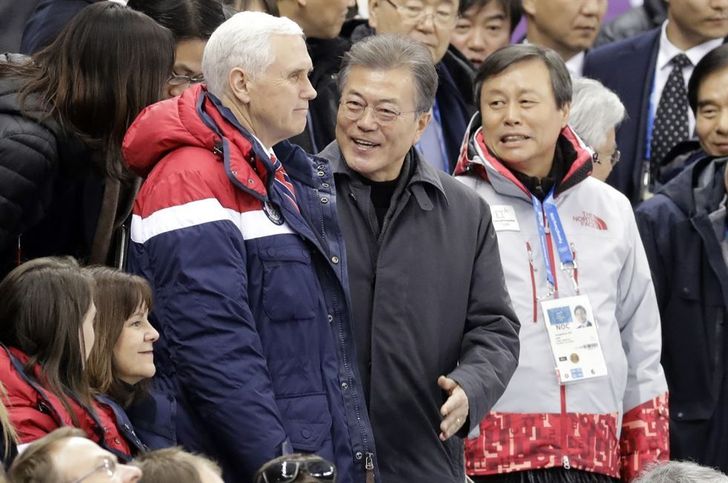
President Moon Jae-in, center, and U.S. Vice President Mike Pence, left, attend the ladies' 500 meters short-track speedskating in the Gangneung Ice Arena at the Winter Olympics in Gangneung, Gangwon Province. AP-Yonhap
This rather inflexible attitude was reflected in the rather tone-deaf behavior of U.S. Vice President Mike Pence at the opening Olympics ceremony. Pence was accused of acting in boorish manner when he refused to stand as the joint Korean team marched into the stadium. Many South Koreans saw that as an insult that revealed a lack of respect to a key U.S. ally that has spent billions of dollars in hosting the event.
American media coverage of the Olympics has added to the belief among South Koreans that the U.S. knows little and cares less about their country. The commentary about Korea aired by the American broadcaster NBC during the opening ceremony sounded like it had been complied by an intern after searching for facts on Wikipedia.
To add insult to injury, NBC commentator Joshua Cooper Ramo then told his U.S. audience that “every Korean will tell you that Japan is a cultural, technological and economic example that has been so important to their own transformation,” which sparked outrage and a belated apology by NBC.
And while the U.S. has been trying to persuade Seoul to work more closely with Tokyo on a common defense against North Korea, Japan has not helped matters with its own behavior. Prime Minister Shinzo Abe also refused to stand for the united Korean team at the opening Olympics ceremony, while Japanese officials have been busy warning that nobody should be blinded by North Korea’s “charm offensive.”
Despite earlier predictions that young South Koreans in particular are unhappy about Moon reaching out to the North Koreans, his poll numbers have gone up recently and nearly two-thirds of South Koreans say they think an inter-Korean summit should be held.
Moon is more pragmatic than he is given credit for in the U.S. He has supported the U.S. policy of “maximum pressure and engagement.” But while Washington has focused on the “maximum pressure” part, Moon is reminding the U.S. of the need for the “engagement” part as well.
Washington should chill and follow the example of the late Stephen Bosworth, the former U.S. ambassador to Seoul from 1997 to 2001.
Bosworth once told me of his first experience in dealing with Koreans. It was 1995 and Bosworth had been just appointed the first director of the KEDO project to supply North Korea with light water nuclear reactors as part of the 1994 framework agreement to end the North’s nuclear weapons program.
Bosworth said he grew frustrated after he tried to mediate between the North and South Koreans as they negotiated in the KEDO offices in New York. Finally recognizing that he did not know much about Korean cultural interactions, he decided to lock the two sides in a room and let them thrash out the problems on their own. It worked. “It would have taken far longer if I continued to intervene,” he said. “I just got out of the way.”
John Burton (johnburtonft@yahoo.com), a former Korea correspondent for the Financial Times, is now a Washington, D.C.-based journalist and consultant.