Many faces of #MeToo
By Jun Hannah

Hannah Jun
Since 1927, TIME Magazine has devoted an annual issue to its Person of the Year. This distinction would go to the person who had the greatest influence ― for better or worse ― on events during the year. In 2016, this title went to U.S. President Donald Trump.
This year, TIME honored “the silence breakers” ― individuals who spoke out against sexual harassment and assault and contributed to the broad social movement encapsulated by the #MeToo hashtag.
In many ways, the #MeToo movement has focused on female victims and male perpetrators. Given that men have typically been in more powerful positions and have exerted disproportionate influence on most sectors of society, women have had few incentives to cry foul and faced little hope of getting justice.
In this sense, understand (and agree with) the aim of empowering women to speak up against systematic exploitation.
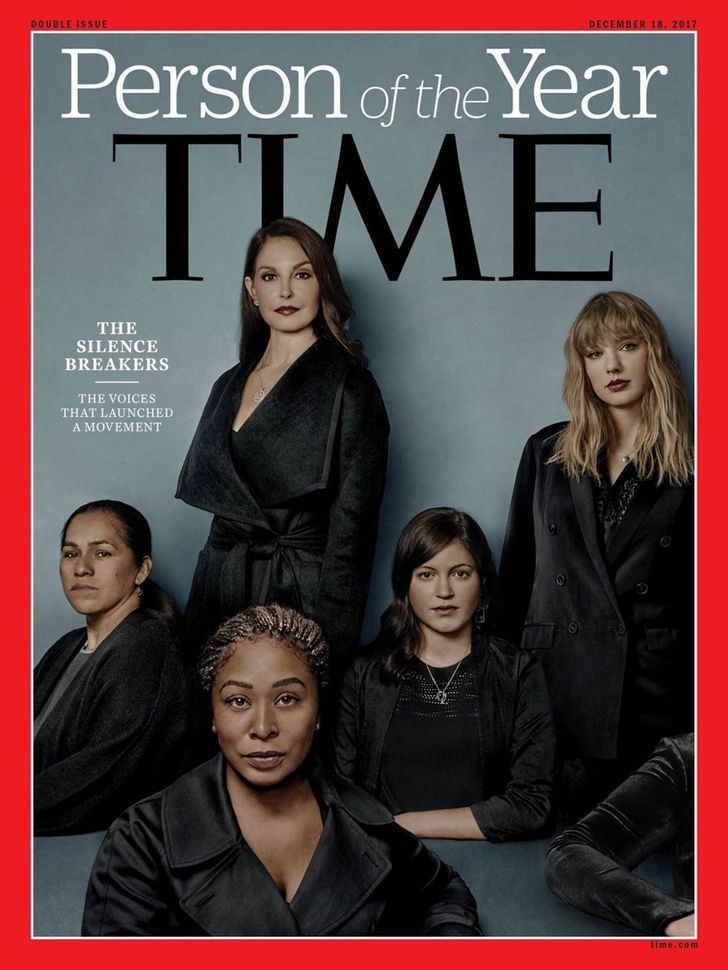
TIME cover "The silence breakers" / Screen captured from TIME
At the same time, anyone can be a victim (or perpetrator) of sexual harassment or assault. In 2016, Korea’s Saturday Night Live (SNL) program came under fire after footage surfaced of K-Pop boy groups B1A4, INFINITE and Block B being touched inappropriately by SNL’s female crew members in an apparent hazing ritual.
After joking in a message that the boy group members (in this case, B1A4) were not “really” touched, SNL issued a formal apology on November 27, 2016 to its guests and fans regarding the “inappropriate” incident.
We have also seen similar cases in academia. In 2015, a female dance professor at Korea National University of Arts was fired after a disciplinary committee upheld male students’ accusations of sexual harassment.
According to the accusations, the professor made provocative comments towards the males and asked them to undress for class.
This particular case suggests that power dynamics, rather than gender itself, may better explain why sexual harassment and assault take place.
But while celebrities such as Amber of K-Pop girl group f(x) ― who has also been the target of sexual harassment online by female users regarding her tomboyish image ― have contributed to the local #MeToo movement, we have yet to see participation on a wide scale in Korea.
For one, the risk of speaking out publicly is just too high. Korea is a closely-knit society where opportunities may be closed to perceived “instigators.” In cases of male victims, data also suggests that men are less likely to speak out because they may be viewed as petty.
But whether #MeToo as a social media movement takes off in Korea or not, we need to acknowledge the many faces of sexual harassment and assault and deal with them accordingly.
At this point, I provide a word of caution. We live in a society that is now hypersensitive to accusations of sexual harassment and assault. While it is important to give those who were once powerless an avenue to speak up, the nature of social media and digitization has made cyber bullying ― and even online defamation ― possible.
My hope is that #MeToo will be used as a starting point to help build awareness, and encourage better policy and systematic change. But to do this, I also suggest exercising prudence, a topic I will explore next time.
Jun Hannah, Ph.D. (hannahjun@ewha.ac.kr) is director of the Center for Global Social Responsibility (CGSR) and professor of International Business at Ewha’s Graduate School of International Studies, specializing in corporate sustainability and branding strategy.