Alcohol: 'The cause of most American downfalls' in Korea
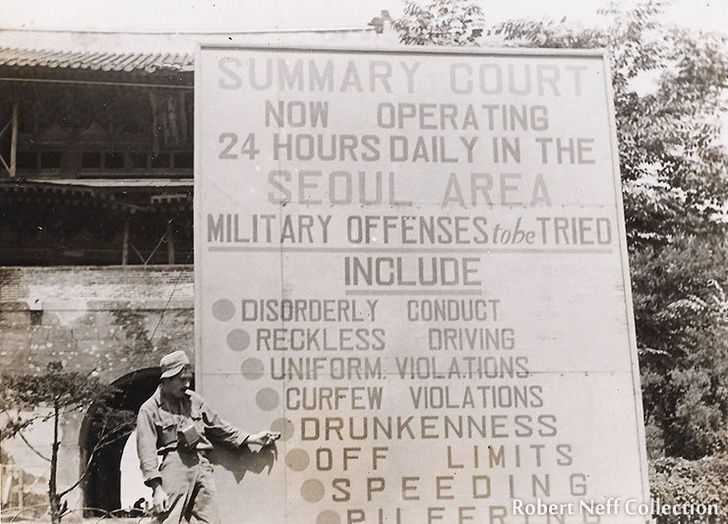
Gag photograph taken by an American soldier on August 5, 1952
By Robert Neff
In August 1952, an American soldier took a “gag shot” of his friend pretending to be drunk in front of a sign warning soldiers of what offences they could be prosecuted for ― including drunkenness. The “gag shot” might have been amusing to some, but American alcoholics were a serious problem in Korea in the late 19th century.
In 1904, Horace Allen, the American representative to Korea and a former missionary, described alcohol as “the cause of most downfalls” in Korea. He may have been referring to one of his predecessors, William H. Parker.
When Parker arrived in June 1886, he was accompanied by a naval doctor due to his drunkenness. Parker managed to sober up for a few days but then, much to the Western community’s embarrassment, started drinking again and was often found in a drunken stupor.
Even worse were allegations that he tried to force himself on a young Japanese woman while he was drunk. Much to the relief of the small foreign community (and probably the Korean court), Parker was relieved of duty in September and sent back to the United States.
Parker wasn’t the only alcoholic. On December 11, 1894, a young Marine from the American warship Baltimore, who was temporarily attached as a guard to the American legation in Seoul, deserted his post and sold his rifle to a Japanese merchant for $10. He then disappeared on a drunken spree that lasted until December 23, when he suddenly reappeared. The Marine claimed “he had such an irresistible desire for drink that he could not help going after it.” He was immediately clapped into irons and faced at least five years’ imprisonment.
More alarming than the desertion was a letter sent to Washington, D.C., by Rose Moore, the wife of Samuel Moore, an American missionary. She wrote:
“We have to blush for our American soldiers and some of the officers from the Baltimore. They get beastly drunk and carouse about the streets in a most disgraceful manner, frightening and surprising the [Japanese] and Koreans.”
Captain Benjamin F. Day, the commander of the Baltimore, responded that “it would have been surprising, and not in accordance with the usual experience with landing parties had there not been some drunkenness amongst them as they were supplied with money monthly” and added, “Men who do not get drunk are not plentiful in the Navy and Marine Corps.”
While the hard-drinking reputation may have had some merit, in this instance it appears to have been undeserved or exaggerated.
An investigation was conducted by John Sill, the American Minister, who immediately summoned Rose Moore to his office to identify the service members. She could not.
According to Sill: “It turned out that she had, upon mere hearsay [she had heard from her husband], directly and squarely charged the officers and men with drunken and disgraceful carousals on the public streets.” Sill demanded Samuel Moore to provide him the names of witnesses, but Moore claimed he could no longer remember the facts. Disgusted, Sill denounced him as a “holy liar” and the investigation was closed.