Thanksgiving week to forget in the US
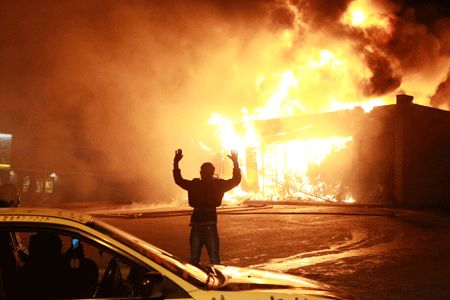
A protestor poses for a "hands up" photo in front of a burning building in Ferguson, Mo., on Monday. “Hands Up, Don’t Shoot” has become a rallying cry after Michael Brown was fatally shot by a Ferguson police officer in August. / AP-Yonhap
By David Keelaghan
Today is the day after Thanksgiving. It’s a holiday that holds a special place in the hearts of Americans and an occasion when many of the world’s nations gaze upon the United States with admiration. This year, given the events of the past week, the warm glow associated with Thanksgiving has been replaced by something quite different.
It would be a stretch to say the world’s one true superpower is in crisis, but it cannot be denied that deep-seated maladies exist throughout the 50 states.
It’s a well-worn axiom that a week is a long time in politics, but that has certainly proven the case for Barack Obama over the past seven days. It was just last Friday that he was announcing immigration reform plans that would offer a pathway for 5 million illegal immigrants to gain citizenship.
Not surprisingly, this move was furiously opposed by the Republican Party, who claimed the president was acting "like a king or emperor" in using his executive power to bypass Congress. For the estimated 11 million undocumented people in the U.S., however, this was certainly a step in the right direction.
Immigration reform has loomed large over a succession of U.S. presidents, democrat and republican alike; in fact, both George W. Bush and Ronald Reagan exercised their executive power to effect change on the issue. Obama’s bold decision to force through legislation can therefore be taken as a clear sign he is in the legacy-building stage of his second term.
Speaking in Las Vegas as he launched the plan, his words seemed to reflect that: "We didn't raise the Statue of Liberty with her back to the world. We did it with her light shining as a beacon to the world."
America has always presented itself in such romanticized terms _ the “Land of Opportunity” and the “Home of the Brave.” The narrative of the country this week has been far from the ideals of the American Dream, however.
Even more than immigration, race is the divisive issue in the United States. The historical and cultural reasons for that are deeply entrenched, and were no better illustrated than in Ferguson, Missouri this Thanksgiving week.
Monday’s decision by a 12-person grand jury not to indict officer Darren Wilson for the killing of Michael Brown provided the spark for a country that has started to resemble one giant tinderbox. Violent protests erupted in Brown’s hometown despite the dignified pleas of his family, saying: “We are not here to be violent. We are here in memory of our son. We are here for protection of all children. We are here to support justice and equality for all people. We lift our voices to ensure black and brown men, women and children can live in this country without being devalued because of the color of our skin.”
Responding to the disturbances, which saw looting and businesses in the downtown core set alight by protestors, Ferguson police used tear gas to disperse the crowds. It made for an ugly scene, one that played out under the full glare of the world’s television cameras.
The riots in Ferguson, and indeed the many peaceful protests that occurred in cities across the country, were lapped up by countries who perhaps felt they had been patronized by the United States in the past. News channel Russian Today broadcast live from Ferguson, and later quoted U.N human rights chief Zeid Ra’ad Al Hussein who chastised America’s race relations and the fact that a disproportionate amount of African Americans ended up in jail.
Chinese Foreign Ministry spokeswoman Hua Chunying was more subtle with her critique, telling the Wall Street Journal: “I would like to say that there’s no such thing as perfection when it comes to human rights regardless of whatever country you're in. We have to improve the record of human rights and promote the cause of human rights. We can learn from each other in this area.”
The German newspaper, Frankfurter Allgemeine Zeitung, was much more damning in its editorial: “Potentially the grand jury has indeed examined all evidence comprehensively and impartially. But the fact that so many people between New York and Los Angeles are convinced that justice has not been administered is another tragedy,"
The scale of protests showed just how many people feel disenfranchised in modern-day America. This was voiced by President Obama, "The frustrations that we've seen are not just about a particular incident. They have deep roots in many communities of color who have a sense that our laws are not being enforced uniformly or fairly.”
Whether or not the actions of officer Wilson that fateful day back in August were vindicated by the grand jury’s decision has varied widely depending on people’s perspective. In his testimony, Wilson was unequivocal that, “The only option I thought I had was my gun.” When interviewed by ABC news on Tuesday, he reiterated that, “the reason I have a clean conscience is that I know I did my job right.”
Those taking to the streets in Boston, Chicago, Los Angeles, New York, Oakland, Philadelphia, Seattle and Washington DC, among many other cities in America and abroad would certainly disagree with that assessment.
The incident has reignited the debate over the police’s role in society and if their tradition of “to protect and serve” has been disregarded for more military-style enforcement. Two days before the disturbances in Ferguson, 12-year-old Tamir Rice was shot dead by Cleveland police officer Timothy Loehmann after he mistook a BB gun the boy was holding for a real firearm. Tragedies such as this are becoming more and more prevalent in a nation where gun crime has become such a problem that police often feel the need to fire first and ask questions later.
Regardless of his current unpopularity, the President’s efforts to reform immigration and healthcare are entirely justified. When thinking of what legacy Obama may bestow on the U.S. upon leaving office in two years time, some form of definitive action on gun control has to be under consideration also.
Gun violence is a blight on the nation; so far in 2014 there have been over 11,000 gun deaths, which is by far the most in the developed world. Despite this, the influence pro-gun lobbies exert on Capitol Hill means proper legislation for gun control repeatedly falls by the wayside. Obama has already stoked the GOP hornet’s nest with his moves on healthcare and immigration; gun control would therefore make a worthy triumvirate to write his name into the history books.