Collaborative robots emerge as new growth engine for Korean conglomerates

Hanwha's collaborative robot is on display during the China International Industry Fair in Shanghai in this 2019 file photo. Courtesy of Hanwha Group
Hanwha set to spin off robotics business to join global competition
By Park Jae-hyuk
The stereotypical images of industrial robots in the past depicted automated machines working behind fences, isolated from human workers.
The development of elaborate sensors detecting human contact and lightweight materials, however, has ushered in an era of collaborative robots, or “cobots,” which can interact with human workers more safely within a shared space, or in close proximity.
As these robots are now used not only in factories, but also at fried chicken restaurants and coffee shops amid labor shortages caused by a declining population, MarketsandMarkets, a global market researcher, estimated the global market size for collaborative robots to reach $10.5 billion in 2027, up from $1.2 billion in 2021.
Following the trend, Korean conglomerates are also reinforcing their robotics businesses to gain the upper hand in the collaborative robot market.
Hanwha Group, which is the latest example of such conglomerates, has decided to establish Hanwha Robotics by October, after spinning off its collaborative robot and automated guided vehicle (AGV) businesses from the factory automation division of Hanwha Corporation, the group's de facto holding firm.
Hanwha Corporation/Momentum Executive Director Seo Jong-hwi, a robotics expert who previously worked for Samsung Electronics, will lead the new company, which will be founded as a joint venture between Hanwha Corporation, which will hold a 68 percent stake, and Hanwha Hotels & Resorts, which will own the remaining 32 percent.
“In line with the globally changing social structures caused by labor shortages and rising labor costs, the robotics market is expected to grow rapidly,” a Hanwha official said. “In the short run, we plan to target manufacturers demanding robots for welding and machine tending, and in the medium to long run, we will expand our presence in the market for collaborative robots that can cook, manage buildings and recharge electric vehicles.”
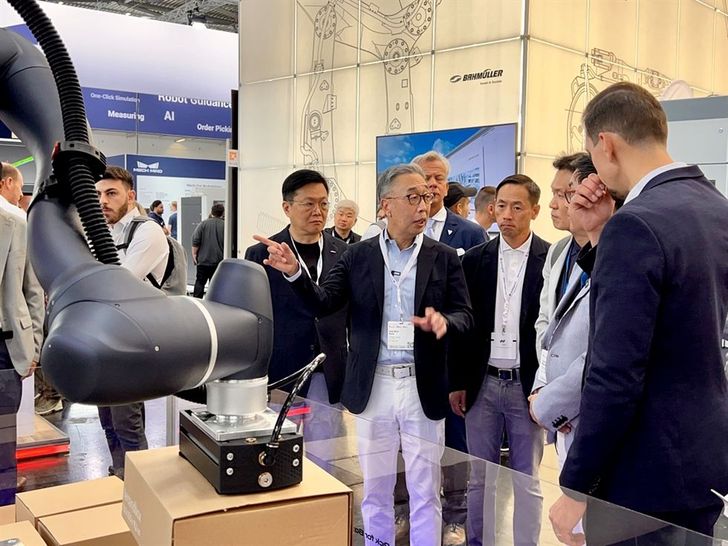
Doosan Group Vice Chairman Park Ji-won, center, talks about Doosan Robotics' collaborative robot with company officials during Automatica 2023 in Munich in this June file photo. Courtesy of Doosan Group
Late movers challenge Doosan Robotics
Once Hanwha Robotics is established, it will go after Doosan Robotics, the leading collaborative robot maker in the domestic market.
The Doosan Group affiliate is the world's No. 5 collaborative robot manufacturer in terms of market share, following Denmark's Universal Robots, Taiwan's Techman Robot, Japan's FANUC and China's AUBO Robotics.
It is also trying to get listed on the benchmark KOSPI to further increase its global market share.
“Once used to help with repetitive work at manufacturing plants, collaborative robots are now interacting with humans in a wider range of industries through their integration with artificial intelligence,” Doosan Group Vice Chairman Park Ji-won said during his participation in the Automatica 2023 robotics exhibition in Munich, Germany, in June. “To achieve dominance in the fast-growing collaborative robot market in advance, we should discover new opportunities by collaborating with various companies.”
Samsung Electronics has shown interest in collaborative robots by making large investments in Rainbow Robotics.
After acquiring a 10.22 percent stake in the Korean robotics firm in January, the tech giant bought an additional 4.77 percent stake in March. Samsung spent a combined 86.8 billion won ($65 million) in purchasing the 14.99 percent stake.
Samsung Electronics Vice President Yoon Joon-oh was appointed a director of Rainbow Robotics in April.
Based on the investments, Rainbow Robotics has made efforts to sell its products in the domestic market and export its products to the North American and European markets.
“By lowering the costs for producing collaborative robots drastically, we have aggressively expanded our presence in the global market and increased revenue,” a Rainbow Robotics official said.
Hyundai Motor Group is carrying out its collaborative robot business via Boston Dynamics, a U.S. robotics firm acquired by the Korean automotive group in 2020.
HD Hyundai, which has HD Hyundai Robotics as a subsidiary, is currently focusing more on conventional industrial robots, as the company regards the collaborative robot market as immature.
In March, a Chinese subsidiary of HD Hyundai Robotics started producing conventional industrial robots, after finishing the construction of its factory in Jiangsu Province. HD Hyundai Robotics has also maintained the top spot over the past 40 years in the domestic market for conventional industrial robots.
However, the company has not ruled out the potential of the collaborative robot market.
After launching the YL series in 2020, HD Hyundai Robotics has continued its studies on collaborative robots, with the aim of supplying its products to shipbuilding and various other industries.
“Following the labor shortage and rising labor costs, the use of robots has spread from the manufacturing sector to the service industries,” Eugene Investment & Securities analyst Yang Seung-yoon said. “As the use of robots has become reality, investors are advised to keep paying attention to the collaborative robot market.”