INTERVIEW Jeju's 'haenyeo' through eyes of US filmmaker

A still from an upcoming documentary featuring the haenyeo of Jeju Island / Courtesy of C. W. Winter
'Jeju's haenyeo are strong, competent, gracious and rugged'
By Dong Sun-hwa
JEJU ISLAND ― Driving loud motorcycles, the “haenyeo” on the southern scenic island of Jeju arrived at the sea to begin their work at 10:30 a.m. on a Saturday morning. Donning black-and-orange diving suits and flippers, the female divers swiftly grabbed their “tewak” ― orange ball-like flotation devices ― and descended to the depths of the sea to catch various aquatic organisms ranging from abalone to conch.
These robust women, who are mostly in their 70s and 80s, do not need any breathing equipment to go 10 meters underwater. They simply come to the surface every two to three minutes to breathe and dive again in a mermaid-like move. They repeat the process multiple times during their four hours of work until they harvest some 10 kilograms of seafood. In bygone days, they were able to catch as much as 50 kilograms, but the harvest volume has seen a dramatic fall recently due to marine pollution.
And there is a man capturing all these moments. C.W. Winter, a U.S.-born filmmaker and a postdoctoral researcher in the faculty of Asian and Middle Eastern Studies at the University of Oxford, has been staying on the volcanic Island since early April to produce a documentary featuring the lives of the haenyeo. It is part of the university's project highlighting the language and folklore of Korea's female divers, which intends to shed light on their quickly fading culture before it disappears. The total number of haenyeo in Korea stands at only 3,400 today, according to Shin Woo-bong, a professor at Jeju National University specializing in Jeju dialect.
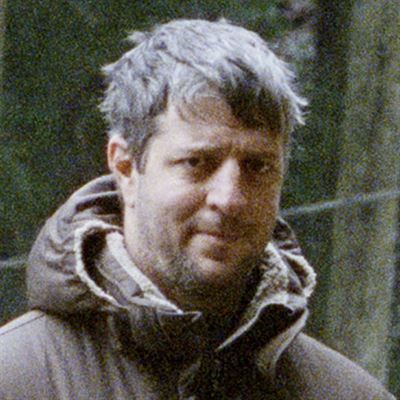
Filmmaker C. W. Winter / Courtesy of C. W. Winter
Since the unique haenyeo culture was inscribed on UNESCO's intangible cultural heritage list in 2016, a plethora of people have made films or other types of creative works centering on them. In the eyes of Winter, however, most of them were far from plain or straightforward.
“I have seen a number of documentaries about the haeneyo, but I have not seen any that I care for,” Winter told The Korea Times during a recent interview at a restaurant in Jocheon on Jeju Island. “They were either very touristic and superficial portraits made by broadcast companies or were condescending films that treat the haenyeo with pity. In one case, I saw it was an American coming in and imposing her own kind of American ideology onto these women, which were just clearly views that they did not share. So our goal is to make a film about them that is as plain and straightforward as possible because they do not need anything more than that.”
As Winter pointed out, to date, quite a few TV shows have observed them just as detached voyeurs or depicted them as pitiful women doing hard labor to make ends meet. They did not highlight the divers' love for their job and the sea, turning a blind eye to their pride and professionalism. Many of them, indeed, describe the sea as their cozy home despite the life-threatening risks it can pose.
Winter believes the haenyeo can just be shown as they are.
“They are strong, competent, gracious and rugged,” he emphasized. “There does not need to be any kind of imposed creativity.”
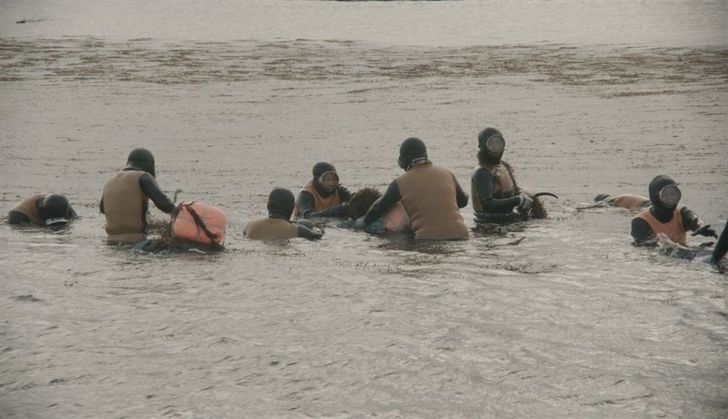
A still from the upcoming documentary featuring Jeju's haenyeo in the sea / Courtesy of C. W. Winter
For Winter, who is often inspired by the stories of the older generation, the ongoing haenyeo project is more than compelling.
“I have made three long films with director Anders Edstrom and our first protagonist was 71 years old,” he said. “Our second and third protagonists were 69 and 72, respectively. I hate to disappoint young people, but old people have more priors and experience. They know more about life and they wear it on their bodies. You can see it in their posture, hands and faces that they have more to tell and share. These features make them good subjects.”
He continued, “On top of that, the haenyeo's work ― a type of work that is close to the exigencies of life ― takes courage, resilience and ruggedness. And when people dedicate their lives to work that is close to survival, I think it tells us stories about what it means to be a human being because it is closer to the kind of self-relexive building blocks of life. It can give people lessons that they can apply to their own lives, as these lives are so unadorned and uncomplicated by contemporary life.”
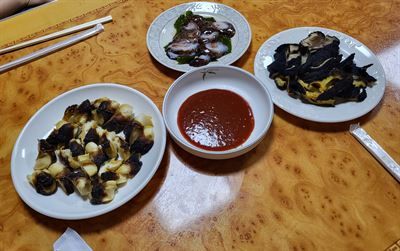
Seafood harvested by Jeju's haenyeo / Korea Times photo by Dong Sun-hwa
The haenyeo project has also enabled him to record a traditional way of working and life while promoting the Jeju dialect. Also known as “Jejueo” or “Jejuan,” Jeju dialect was designated as an endangered language by UNESCO in 2010, and it is known to have fewer than 10,000 remaining native speakers.
“Jeju dialect is spoken less and less, but it is spoken very commonly among the elder haenyeo,” Winter noted. “So it was also a chance to document the dialect again while it is still possible.”
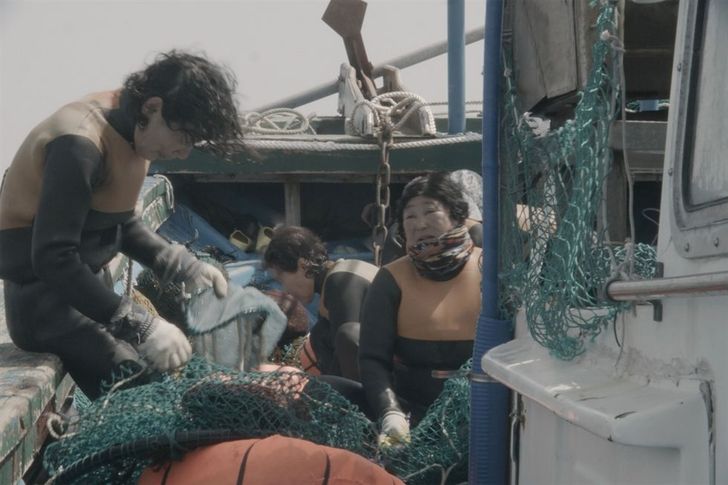
A still from the upcoming documentary shows haenyeo on a boat. / Courtesy of C. W. Winter
However, making a documentary is not a walk in the park, especially for a filmmaker like Winter, who puts his blood, sweat and tears into every scene. Even when he slips while shooting the divers in proximity, his first instinct is to protect his camera rather than try to prevent injury to himself. He says his body can heal, but his camera cannot. Winter even joined them on a private trip and observed how they interact with one other, so as to delve deeper into their authentic lives.
He plans to stay on Jeju until the end of April.
“Making a film in this way is very difficult,” he said. “Every day is about solving problems of how to record images, sounds and people's stories in a plain and straightforward way. This is more challenging than doing in the way that is normally done by broadcast companies or independent filmmakers, who bring various biases or excessive creativity to the table.”
For him, showing the fundamental nature of what a movie is and accessing people's emotions are of prime importance.
“It is a film, not a paper or a piece of music,” he stressed. “So it is about the fundamental building blocks of a film, which are pictures, sounds and the overall composition. It is also very important to access the emotions of people and have them be comfortable sharing their stories and willing to share with us things that make them ache and hope.”
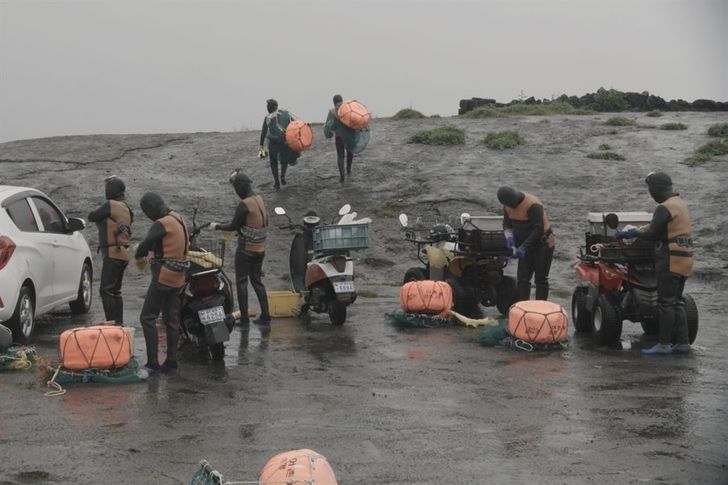
A still from the upcoming documentary shows Jeju's haenyeo heading to the sea. / Courtesy of C. W. Winter
Winter created his first film with one of his best friends when he was 13. Since he has lived most of his life in Los Angeles ― a place where it is easy to end up making films ― he naturally decided to go to a film school after turning 18. But at that point, his primary interests were music and art, so he dropped out about a year later. However, when he turned 22, he unexpectedly became a ghostwriter in Hollywood.
“I was not pursuing it, but I just happened to,” Winter recalled after a moment of thinking. “I just happened to be at the house of a producer who needed some writing done within a couple of hours. She asked me if could do the writing and I said I could. And a couple of hours later, I was hired by a production company and spent the next eight to nine years living out of hotel rooms and airports and working on films in 26 countries. Then, I got to the point where I decided to make my own films.”
One of his major projects is the eight-hour masterpiece, “The Works and Days (of Tayoko Shiojiri in the Shiotani Basin),” for which he worked together with his long-time partner, Anders Edstrom. It won best film in the Berlin 2020 Film Festival's “Encounters” section. The movie, which is about a small farming village in Japan, will be played at the Museum of Contemporary Art Busan (MOCA Busan) next month.
What makes Winter stand out from others is that he does not strive to embed a message into his creation.
“I think the 'message films' tend to have something that they want to say before they begin filming,” he said. “This can build confirmation bias into the whole process and lead to results that get further away from the subject that is right in front of them. So my aim is to have as little message as possible going in and just to observe the subjects in the most open and non-pre-determined way. The messages will take care of themselves.”
Winter's documentary about the haenyeo is slated to be released next year.