Korea Encounters Discrimination, stifled protests, race riots in 1971

U.S. servicemen in civilian clothes stage an anti-war demonstration on the steps of Cosmos Department Store in Myeong-dong, May 18, 1971. / Korea Times archive
By Matt VanVolkenburg
Several Black Lives Matter rallies were held in Korea in the second weekend of June ― taking place in Seoul and at U.S. Army Garrison (USAG) Humphreys in Pyeongtaek, where a race riot took place in 1971.
Race relations in the U.S. military were volatile in the early 1970s, particularly in Korea. Protests against “discrimination in the barracks” at Camp Kaiser near Cheorwon in May 1970 led to a clash with military police (MPs) and the burning of five buildings.
On the morning of Jan. 15, 1971, 600 black soldiers from various units held a memorial service for Martin Luther King on the third anniversary of his assassination at a base in Paju. Two hundred of them then marched in the streets, “chanting Negro spirituals and shouting anti-racial discrimination slogans” before gathering for five hours in a nightclub and demanding Jan. 15 be legislated as a holiday, according to The Korea Times.
In response to this, despite the club owner describing them as being “rather in good order,” more than 30 U.S. Army armored personnel carriers were rushed to the scene: “30 U.S. military policemen surrounded the night club and blocked more black soldiers outside from joining the rally. Several helicopters continuously hovered over the town.”
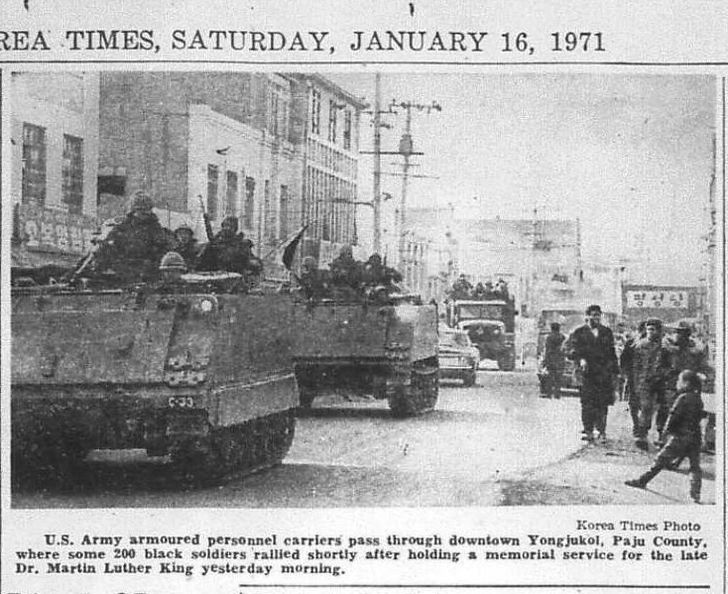
U.S. Army APCs pass through Paju's Yongjugol, where some 200 black soldiers rallied shortly after holding a memorial service for Dr. Martin Luther King on Jan. 15, 1971, on the third anniversary of his assassination. / Korea Times archive
This mobilization stands in contrast to what happened when an anti-Vietnam War sit-in was held in Myeong-dong on May 17, 1971, by mostly white GIs, 31 of whom were arrested and questioned for three hours by KCIA agents. In that case, U.S. military sources said they would likely not take any action against protesters because they “had violated no American military statutes.”
Two days later, on May 19, 1971, around 200 black soldiers held a sit-in rally on Knight Field on USAG Yongsan to protest racial discrimination on post. As The Korea Times reported, “The ralliers showed clenched fists and waved three-colored flags, both symbols of the black power movement in the US.” When participants tried to eat lunch in a mess hall, however, soldiers who were not from the base were refused service, and some of the protesters destroyed furniture in the mess hall in response.
While newspapers reported tight surveillance by 150 MPs and attempts to block soldiers from attending the protest by stopping bus services from bases outside Seoul, a soldier in the 19th Aviation Company at Camp Humphreys remembered that his unit was “tasked by the 8th Army to bring armed infantry from Camp Casey on the DMZ to Seoul to quell the rioting in Seoul by black soldiers.” He added, “We stayed for two days [and…] slept in our helicopters on Kimpo Airfield.”
Three days after the protest in Seoul, grenades exploded around Camp Humphreys in the mess hall and at the front gate, injuring Korean guards. Helicopters were also booby-trapped with grenades, and one went off, severely injuring a crewmember. According to the aforementioned soldier, the helicopters were targeted “because we transported the troops to stop the rioting in Seoul.” It was soon discovered that a box of 50 grenades was missing, and weeks later five black soldiers were arrested, three of whom were charged with two counts each of attempted murder.
On June 8, two days after the arrests, a “brawl broke out between 30 black and white GIs” in Itaewon “during which soldiers fought with knives and clubs and had to be subdued by Korean riot police.” The quarrel began “between two GIs at a night club when one of them, black, asked a hostess with a white soldier to serve him a glass of beer.” A week or so later, a brawl broke out between black and white soldiers in Incheon.
Things turned worse when a white soldier was stabbed to death in “Texas Town" in Busan during a “racial clash” at a bar on July 4. It took place “after an attempt to hold a demonstration in Pusan by some 50 black GIs from US Army units in Taegu and Waekwon was thwarted by MPs.”
Tensions erupted in bars and clubs because, unlike official U.S. military policy, camp town clubs in Korea were segregated based on the music they played and by the willingness or unwillingness of the hostesses to serve black soldiers. The situation was particularly severe outside Camp Humphreys, where only one of the four largest clubs served black soldiers, despite them making up a third of the base's population, but it closed abruptly that summer.
According to Robert Gardner, an African American soldier who also served in the 19th Aviation Company, “It was later discovered that the other club owners had pressured the closure because they didn't want a club that catered to Black G.I.s in the alley,” and with the club closed, “the Black soldiers were left with no place to go in the alley since their treatment in the other clubs was made plain.”
Tension came to a head on the night of July 9, 1971, when a group of black soldiers stormed into the other clubs and, as one club owner remembered it, “began destroying everything in sight.” Soon, hundreds of Koreans gathered, began beating black soldiers and surged toward the gate of the base, where throughout the night MPs backed by other hastily mobilized soldiers fired tear gas and hundreds of rifle rounds over the heads of the crowd to keep them at bay.
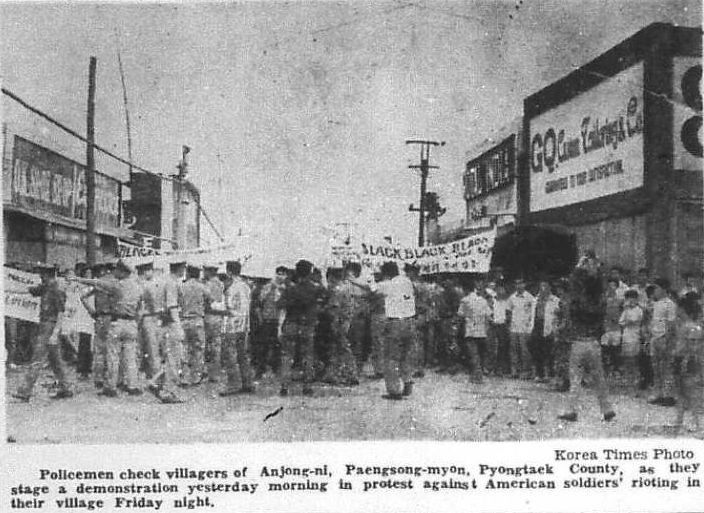
Police check villagers of Anjeong-ri in modern-day Pyeongtaek, as they protested on July 10, 1971, against African American soldiers' "rioting" earlier in protest of racial segregation in Korean-owned nightclubs. / Korea Times archive
The next day, hundreds of Korean protesters gathered outside the base demanding compensation and punishment for the soldiers, but the banners they held aloft ― with messages like “black black black” and “Go back to cotton fields” ― made clear both the nature and the source of their attitudes toward the black soldiers.
In the aftermath of the riots, which “appeared to have resulted from black anger over segregated Korean-owned businesses,” it was announced in Washington that “any businesses in Korea that discriminate against black soldiers would be declared off limits,” and diplomats and military commanders were urged to “move more aggressively against discrimination aimed at black US servicemen.”
No comment was made on the role that the U.S. military's constant suppression of black soldiers' protests against discrimination might have played in sparking the riots.
Matt VanVolkenburg has a master's degree in Korean studies from the University of Washington. He is the blogger behind populargusts.blogspot.kr.