Small restaurants struggling to revive Gyeongnidan-gil

The lower end of Gyeongnidan-gil, once lively with walk-in shops and restaurants, now offers mostly darkened storefronts at the ground level. / Korea Times photo by Jon Dunbar
By Kyung Lee
As the tally of empty spaces increases along Gyeongnidan-gil in Seoul's foreign neighborhood Itaewon, existing small businesses refuse to hang up their gloves in a fight to re-nurture the charms that once enlivened the neighborhood's diverse appeal.
By employing their own grassroots methods, restaurateurs located in alleyways diverging from the main street say it is imperative they maintain close-knit relationships with other struggling owners while potential customers continue to overlook what Gyeongnidan-gil still has to offer.
“We obviously welcome and build connections with new businesses,” said Anna Kim, co-owner of the nearly two-year-old brunch cafe
. “If there are establishments nearby that are successful, we would like to share with them insights that can attract a larger inflow of customers.”
Between the bars, cafes, boutiques and other shops that operate in branching Hoenamu-ro, Kim adds that a nearby realtor helps them coordinate regular group meetings through KakaoTalk to organize flea markets and other cultural spaces for its incoming visitors ― events Kim aims to be more active in participating in the near future.
Utilizing homey atmospheres to deliver authentic cuisine to its customers is another key ingredient restaurants like Summer Lane and nearby brunch cafe Sunday Arvo lean on, but both establishments say they intend to emphasize their brands as a reminder to the public that Gyeongnidan-gil remains open for business.
“Since opening last September, we've seen diners waiting in long queues on the weekends, and we feel grateful for that,” said Summer Park, co-owner of
. “The overall sentiment through media is that Gyeongnidan-gil is becoming even less popular, but we feel we should inject new life into this place by encouraging nearby businesses to do well.”
Following a TV documentary that covered the effects of gentrification in Gyeongnidan-gil on KBS late last year, Kim says a friend phoned her with concerns about Summer Lane.
“We're doing fine,” she recalled telling her friend. “I hope viewers don't think the whole area is failing, because the charms still exist.”
Despite having received extensive coverage on its downfall through other outlets for some time ― including through interviews with celebrity restaurateur Hong Seok-cheon ― Gyeongnidan-gil remains excluded from government initiatives that could empower local residents and proprietors with various civic participation methods to prevent their communities from going belly-up.
And while 71 locations in Seoul have so far qualified to receive grants of up to 140 million won to support urban regeneration projects, education seminars and cultural programs through the Seoul Metropolitan Government since 2016, this area has received no such help.
“At this time, we have no such projects in place targeting that area for revitalization because stakeholders [in Gyeongnidan-gil] are taking action upon themselves,” said Kang Myeong-jun, a policy team manager at the Seoul City Urban Renewal Support Center.
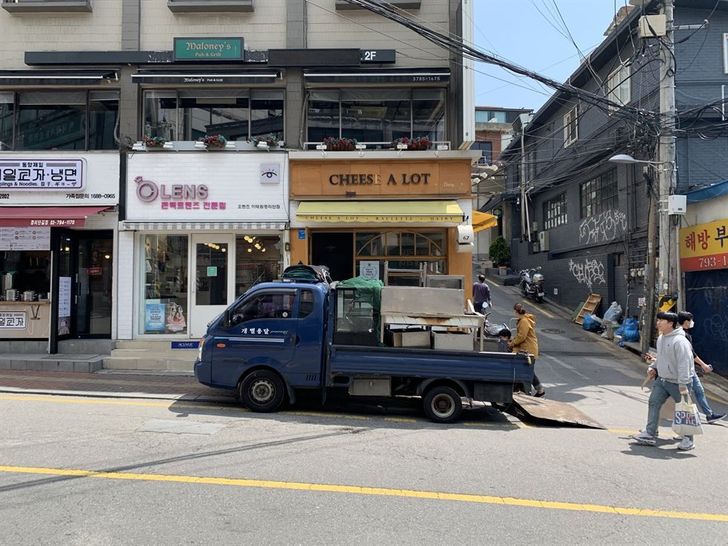
Kitchen equipment is stacked in the back of a truck parked on the main street of Gyeongnidan area. / Courtesy of Kyung Lee
Though Summer Lane and Sunday Arvo are committed to restoring a neighborhood that thrived with a diverse crowd excited to dine on its attractions, Lim Hyeong-do, co-owner of the Japanese restaurant
located on Sinheung-ro near Haebangchon Intersection ― and a member of the Haebangchon Urban Regeneration Support Center ― says he remains cautious.
“If artists come in to set up galleries, you'll need a cafe, and once you have a cafe, you'll need restaurants to accommodate them, and once you have restaurants, you'll need cultural venues like virtual reality (VR) rooms or book cafes, but in Gyeongnidan-gil, nearly all of those components have disappeared,” he said. “If that locale ever expects to make a recovery, building owners should lower rent prices and quit speculating with high hopes that U.S. Army Garrison (USAG) Yongsan will soon be demolished and converted to a park, a tune they've been singing for five years.”
Anticipating Gyeongnidan-gil could make a recovery if the former base is converted into a park, one local realtor, who wants to be identified only under his surname Park and business name L Real Estate, says that, he too, shares the same sentiment on Yongsan Garrison's uncertain timeline.
“Who knows, it could take 10 years for actual changes to surface,” he said. “Regarding the current climate [in Gyeongnidan-gil], building owners lowered monthly rent from an average of 8 million won down to 5 million won for 50 pyeong (165 square meters) of space to reach out to prospective tenants, but the lack of bustle has already devalued the local market. Their original plans entailed buying up property at inflated prices as part of an investment that could yield high returns once the park opens.”