From ritual wear to runway: Korea’s traditional hanbok is trending again thanks to Netflix
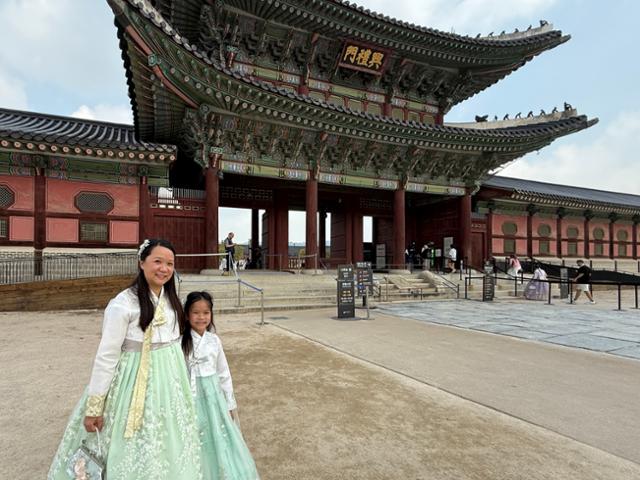
Jessica from the United States and her daughter pose in hanbok at Gyeongbokgung Palace in Jongno District, Seoul, Oct. 1. Hankook Ilbo
Ahead of the Chuseok holiday, Kim, 76, from Gyeryong, South Chungcheong Province, carefully ironed a red jeogori and black pants — a modernized hanbok her eldest daughter gifted her five years ago. She plans to wear it during the family’s ancestral rites to delight her grandson, who is obsessed with the Netflix animated film “KPop Demon Hunters.” The boy can sing the theme song by heart and is particularly fascinated by the hanbok-inspired outfits worn by the main characters.
“I took it out because he was curious, and I think our ancestors will be happy if I wear hanbok during the ceremony,” Kim said with a smile.
According to Netflix’s official rankings site Tudum, “KPop Demon Hunters” has racked up 325.1 million cumulative views worldwide in the 91 days since its release on June 20. It is the first Netflix title — film or series — to surpass 300 million views globally, and it continues to dominate the platform’s overall rankings.
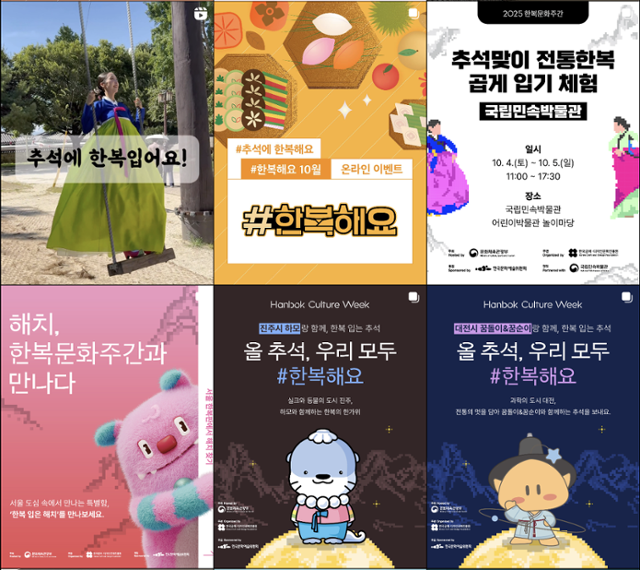
Chuseok hanbok event posts are seen on the official social media account of the Hanbok Promotion Center. Screenshot from Instagram
The show’s fashion has played a major role in this success. The girl group “Huntrix” wears stage outfits inspired by reinterpreted hanbok, while the boy group “Saja Boys” dons traditional durumagi coats and gat hats — looks that have quickly become pop-culture sensations. The craze has even brought back the nearly forgotten tradition of “Chuseok-bim,” the custom of wearing newly bought or freshly laundered clothes and accessories for the holiday.
For many young Koreans, “KPop Demon Hunters” has sparked a new appreciation for hanbok. “I used to think hanbok was just something you wear for ancestral rituals on Chuseok or Lunar New Year, but now I realize it’s beautiful and breathable,” said Kim Young-jin, a 15-year-old student in Incheon. He plans to incorporate hanbok into his everyday wardrobe. His friend, Kim Kang-ho, also 15, said, “The last time I wore hanbok was two years ago, but after watching ‘KPop Demon Hunters,’ I wanted to try it on again.”
The trend isn’t limited to Koreans. Foreign visitors are also embracing hanbok experiences during the holiday season. “I love the vibrant colors — wearing it makes me feel like a princess,” said Katharina, 29, from Austria, who plans to wear hanbok several more times during her month-long trip to Korea in October. Jessica, 40, from the United States, shared the experience with her 9-year-old daughter and 10-year-old son, both fans of “KPop Demon Hunters,” during a visit to the Netflix-themed zone at Everland in Yongin, Gyeonggi Province.
The Korean government is also seizing the cultural moment by promoting Chuseok-bim in modern ways. The Hanbok Promotion Center, part of the Korea Craft and Design Foundation under the Ministry of Culture, Sports and Tourism, is holding a “Chuseok-bim of the Year” photo contest on social media until Oct. 12. “Our influencer crew ‘Hip Hanbokdan’ posted a ‘KPop Demon Hunters’ cover dance video that has already reached 700,000 views on YouTube,” a center official said. “With this heightened interest, we wanted to use the holiday to encourage more people to wear hanbok.”
The ministry and the foundation are also running a “Wear hanbok for Chuseok” campaign, while the National Folk Museum of Korea is hosting a “How to wear traditional hanbok beautifully” experience on Oct. 4-5.
Experts say this surge of interest should serve as an opportunity to sustain and expand traditional culture. “'KPop Demon Hunters’ shows once again how much popular culture can influence fashion,” said Choi Jung, president of the Hanbok Culture Association and professor of fashion design at Wonkwang University. “We’re seeing a clear increase in foreigners and young people enjoying hanbok, and I hope more people will develop a deeper understanding of Korean dress culture and help it spread globally.”
This article from the Hankook Ilbo, the sister publication of The Korea Times, is translated by a generative AI system and edited by The Korea Times.