Pangyo Techno Valley emerging as mecca for practicing orthopedics

An IT company employee works in an office in Pangyo at around 10 pm, July 9, 2021. Korea Times photo by Lee Hae-rin
Chronic ailments among software engineers and some 50,000 commuters make it attractive place for orthopedics
By Lee Hae-rin
Pangyo Techno Valley, South Korea's equivalent of Silicon Valley, has no nightlife to speak of, compared to other brand-new towns around the greater Seoul region. Stretching across a 670,000-square-meter area in central Seongnam, Gyeonggi Province, it is home to some 1,300 high-tech startups and IT giants that employ over 70,000 people, including software engineers, programmers and graphic designers who work invariably day and night.
Contrary to the boring nightlife, there's a defining characteristic that makes the Pangyo Techno Valley a unique outlier ― it has become a mecca for orthopedic clinics.
Pangyo is unrivaled in terms of the number of orthopedic facilities. According to Statistics Korea, there are 3.64 orthopedic hospitals for every 10,000 people in Pangyo. The figure is six times higher than the entire average of Seongnam (0.56). The figures for Gimpo and Gwanggyo, two other Gyeonggi Province cities, are 0.4 and 0.55, respectively.
Sitting in a chair all day and working long hours to meet deadlines for the releases of games or other IT products, software engineers, programmers and technicians there are prone to chronic back, neck and wrist problems.
Lee Su-woon, communications director at Naver's union, said overtime work has been part of life for IT workers, particularly software engineers or other computer technicians who work under extreme pressure to meet deadlines for the releases of their products.
“The deadlines are the ultimate guideline that all people in the industry must meet under any circumstances,” she said.
In addition, she said some IT employees are also exposed to cardiovascular diseases because their working environment requires them to work long hours without physical movement.
“An unofficial survey taken by a group of workers here found about 10 percent of employees here had worked overtime during the past six months,” she told The Korea Times.
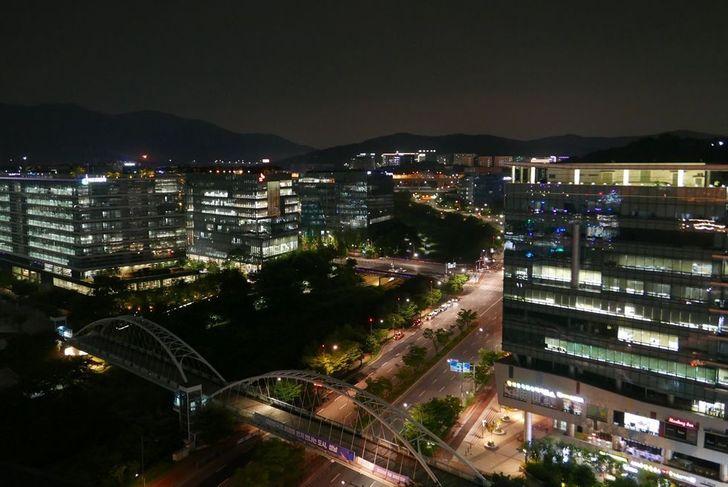
Seen above is a night scene of Pangyo Techno Valley at around 9 pm, July 12. Korea Times photo by Lee Hae-rin
She pointed out a unique corporate culture that encourages employees to work overtime, noting that putting in long work hours is valued as evidence demonstrating an employee's commitment to work.
“We're often told that the founders of our company had worked day and night in the early days of this company and this kind of culture advocating overtime work makes us feel pressure. Overtime work is praised and it's taken for granted particularly when the deadline for product releases is nearing,” she said.
Back, neck and wrist ache are common chronic ailments many IT workers suffer from, according to people familiar with the industry.
Lee Bo-young, a 31-year-old graphic designer, said she sits in her chair almost all day at her workplace, and this has caused her to see an orthopedic specialist regularly as she has aches in her neck and wrists.
She said she was diagnosed with turtle neck and carpal tunnel syndrome as well as intervertebral disc herniation.
Jeong Mi-joo, a website developer, said she also suffers from neck ache due to her work. Her muscles also grew stiff. She said her fellow programmers also have the same types of aches she suffers, noting such problems are common among IT workers.
Practicing surgeons have their side of story about what contributed to Pangyo emerging as an attractive urban district for orthopedics.
“When searching for locations for hospitals, practicing doctors look into various factors. Target patients and the average age of populations are some of the key factors that we consider when choosing locations for hospitals,” a Seoul-based orthopedic surgeon said on condition of anonymity. “Opening a hospital in Pangyo makes sense, because it has a large number of commuters and I believe most of the workers there are people in their 20s or 30s. Unlike older people in rural areas, the high-paid younger employees are insured and willing to pay for relatively expensive treatments. This makes me believe that orthopedic practitioners have a relatively easier time making money when they open hospitals in Pangyo.”
He said orthopedic manual physical therapy on muscles and spines is the most popular treatment sought by younger patients. It is a non-surgical treatment that involves moving joints, muscle stretching based on clinical theory, and costs around 100,000 to 200,000 KRW per session.
About 50,000 out of 70,000 people working in Pangyo are commuters. According to the orthopedic doctor, the younger patients prefer dropping by hospitals nearby their workplaces for treatment during weekdays, rather than seeing doctors during weekends.