INTERVIEW Designer applies traditional Korean aesthetics to wallpaper

Interior designer Teo Yang poses after an interview with The Korea Times in his studio, Monday. /Korea Times photo by Choi Won-suk
By Kwak Yeon-soo
Teo Yang, 39, is a Seoul-based interior designer who brings traditional aesthetics to modern spaces. Under the theme “the past in the future,” he combines the past, present and future in multisensory experiences that include interiors, furniture, scents and skincare.
After graduating from the Art Institute of Chicago, he worked under designer Marcel Wanders in Amsterdam and now runs Teo Yang Studio in the Bukchon neighborhood of Seoul.
Yang explained that exposure to Western art and working alongside top designers benefited him in ways he could never have imagined. However, he said he often asked himself “What can I offer to the world as a designer?”
“That's when I started studying Korean history and tradition. It became a manifesto for me to use traditional Korean artifacts and design in contemporary spaces,” Yang said during an interview with The Korea Times in his studio, Monday.
To put his thoughts into action, Yang moved his residence/studio to a hanok, or Korean traditional house, eight years ago. His art collection also combines modern and traditional design elements ― ranging from pottery from the 42-532 Gaya Confederacy to works of Korean contemporary artists such as Lee Ufan and Ha Chong-hyun.
Yang, one of Korea's most-in-demand interior designers, has participated in major projects such as designing the 123rd-floor sky lounge at Lotte World Tower and the VIP reception room at the Korean Cultural Center in Beijing, as well as renovating Kukje Gallery in Samcheong-dong, central Seoul.
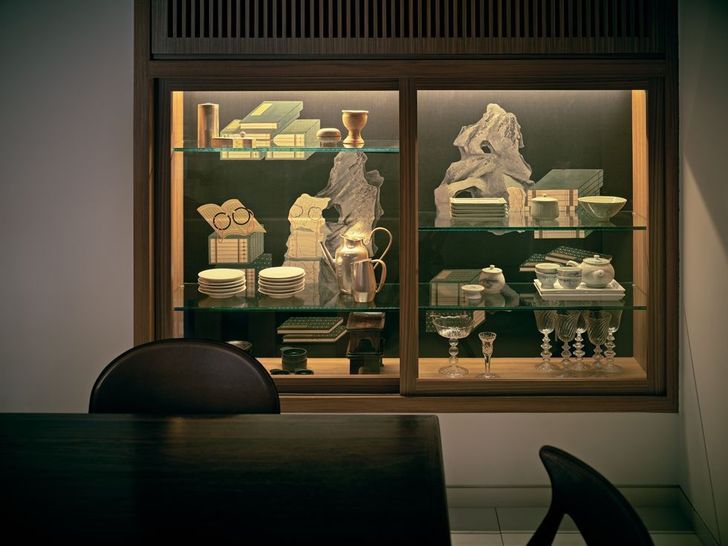
Teo Yang's design for Korean collection “Art of Learning” (chaekgeori) /Courtesy of Teo Yang Studio
His latest work was collaborating with British high-end wallpaper house de Gournay on creating a collection of wallpaper with a traditional Korean aesthetic.
De Gournay is known for its custom-made chinoiserie wallpapers, which are hand painted by the artist. Chinoiserie designs often include delicate patterns such as garden landscapes, flowers and animal paintings.
While the company has included Chinese and Japanese collections, embracing paintings of birds and flowers as well as gardens in its works before, it has never had a Korean collection.
It was when the brand started to see its Korean customer base grow that it started searching for a designer who could feature the unique beauty of Korea.
“It felt like a dream to collaborate with de Gournay, a well-respected brand that interior designers admire," he said.
“The company reached out to me about a year and a half ago, saying they would like to launch the brand's Korean collection. Making a foray into the Korean market, the company became aware of the fact that Korea is sensitive about historical ties with Japan and China.”

Teo Yang's design for Korean collection “Steps for The Flower” (gunggwoldo) / Courtesy of Teo Yang Studio
The new Korean collection, which was unveiled in Paris in January, showcases two designs with unique Korean aesthetics. The first, gunggwoldo, are paintings of traditional royal palaces, and the second, chaekgeori, still-life paintings of books.
The first design titled “Steps for The Flower,” is a royal palace architecture painting inspired by two Korean palaces. Hwa-gye is a miniature garden decorated with flowers and beautifully shaped stones for the queen or a female member of the royal family. Beautiful gardening techniques create a sense of comfort and peacefulness that can only be found in Korea, according to Yang.
“The paintings have various symbols, such as peonies for wealth and honor, butterflies for longevity and frogs representing good fortune,” he explained. “I hope viewers enjoy the harmony of nature and architecture in space.”
The second design titled “Art of Learning” shows the intellectual culture of the 1392-1910 Joseon Kingdom. Historically, chaekgeori paintings were an integral part of household furnishings. Though stylistically distinct types of chaekgeori, they are thematically united by the depiction of scholarly objects ― books, ceramics, flower arrangements, bowls of fruit and miniature landscapes.
“The traditional book painting named chaekgeori is an image that shows the desire for learning and admiration for books. It reveals Korea's book-loving culture,” Yang said.
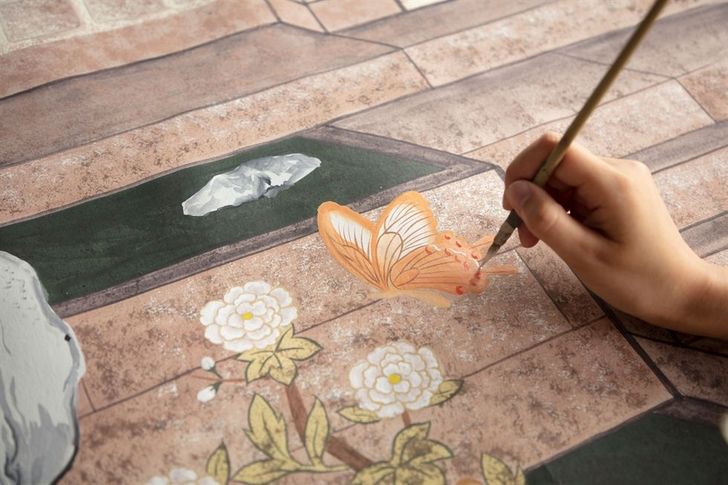
Teo Yang hand-paints de Gournay's Korean collection /Courtesy of Teo Yang Studio
The designer said he is pleased to see Korea-themed wallpaper being added to de Gournay's collection.
“I've always hated the notion that Korean art is classified as having a third-world aesthetic. This collaboration is significant in the sense that traditional Korean aesthetics are included in one of the most-sought-after cultural products.”
Yang shared that he gets most of his inspiration and ideas from traveling and visiting museums. “My favorite spots in Korea are Andong and Gyeongju. Both are well known for preserving traditional cultural practices and historical sites. I also enjoy looking through catalogs of museums,” he said.
His inspirations in the design world are Korean contemporary artists like Lee Ufan, Ha Chong-hyun, Kwon Young-woo and architect Choi Wook.
Although Yang is a celebrity figure in the increasingly sought-after world of design, his business has not always been brisk.
“The biggest misconception that people have about me is that they think things come easy for me. It has not been easy. Every opportunity is precious and I give all my energy in each project,” he said.
“I don't want people to look at my space and just think it's aesthetically pleasing. I'd like them to enjoy a moment of enlightenment and appreciate traditional architecture and design. Most of all, everything should always be comfortable and natural.”