Shoe-throwing, egging put freedom of expression to the test

Jung Chang-ok, a protester who threw his shoe at President Moon Jae-in last week in the National Assembly, speaks during an outdoor news conference in front of Dong Hwa Duty Free Shop in central Seoul, Monday, with his shoe on the table. Some right-wingers lauded him as a man of courage. / Yonhap
By Kang Hyun-kyung
Shoes, eggs and paintings.
These three objects appear to have nothing in common. In the discourse of freedom of expression, however, they are interrelated. Outraged people and sarcastic artists use them as mediums to express their anger and resentment toward politicians responsible for dysfunctional policies that put their lives in peril.
Egging and throwing shoes at politicians are considered forms of protest and vandalism which have been utilized to make dissenting voices heard. Satirical paintings, meanwhile, are a non-violent form of protest and criticism designed to humiliate the targeted public figures. It's a shame tactic.
These actions, however, spark a heated means vs. ends debate in freedom of expression. People are divided over whether or not such vandalism or humiliation tactics, albeit minor compared to violent acts in terms of the physical effects on the victims, can be justified in the name of freedom of expression.
Egging has been a rite of passage for prominent politicians. The late former President Roh Moo-hyun was the most unfortunate politician when it comes to the assault ― he was pelted with eggs four times. Three other former presidents ― Kim Young-sam, Chun Doo-hwan and Lee Myung-bak ― were also humiliated by eggings.
Conservative politician Lee Hoi-chang, who unsuccessfully ran in presidential elections three times in 1997, 2002 and 2008, managed not to show embarrassment on his face with his witty reaction to egging. In November 2007, he was hit by an egg thrown by an angry resident in the southern city of Daegu during his presidential election campaign. Without revealing his emotions, Lee said his skin was softened thanks to the egg.
The form of protest has developed into something more aggressive after President Moon Jae-in took power ― people throw shoes at politicians.
On Saturday, hundreds of protesters gathered in front of the Korea Deposit Insurance Corporation in Jung-gu, central Seoul, demanding the Moon government scrap a set of what they called exploitive real estate policies and heavy taxes levied on owners of multiple home. The signs they held during the rally had various messages. One read “Like tenants, landlords are citizens to be protected.” Another read “The Moon Jae-in government is worse than coronavirus.”
In the middle of the protest, all the protesters threw their shoes in the air.
Inspired by a protester who was arrested after throwing his shoe at President Moon a couple of days earlier, the landlords did the performance to ridicule the government's “excessive” tax policies on real estate and owners of multiple homes. Throwing shoes in the air was also their satirical reaction to the law enforcement agencies which “overreacted” to the shoe-throwing incident.
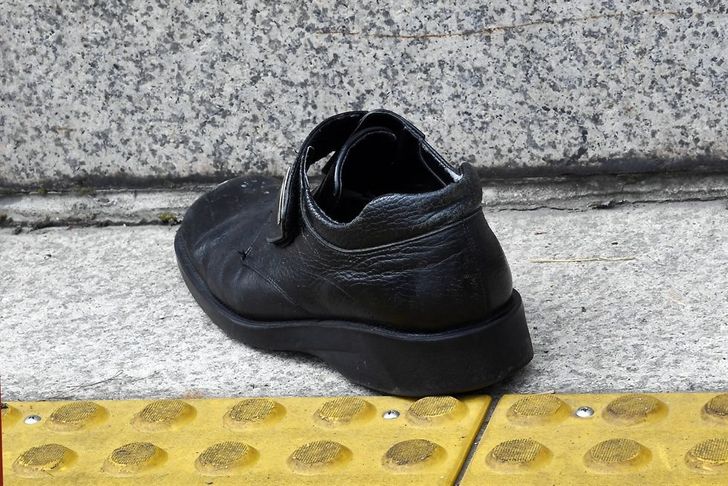
Jung's shoe / Yonhap
Jung Chang-ok, 57, threw his shoe at a lawn Wednesday when President Moon walked down on the stairs of the National Assembly toward his vehicle after delivering an opening address in the legislature. Jung's shoe fell near the red carpet rolled out for the President after Moon's vehicle had already left the Assembly.
Calling Moon “ppalgaengi” (communist), he alleged that the President is a fraudulent human rights advocate and urged him to step down.
Jung was arrested by the police on the spot and questioned for eight hours. The Seoul Central District Prosecutors' Office sought an arrest warrant on charges of obstructing justice and trespassing, which was denied by a court later.
In an outdoor press conference in front of Dongwha Duty Free Shop building near Gwanghwamun Square in Seoul on Monday, Jung's lawyer Yoo Seung-soo claimed hurling his shoe was Jung's way of expressing his frustration and anger toward the President, thus his client shouldn't be punished. Yoo raised the police brutality issue, accusing the police of having used “excessive” physical force to arrest and restrain Jung. Jung was spotted wearing a neck brace and cast on his right arm when he was released from detention after the court denied his arrest warrant.
On the internet, Jung rose to stardom among right-wing YouTubers. Jung is portrayed as a hero by his supporters. Some described him as a man of courage whose heroic act was something akin to that of independence fighters who tried to save Korea from Japan's colonial rule through self-immolation protests.
Lawyer Park Sang-yung said throwing shoes or eggs at politicians is not allowed and it will be inevitable that those who carry out such acts will face legal consequences.
“Imagine what would happen if people are allowed to throw shoes or eggs at others in the name of freedom of expression. I understand a certain action is protected under freedom of expression only when the doer doesn't use violence,” he said. “Egging and throwing shoes are violent acts.”
Oh Yoon-sung, a professor of criminology at Soon Chun Hyang University, however, says there's room for tolerance in Jung's shoe-throwing protest, noting the court will rule whether he's guilty or not.
“I think whether throwing shoes at a politician is punishable or not should be determined based on a case-by-case principle,” he said.
He mentioned an Iraqi journalist who threw both of his shoes at then U.S. President George W. Bush during a news conference in 2008 in Baghdad, Iraq, as the incident is similar to what happened in Korea.
“The Iraqi reporter was imprisoned for his action because his deed could have put Iraq's relations with the United States to the test. I think the protester who threw his shoe at President Moon is different. He appeared not to have the intention to hurt the President, considering the distance his shoe fell on the ground and what he did after he threw his shoe. He chanted several political slogans. This makes me think that what he did was a political statement, rather than a criminal act to harm the President.”
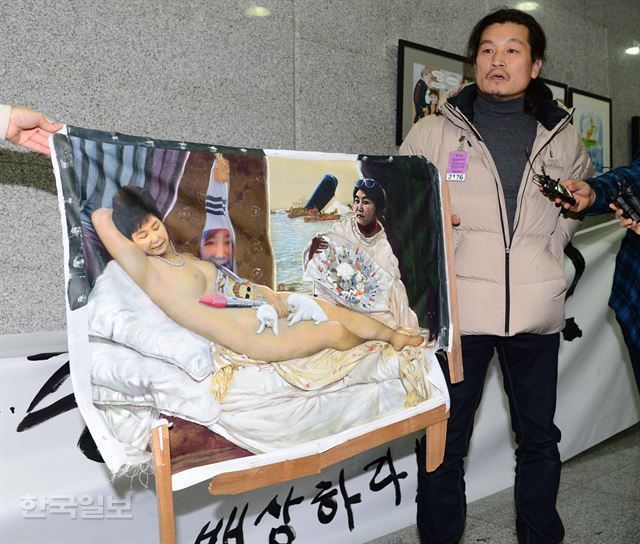
Artist Lee Gu-young stands near his satirical painting “A Dirty Sleep” exhibited at the National Assembly in this January 2017 file photo. In the painting, a naked woman with then-President Park Geun-hye's face sleeps in a bed and near her is her longtime friend Choi Soon-sil. The work ignited a heated debate on freedom of expression at the time as some alleged it was an insult and sexual harassment in the guise of art. / Korea Times file
The shoe-throwing incident reminds the public of a satirical painting case during the Park Geun-hye government in that both actions targeted the presidents as forms of protest.
In January 2017, then lawmaker Pyo Chang-won organized an exhibition titled “Soon, Bye!” in the lobby of the National Assembly. One of the works on view at that time was a painting titled “A Dirty Sleep” in which a naked woman having President Park's face is sleeping in a bed and near her is her long-time friend Choi Soon-sil. Behind Choi, there is a painting on the wall featuring a ship sinking. The artist, Lee Gu-young, appears to allege that President Park was sleeping when the passenger ferry Sewol was sinking and hundreds of lives aboard the ship were lost.
The painting ignited a debate about freedom of expression. Rep. Pyo and some politicians defended the exhibit, echoing the view that the painting in question was a satirical work. But many others were critical of the exhibition, with some saying it was an insult and sexual harassment in the guise of satire.