'Social dining' program seeks meaningful use of shared kitchens

The social dining program DaeDae Kitchen provides a platform for people to connect with one another while preparing a nutritious meal for themselves. Courtesy of Youth Building
By Lee Gyu-lee
In the sharing economy a new trend has emerged, with more businesses in Korea offering shared kitchens for various purposes from entrepreneurial to social. The idea of the shared kitchen has been implemented by a number of companies to provide low-risk, commercial spaces to food entrepreneurs.
For others, a shared kitchen is used as a community space for people to gather with close friends and cook while relaxing comfortably without making a mess at home.
Among the various shared kitchen initiatives is social dining program DaeDae Kitchen. It seeks more meaningful usage of the kitchen: encouraging healthy dietary habits and forming a community of young adults as they come for a cook-out with strangers.
Located in Geumcheon-gu, southern Seoul, the Youth Building is a four-story community building dedicated to providing young people with an open and shared space to use for working, pursuing hobbies, and gathering. It is run by nonprofit organization Ggumjirak Network with the fund from the local district.
“At first the area was just built to be an open kitchen as part of the Youth Building. But then, it seemed we could make better use of the kitchen. So our CEO came up with the cooking-gathering program,” Kim Kyu-hee, the supervisor of the program, told The Korea Times, last Thursday.
About two years after the program was first established, DaeDae Kitchen has settled into one of the most popular programs among the numerous activities ran throughout the building.
The program runs every Thursday evening from February to November at a kitchen equipped with cooking utensils, spices and commodities. The kitchen is open to the public for anyone to use, when it is not in session.
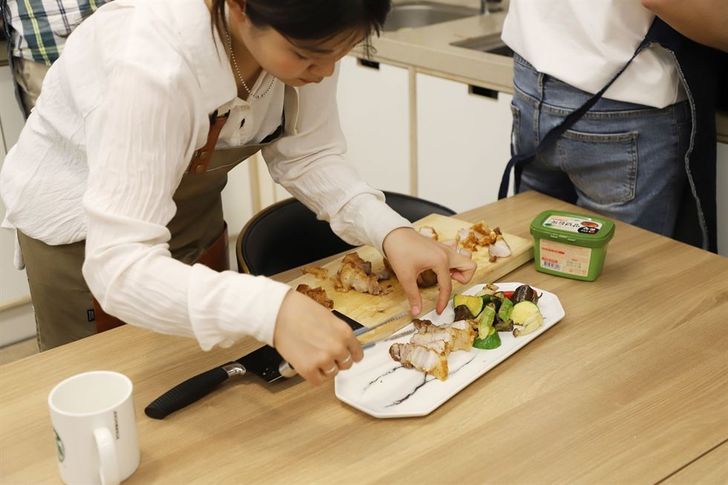
Program supervisor and instructor Kim Kyu-hee places pork on a plate after cooking. Courtesy of Youth Building
When participants arrive at the kitchen on the third floor, they pick up a spoon-shaped piece of paper to write down a brief introduction of themselves. “If people don't want to disclose personal information such as their name and age, we don't ask them,” said Kim, who also teaches the program.
The space soon gets filled with energy as over 15 young people gather in the kitchen. After a brief introduction, people get into groups of four and get straight to cooking, relying on recipe notes.
Not many details are given as the process of following the recipe itself gives room for people to interact and discuss things. No pressure is put on anyone since the most important of this cook-out is for them to have fun and enjoy the experience.
About 60 percent to 70 percent of participants live alone, the supervisor noted. So each week's menu is designed to be nourishing and something that people would not normally make at home.
Kim said she tries to select dishes using seasonal ingredients, depending on the time of year. “Living alone is not something to pity someone for and I want to show that 'look, we can fix ourselves fancy meals like this,'” she said, adding that she usually goes for quality and fresh ingredients.
Jang Go-eun, a 27-year-old participant, said she began to learn cooking through this program. “I can't cook at all, but I found myself enjoying it as I started to learn things even as simple as making a tasty sauce.”
But what she kept her participating in the program for the past few weeks is interacting with people from a diverse range of backgrounds. “I'm curious about how other people live, so this is a great opportunity to meet people from outside your group or profession,” she said.
The fun not only comes from cooking but also from meeting fellow participants, the supervisor noted. “This program is very accessible. So people come and connect using cooking as the link. Most of them look for a sense of community,” she said.
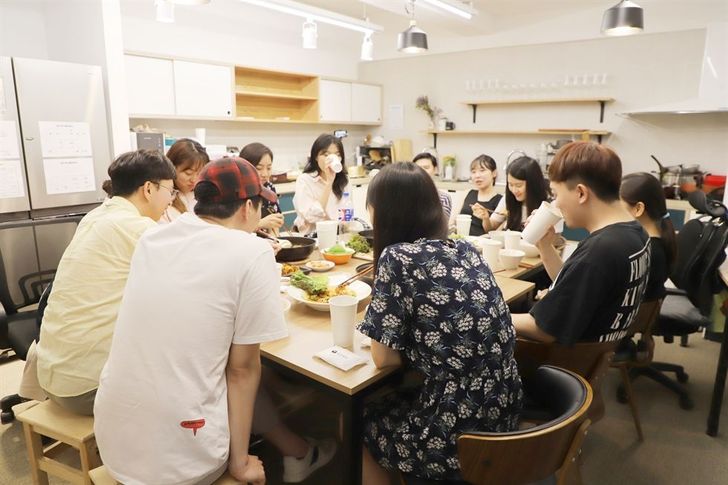
People gather around to socialize as they eat the food they prepared together. Courtesy of Youth Building
Once the cooking is done, the participants gather around the table with the meal they prepared. As they share the food and exchange feedback on it with different groups, they also discuss things about their lives, interests, and anything they wish to talk about.
A student from Hong Kong, Li Jung, 25, said that the place helps her to build a community to find Korean friends to interact. “People I meet from language school are foreign friends studying abroad like me. So coming to this place allows me to communicate and make friends with the locals.”
Ensuring a comfortable environment and keeping up with the trends are the two key factors that Kim keeps in mind as she runs the program. “In such a rapidly flowing world, young people are very sensitive to trends.” So she makes it a priority to follow trends, carefully selecting kitchenware for picture-friendly plating and frequently posting them through social media.
Her efforts have paid off as people respond to them with compliments on the dishes. “Some people would tell me that 'I never thought I could cook, but with the environment and assistance provided, I'm encouraged that I can do it too,'“ she said.
“Whenever I hear this feedback, I feel reassured that what I'm doing is worth it. And I will continuously work to do my part in creating a platform for young people to network and reconnect.”