Think flipping meat twice makes it juicier? Korean pork expert says the opposite
Summary
Cha Ho-myung, a former chef who leads Sunjin Technology Research Institute’s Meat&Food Food Solution Team, taught pork-grilling techniques at Yaksan Dwaeji in Seoul on Oct. 14. He recommends flipping meat frequently rather than only twice, and keeping the grill between 150 and 180 degrees Celsius. Sunjin’s Grilling Meister program combines a written test with practical training and assessment to teach professional knowledge about pork and cooking science.
Key Facts
- Sunjin introduced the private Grilling Meister certification program in 2021.
- Candidates are assessed on more than 20 criteria, including hand cleanliness, grill temperature, browning and juice retention.
- The average pass rate exceeds 90 percent, and more than 400 people have taken the exam.
- Cha recommends storing pork at between 0 and 2 degrees Celsius.
- For 2-centimeter-thick samgyeopsal, Cha’s 2-1-4 method calls for grilling each broad side for two minutes, then grilling each remaining side for one minute after cutting the pork into bite-sized pieces.
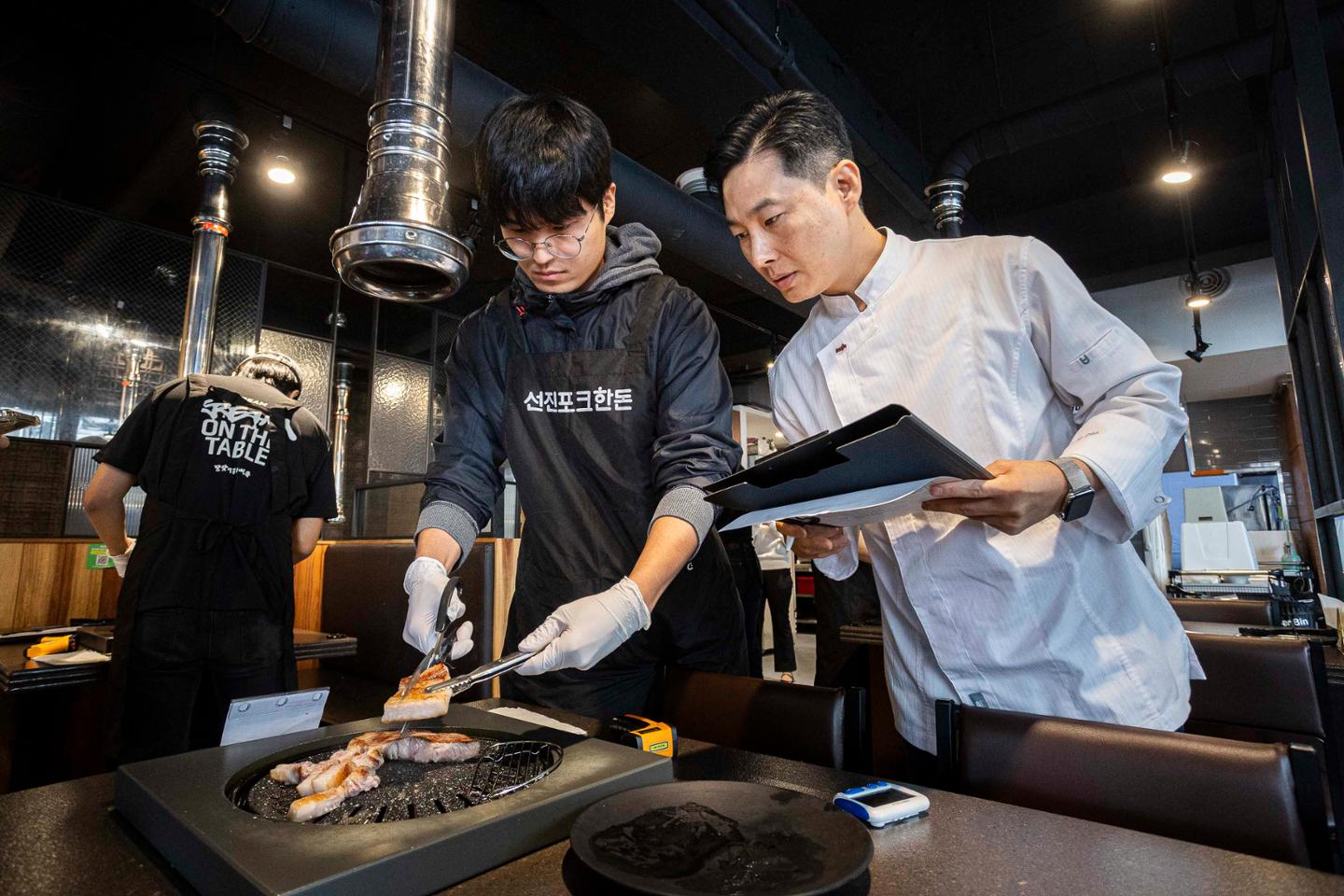
Cha Ho-myung, right, head of the Food Solution Team at Sunjin Technology Research Institute's Meat&Food Innovation Center, evaluates a participant's grilling technique during the 19th Grilling Meister certification exam at Yaksan Dwaeji in Yeongdeungpo District, Seoul, Oct. 14. Courtesy of Sunjin
"Is it really true that meat tastes better if you flip it exactly twice? That might work for very thinly sliced pork belly. But with meat of ordinary thickness, juices move in the direction the heat is applied. If you want to keep the juices toward the center and make the meat moist, it's better to flip it frequently."
Cha Ho-myung, a former chef with 26 years of experience who now leads the Meat&Food Food Solution Team at Sunjin Technology Research Institute, challenged a widely held belief about grilling meat as he taught the science behind cooking pork at Yaksan Dwaeji, a restaurant in Yeongdeungpo District, Seoul, on Oct. 14.
The lesson was part of the practical training for "Grilling Meister," a private certification program introduced in 2021 by Sunjin, the agricultural and food company behind Sunjin Pork, Korea's first branded pork product.
Candidates first take an online written test covering pork production, processing and nutrition. Then comes the centerpiece of the certification process: a practical exam for participants to demonstrate their skill in grilling "samgyeopsal", or pork belly, and "moksal," the meat from the neck.
Evaluators scrutinize more than 20 criteria ranging from the cleanliness of the cook's hands and the temperature of the grill to whether the meat has developed a proper Maillard reaction — the browning process that produces distinctive flavors and aromas — and retained enough of its juices.
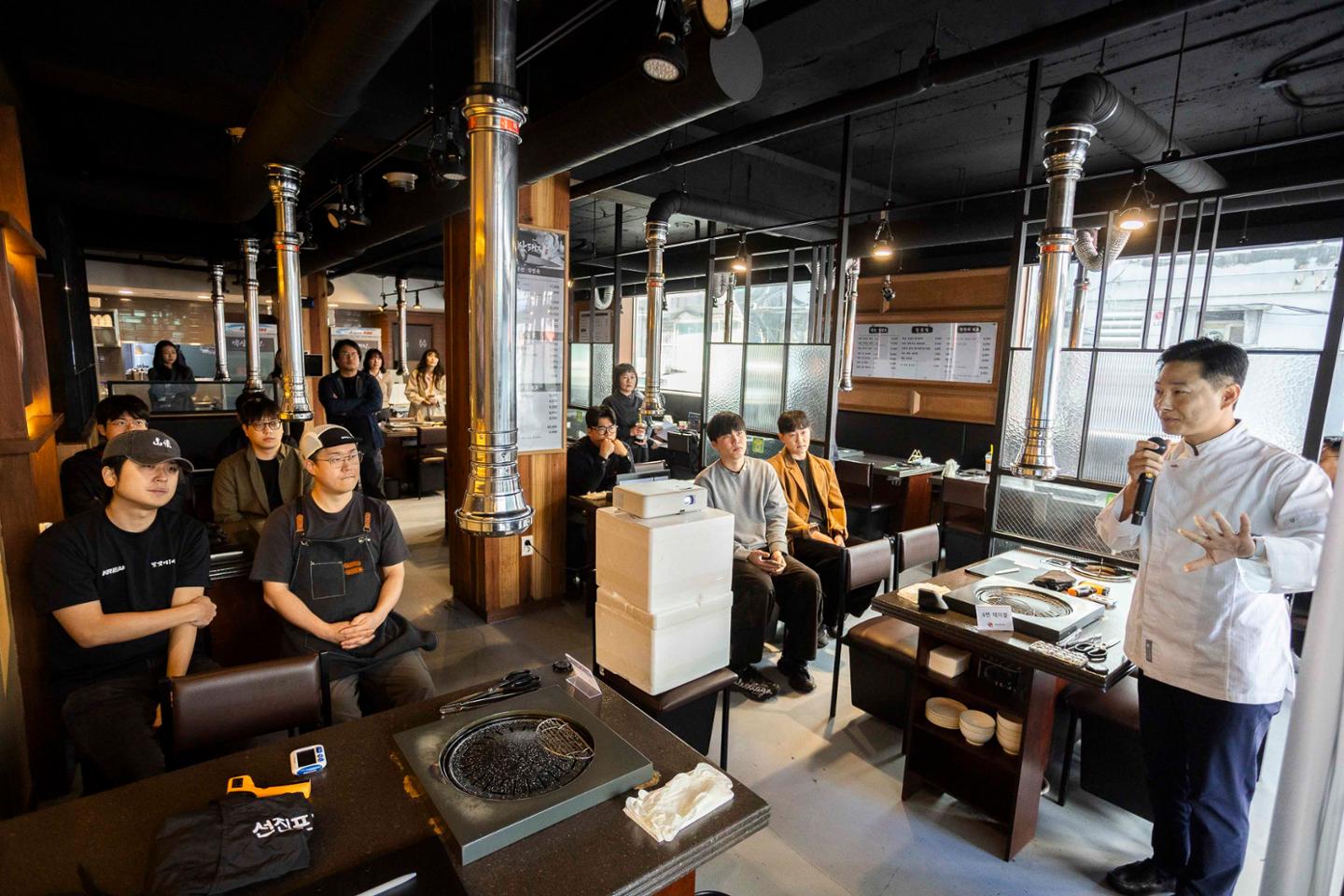
Cha Ho-myung, right, head of the Food Solution Team at Sunjin Technology Research Institute's M&F Innovation Center, gives a lecture ahead of Sunjin's 19th Grilling Meister practical exam on Oct. 14. The hourlong session covers pork food culture, pork production, nutritional aspects of pork and grilling techniques. Courtesy of Sunjin
The average pass rate exceeds 90 percent, largely because most candidates already work in the restaurant industry or are preparing to open their own businesses.
But the program focuses less on passing or failing than on using the roughly two-hour training and testing process to teach professional knowledge about pork and the science of cooking it. More than 400 people have taken the certification exam so far.
Cha, who led research and development of the Grilling Meister program, said he realized the need for a scientific and standardized manual for grilling meat after meeting restaurant owners.
Some, he said, believed misconceptions such as the idea that meat should be seared over extremely high heat to "seal in" its juices. Others blamed the quality of raw meat when problems appeared during cooking, only to discover that the pork had not been stored at the proper temperature — between 0 and 2 degrees Celsius.
Sunjin set out to establish methods that would allow virtually anyone to grill pork consistently and well.
One restaurant owner taking the certification exam said he planned to teach the techniques to his employees.
Cha demonstrated the process himself, beginning with a surprisingly simple step: wiping off moisture on the surface of the meat with a paper towel.
Water interferes with the Maillard reaction.
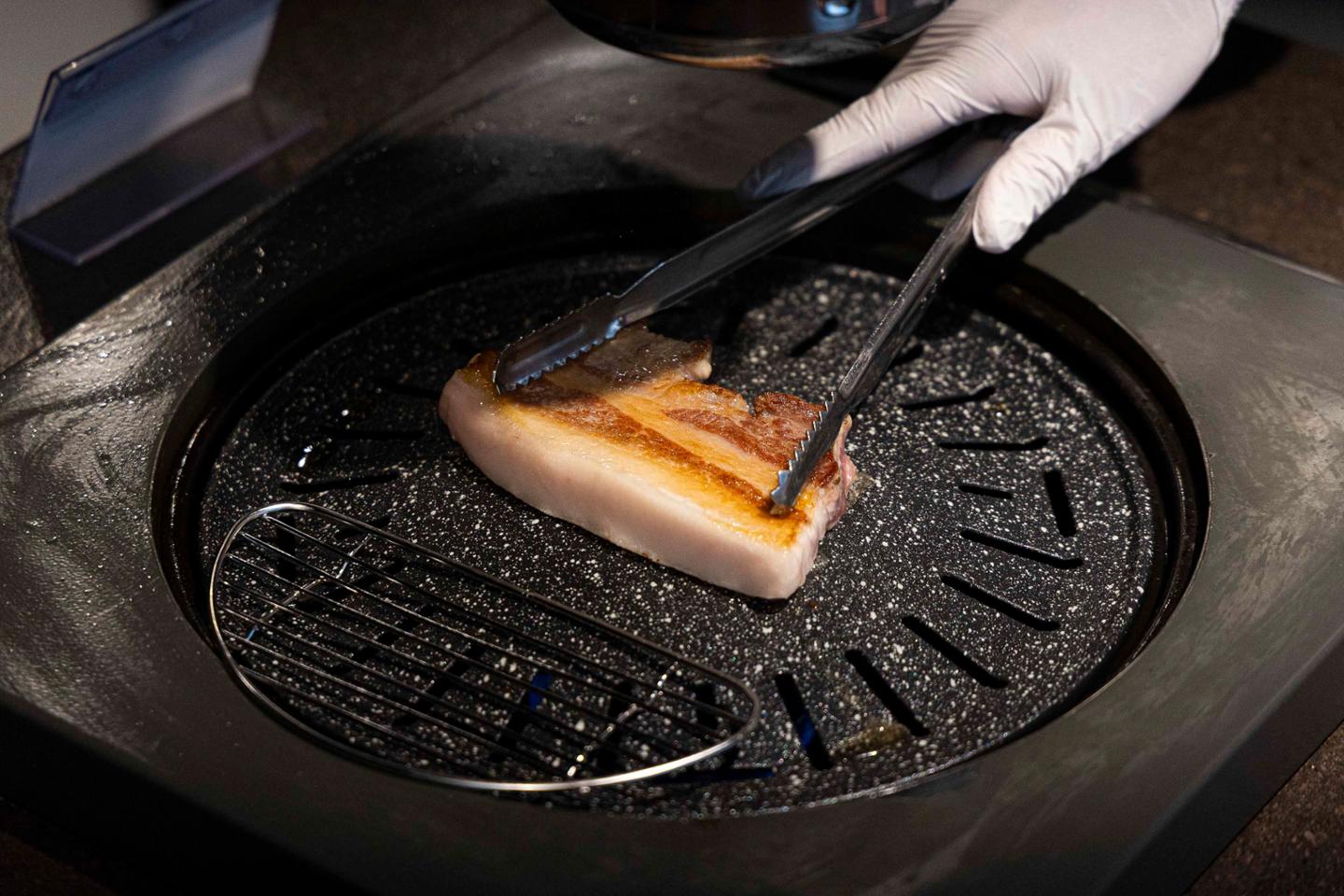
Cha Ho-myung demonstrates how to grill samgyeopsal, or pork belly, according to Sunjin's grilling manual during the 19th Grilling Meister certification exam on Oct. 14. Cha says factors including the temperature of the grill and meat, the thickness of the pork, cooking time and even the color of the rendered fat should be checked. Courtesy of Sunjin
The grill should be kept between 150 and 180 degrees Celsius, the range in which the browning reaction is most active.
"The standard method is to leave chilled meat at room temperature for about an hour before grilling it, but that's not easy in real life," Cha said. "If you heat the grill to 210 degrees and then put meat straight from the refrigerator on it, the temperature will fall to the appropriate level."
For those without a thermometer, smoke can serve as a clue.
"Because the smoke point of pork fat is 189 degrees, there shouldn't be smoke if you're grilling it at the proper temperature," he said.
Then comes the flipping: Cha recommends what he calls the "2-1-4" rule.
For a 2-centimeter-thick piece of samgyeopsal, grill each of the two broad sides for two minutes. Cut the pork into bite-sized pieces, then rotate the pieces and grill each remaining side for one minute.
The result, he said, is properly grilled pork belly with a browned exterior and juicy center.
Beyond grilling techniques, Sunjin's Meat Culture Research Institute studies hygienic meat storage, develops specialized grills and explores pre-grilling methods that can reduce cooking time. It also develops recipes for side dishes that pair well with pork and shares its findings with the restaurant industry.
"Our goal is to train experts in grilling Korean pork so that more people can enjoy a healthy and satisfying grilling culture," Cha said.
This article from the Hankook Ilbo, the sister publication of The Korea Times, was translated by a generative AI system and edited by The Korea Times.
Explore More
- Q.
- Q.
- Q.