From ashes to architectural hotspot, Gangneung temple draws global attention
Summary
A Buddhist temple and two other architectural landmarks in Gangneung are drawing attention for their design and history. Inwol Temple near Gyeongpo Lake won a WA Award from the World Architecture Community in March after being rebuilt following a 2023 wildfire. Sorol Art Museum, perched on a hill in Gyodong 7 Park, is notable for being built closely to its architectural rendering and for hosting a Kim Chong-hak exhibition through Oct. 25. Imdangdong Catholic Church, built in 1955, helped shape the style of later Catholic churches in Gangwon Province.
Key Facts
- Inwol Temple was rebuilt after it burned down in a wildfire that swept through the area in April 2023.
- The temple won a WA Award from the World Architecture Community in March.
- Sorol Art Museum is part of the Gangneung Museum of Art and sits 62 meters above sea level in Gyodong 7 Park.
- Sorol is hosting a special exhibition devoted to Kim Chong-hak through Oct. 25.
- Imdangdong Catholic Church was designated National Registered Cultural Heritage No. 457 in 2010.

Inwol Temple’s Indra Wall in Gangneung, Gangwon Province, features a distinctive design that bears little resemblance to conventional Buddhist temple architecture. Korea Times photo by Lee Han-ho

The main prayer hall is reflected in an artificial pond symbolizing the Mirror of Karma at Inwol Temple’s Indra Wall. Korea Times photo by Lee Han-ho
A wall of brightly colored rectangles floods the field of vision, creating a unique facade for a Buddhist temple. It traces a gentle curve, turning people's thoughts to the temple’s monks as they sit in meditation. Will this rid them of worldly thoughts, or sweep them away in a flood of ideas and inspiration?
The wall belongs to Inwol Temple, near Gyeongpo Lake in Gangneung, Gangwon Province. This March, the temple drew international attention after winning a WA Award from the World Architecture Community. Word quickly spread that the temple was an example of “hip Buddhism,” even helping fuel memes.
The temple is only one of Gangneung’s noteworthy architectural spaces. From Inwol Temple to the Sorol Art Museum, a public building that somehow emerged looking just like its architectural rendering, the coastal city hides a number of stylish spaces.

Inwol Temple is designed in a sweeping curve, evoking the shape of the Buddha’s eyebrow. Korea Times photo by Lee Han-ho
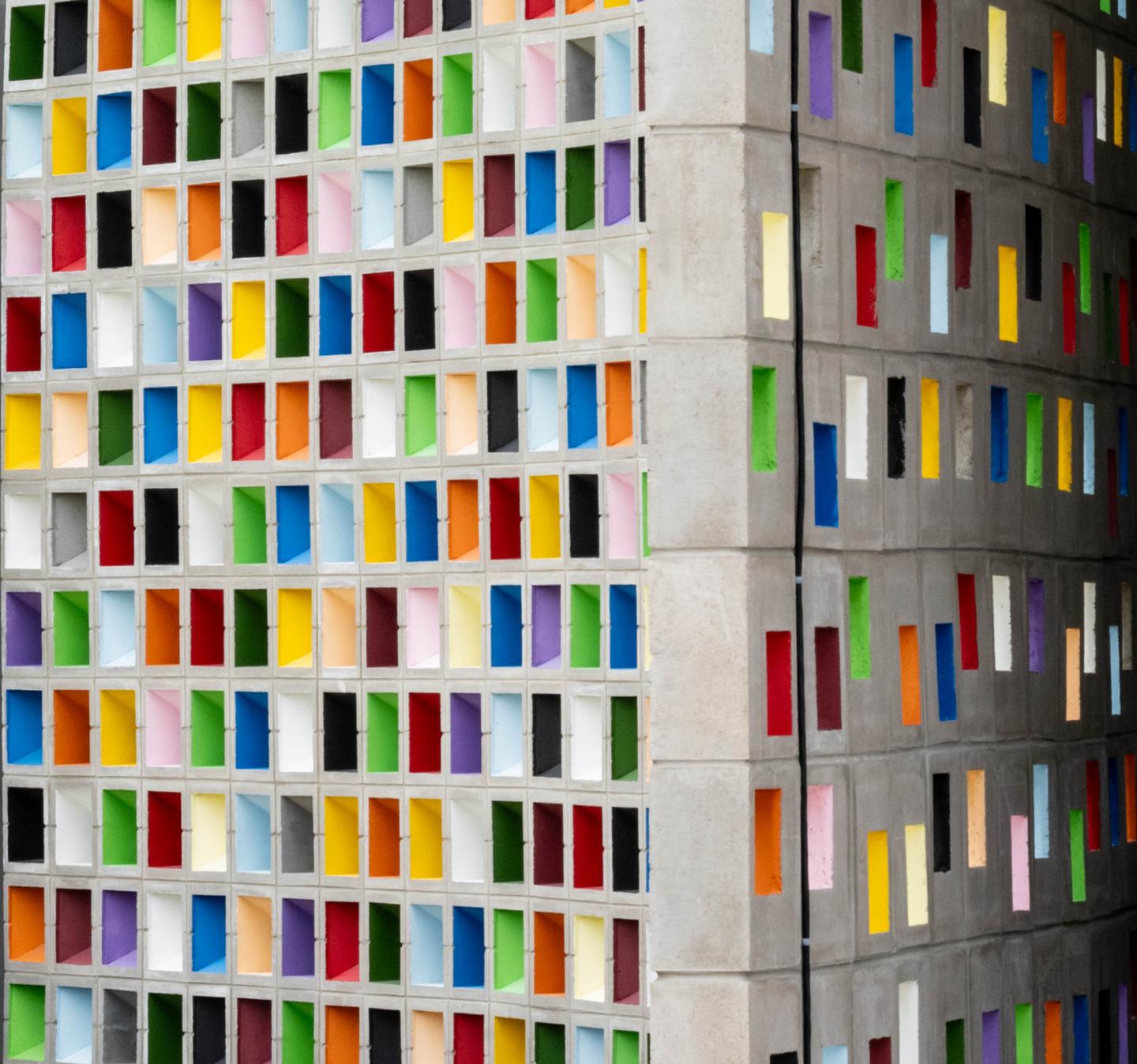
Front and rear views of the Indra Wall at Inwol Temple / Korea Times photo by Lee Han-ho
The ‘temple that looks nothing like one'
Inwol Temple is a single crescent-shaped building, modeled after the curve of the Buddha’s eyebrow. Rather than divide its long, narrow site into a separate prayer hall and meditation center, the architects brought both together into one structure and placed a lobby at its center. The roof follows an irregular curve of its own, designed to settle naturally into the surrounding landscape.
The temple’s signature multicolored wall is known as the “Indra Wall.” Its colored blocks join together to form a netlike screen embodying Indra’s Net, the Buddhist vision of a universe in which all beings are interconnected and reflect one another. The temple describes it as a contemporary interpretation of dancheong, the traditional Korean decorative painting found on Buddhist buildings.
The holes puncturing the blocks allow light and wind to pass through. Symbolically, they represent surrendering a little of one’s own color to communicate more freely with the world. In front lies a pond called the “Mirror of Karma.” Before entering the temple grounds, visitors are invited to look at themselves in the water and reflect inwardly.
First-time visitors may find the temple unexpectedly modest compared to Korea's celebrated ancient temples, which tend to proclaim their long histories through imposing prayer halls and sprawling grounds.
Inwol Temple, by contrast, rewards slow and attentive exploration. Walking along the Indra Wall, visitors begin to notice its subtler details. The pattern shifts with their line of sight. From a distance, the wall appears crisp and uniform but up close, that immaculate image dissolves, revealing the coarse grain of concrete with dents and indentations scattered across its surface.

The interior of Inwol Temple resembles an ordinary Buddhist prayer hall where worshippers come to pray. Korea Times photo by Lee Han-ho

Inwol Temple sits on a hill behind a small apartment complex in Gangneung. Korea Times photo by Lee Han-ho
Its rather dazzling exterior may lead visitors to expect an equally flamboyant interior, but inside is a scene of monastic tranquility. Monks quietly chant before an unassuming statue of the Buddha. Across the lobby from the main prayer hall is the temple dining room, where two unusual house specialties are made and sold: coffee-flavored and peony-flavored sikhye, a traditional sweet rice drink.
The temple was once a small temple visited almost exclusively by local worshippers, perched on a hill behind an ordinary residential neighborhood. After it burned to the ground in a wildfire that swept through the area in April 2023, it was rebuilt in its present form.
The decision to embrace contemporary architecture rather than recreate a traditional temple had a surprisingly practical rationale. According to media interviews given at the time, traditional timber construction would have been considerably more expensive and placed greater constraints on the use of space, so the temple chose concrete instead.
Because Inwol Temple housed no notable cultural assets, it was ineligible for restoration assistance. The flip side was that it was under no obligation to reproduce its original form.
Inspiration reportedly came when the temple’s abbot, the Venerable Jaebeom, visited the military meditation center on a military base, designed by architect Yun Gyeong-sik. “This is it,” he thought, and personally commissioned Yun to design the new temple.

The Sorol Art Museum, part of the Gangneung Museum of Art, has a pristine appearance. Korea Times photo by Lee Han-ho

Part of the museum is seen from below. Korea Times photo by Lee Han-ho
An aloof, pristine museum perched on a hill
The Sorol Art Museum, part of the Gangneung Museum of Art and located in Gyodong 7 Park, is that rare building constructed “exactly as it appeared in the architectural rendering,” with virtually none of the original vision lost along the way.
The building was designed by Meier Partners, the firm founded by renowned architect Richard Meier, known for his devotion to the color white. The person who led the project was Dukho Yeon, a Korean American senior designer who spent more than 30 years at the firm.
The museum was built by the park’s developer and donated to the city. One condition imposed by the Gangneung city government was that the building be designed by an overseas architectural firm. Because the developer commissioned Meier Partners with a clear understanding of its architectural philosophy, the firm was reportedly given broad control over the project throughout construction.
Perched on a hill 62 meters above sea level, the museum remains hidden from the road leading into downtown Gangneung. Follow the pedestrian path uphill, however, and the white building slowly reveals itself. That sense of anticipation, inviting visitors to imagine what awaits as they approach, was precisely what the architect intended.
As more of the building enters the field of vision, its uncompromising commitment to pure white becomes obvious. The space seems to declare that when form is perfect, color becomes little more than an encumbrance. Gleaming white atop the hill, the museum has something of the aloof grandeur of a ancient temple.

An aerial view of the Sorol Art Museum shows a ramp extending across the grounds. Korea Times photo by Lee Han-ho

An interior view of an exhibition gallery at the Sorol Art Museum / Korea Times photo by Lee Han-ho
The museum consists of three pavilions arranged around a central courtyard, which is encircled by a shallow reflecting pool. The composition recalls the courtyard of a traditional Korean "hanok" building. A long ramp extending away from the main entrance is the building’s pivotal feature, linking indoors with outdoors and the first floor with the second. It is disappointing, however, that the second-floor entrance at the end of the ramp is normally kept closed to accommodate the museum’s exhibition route.
Inside, the feast of white continues. At art school, one of the first rituals of preparing a graduation exhibition is making pristine white plinths on which the works will be displayed. Students scrub away the marks left by the previous exhibition and apply a fresh coat of white paint, creating a blank stage on which the art can command attention. Sorol gives the impression that the entire museum is one vast white plinth, built to let the artworks stand out.

The interior of the Sorol Art Museum is dominated by pure white. Korea Times photo by Lee Han-ho

An exhibition at the Sorol Art Museum / Korea Times photo by Lee Han-ho
Museums are generally designed to keep sunlight out, protecting artwork from damage caused by ultraviolet rays. Sorol takes the opposite approach: It was designed around the principle of drawing as much natural light as possible into the building.
That philosophy finds its clearest expression in a small alcove projecting from the first-floor exhibition area. Natural light pours through a triangular opening with softly rounded corners in the ceiling. Because the alcove is partly separated from the main gallery, the light does not reach the other works. It is a meticulous piece of design that remains faithful to the architect’s philosophy while staying mindful of the space’s primary purpose. The alcove currently houses a work titled “Play.”
Sorol is currently hosting a special exhibition devoted to Kim Chong-hak, a major figure in Korean contemporary art known for his vivid depictions of Mount Seorak. The exhibition, which runs through Oct. 25, also includes a recreation of his studio, complete with the artist’s tools, work clothes and even paints.
Imdangdong Catholic Church, the prototype for Gangwon’s churches
Imdangdong Catholic Church in downtown Gangneung was built in 1955, when the scars of the Korean War had yet to fade. It preserves the architectural style typical of Catholic churches constructed across Gangwon Province during that period. Its defining features include a bell tower, a steeply pitched roof, lancet-arched windows and buttresses that distribute the weight of the exterior walls.

Imdangdong Catholic Church in Gangneung, Gangwon Province, is National Registered Cultural Heritage No. 457. Korea Times photo by Lee Han-ho
Considering the circumstances of the time, the church was built with remarkable grandeur. Perhaps for that reason, many churches subsequently built across the region were modeled on it, using it as an architectural prototype. The church was designated National Registered Cultural Heritage No. 457 in 2010.

Stained-glass windows are concealed and can be viewed only from inside the church. Korea Times photo by Lee Han-ho
The stained glass inside the church was created and installed in 1992 by the Rev. Cho Kwang-ho, a Catholic priest and stained glass artist. After studying art in Germany and Austria, Cho returned to Korea and went on to create stained glass works for churches including Namcheon Cathedral in Busan and Pyeongchon Catholic Church in Anyang. Imdangdong was his first project in Korea.
Unusually, the windows are double-layered, with ordinary glass on the outside and stained glass within. As a result, what glows with color from the interior looks like an ordinary window when viewed from outside.
This article from the Hankook Ilbo, the sister publication of The Korea Times, is translated by a generative AI system and edited by The Korea Times.
Explore More
- Q.
- Q.
- Q.