From viral sweets to indie films: Best things to do in Gwangju

A customer buys boxes of rice cakes at the main branch of Changeok Tteok in Buk District, Gwangju. Korea Times photo by Lee Han-ho
On game days, lines outside a rice cake shop near Gwangju Songjeong Station can stretch more than 50 meters, a familiar scene that even local taxi drivers anticipate, often naming the destination before passengers finish asking.
"In my whole life, it is my first time seeing people line up like this at a rice cake shop," a taxi driver said.
The draw is pumpkin injeolmi, a sticky rice cake from the bakery Changeok Tteok that has become a viral sensation drawing crowds rivaling the craze for the Dubai chewy cookie. Yet, while domestic tourists travel across the country for this longtime local favorite, the true appeal of Gwangju reveals itself in the quiet, unhurried neighborhoods just beyond the bakery lines.
Here, the buzz of viral food trends serves merely as a gateway to the city's true draw: a quiet dedication to rich architectural heritage and back-to-basics culinary craftsmanship.

Pumpkin injeolmi from a rice cake bakery Changeok Tteok in Buk District, Gwangju / Korea Times photo by Lee Han-ho
Historic cafes and traditional sweets
In the historic center, the districts of Yangnim-dong in Nam District and Dongmyeong-dong in Dong District — locally dubbed "Dongridan-gil" — offer a patchwork of modernized hanoks, traditional Korean homes, and contemporary craft streets. Here, the city’s culinary focus shifts from viral volume to historic preservation.

Gaeseong juak, a traditional Korean rice donut, and iced coffee are served at Hoyang Horim in Yangnim-dong, Nam District. Korea Times photo by Lee Han-ho
At Hoyang Horim in Yangnim-dong, young bamboo sways against a tiled fence in the yard of a remodeled L-shaped hanok. Visitors sit on a traditional wooden bench, pairing specialty pour-over coffee with gaeseong juak, a traditional fried dough sweet that is crisp on the outside and rich with grain syrup inside. The cafe also serves tiramisu and seasonal shaved ice out of traditional earthen pots.
In Dongmyeong-dong, Teasoha offers a minimalist, black-and-white space accented with bonsai trees and white porcelain. The teahouse is anchored by a traditional teapot set featuring a large leaf-shaped strainer, where patrons time their own white, green, black, or oolong tea with an hourglass. Orders are accompanied by traditional snacks, of dried fruits, nuts and sugar-free, handmade yanggeng, a sweet bean jelly served in chestnut, matcha and white varieties. Offering a contemporary twist, the menu includes fruit matcha parfaits, peach white tea cocktails, and whiskey black tea cocktails.

A white tea plate is prepared at Teasoha in Dongmyeong-dong, Dong District. Korea Times photo by Lee Han-ho
Nearby, cafe Mulheureudeut takes a back-to-basics approach to coffee. The cafe operates without an espresso machine, serving only hand-drip coffee from a curated rotation of two specialty beans, one decaf and one standard roast. The space occupies two former businesses — a cleaner's repurposed into a cozy attic, and a supermarket transformed into an airy lounge complete with an awning and camping chairs.
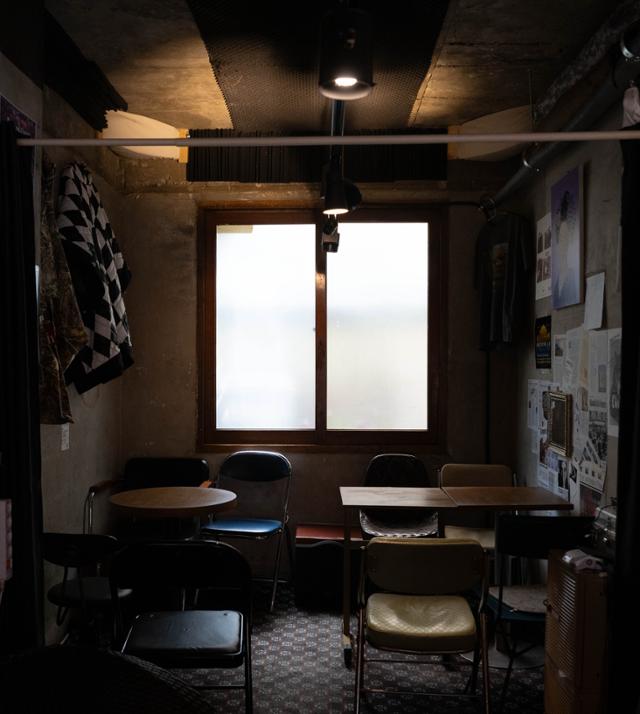
A small room at Mulheureudeut in Dongmyeong-dong, Dong District, offers a quiet retreat. Korea Times photo by Lee Han-ho
Analog cinema and upcycled art
Beyond the cafe culture, Gwangju retains a rich architectural heritage. Located in Chungjang-ro 5-ga, the 1935 Gwangju Cinema is the oldest single-screen theater in South Korea, and the second oldest overall behind Incheon's Ae Kwan Theater. During the Japanese colonial period, it was the only theater operating in the Korean commercial district — Chungjang-ro 1-ga and 3-ga were Japanese districts — functioning as a hub for pansori performances, traditional operas and local organizing.
Though heavily rebuilt after a 1968 fire, the building and its outer lobby retain a 1970s aesthetic. The heavy wooden interiors calm the quiet theater, complementing faded promotional materials written in a clunky, classic stencil typeface. Inside the 856-seat screening room, the theater still features an original Japanese police inspection seat used to monitor audiences and a film projector for actual screenings once a week.

Hand-painted movie posters hang as billboards at Gwangju Cinema in Dong District. Korea Times photo by Lee Han-ho
In Yangnim-dong, architectural history takes the shape of a grassroots effort at Penguin Village. Following a 2013 fire that destroyed a home in the aging neighborhood, 73-year-old resident Kim Dong-gyun began filling the empty lots with art assembled from discarded everyday objects.
Today, the village’s 30 tightly packed homes are covered in wall clocks and intricate scrap-metal fish with butane-gas caps for eyes and beverage cans for scales. Named for the waddling gait of the elderly residents who helped build it, the alleyway now draws 200,000 visitors annually. In 2019, municipal offices purchased nearby hanoks to establish a dedicated craft street featuring a dozen workshops.

Several fish sculptures made from scrap metal are exhibited in Penguin Village, Yangnim-dong, Nam District. Korea Times photo by Lee Han-ho
Preserved mansions and film history
Just 100 meters away sits the Lee Jang-woo's House, offering a sharp contrast to the dense folk art of Penguin Village. Built in 1899 by local figure Jeong Byeong-ho and purchased in 1965 by regional educator Lee Jang-woo — founder of Donggang College, Dongshin University and Gwangju Dongshin middle and high schools — the late-Joseon tile-roofed mansion features a front gate, storehouse, servants' quarters and men's and women's quarters. Surrounded by Western-style garden trees, the inner quarters are designated a Gwangju Folklore Cultural Heritage site and remain open to the public during the day.

Lee Jang-woo's house in Yangnim-dong, Nam District, stands as a preserved late-Joseon mansion. Korea Times photo by Lee Han-ho
The surrounding streets hold the traditional Choi Seung-hyo Old House and the colonial-era Western masonry of the Owen Memorial Hall — situated between the Christian College of Nursing and Gwangju Yangnim Church — though interiors are accessible only through guided tours. For photography enthusiasts, the World Camera Film Museum in Dongmyeong-dong displays rare equipment, opening its doors exclusively on Saturdays.
This article from the Hankook Ilbo, the sister publication of The Korea Times, is translated by a generative AI system and edited by The Korea Times.