'Living like Koreans' is a new trend among visitors to Korea

Japanese tourist Kanako Inoue, 50, before and after a makeover at a studio in Myeong-dong, Seoul, on Feb. 10. Korea Times photo by Lim Ji-hoon
When Lindsay, a 34-year-old visitor from Canada, and Kentaro, a 46-year-old from Japan, arrived in Seoul on Feb. 12, they headed straight to a specialized scalp care clinic in Myeong-dong.
The two said they booked consultations after seeing reviews on social media.
“Going to Korea and getting a scalp massage like Koreans do has become popular abroad,” they said. “The service is delicate and the results are excellent, so we’re very satisfied.”
A different kind of curiosity drew Amanda, a 21-year-old tourist from the Philippines traveling with her family, to an artificial waterfall in Hongje-dong on Feb. 9. A cold snap had transformed the cascading water into a tower of icicles, turning the site into an unexpected winter spectacle.
“You don’t get to see frozen waterfalls in the Philippines,” she said. “It feels unusual and fascinating to find something like this in the middle of a city.”
There is a paradigm shift now in how foreign travelers experience Korea. Beyond well-known landmarks such as royal palaces and Mount Nam, visitors are increasingly seeking out places like Hongje Falls, Han River parks and Mount Bukhan.
They are also booking beauty treatments, such as scalp care and teeth whitening, and having glasses made. At traditional markets and convenience stores, visitors film food content to share online and with friends at home. Fortune tellers, bathhouses and PC cafes have also become popular stops, for the same reason: They're the kinds of places where locals visit as part of their everyday lives.
“There is a stronger tendency to go where Koreans go, try what Koreans do and experience Korea’s modern culture and daily life,” said Kim Nam-jo, a tourism professor at Hanyang University. “The development of social media has significantly changed travel patterns.”

Alex, a visitor from Canada, undergoes an X ray before receiving a laminate veneer treatment at a dental clinic in Seocho District, Seoul, on Feb. 10. Korea Times photo by Lim Ji-hoon
Beauty and wellness tourism expands
Major makeup studios in Seoul are packed these days with international tourists.
Alice, a 29-year-old visitor from China, said she wanted to try a look inspired by K-pop. “Korean makeup is known for being more natural than trends in China,” she said. “I wanted to learn how to do it.”
Kanako Inoue, a 50-year-old Japanese tourist who received makeup services in Myeong-dong, said she has long been interested in makeup and often takes lessons and buys cosmetics while visiting Korea. “The techniques are far more detailed than in Japan, and there is a much wider variety of cosmetics,” she said.
Park Soo-hyun, who has operated a scalp clinic in Myeong-dong for 15 years, said the number of foreign customers has risen steadily as global interest in K-beauty grows. Last year, international visitors to the clinic increased by 60 percent from a year earlier.
According to the Korea Tourism Data Lab, spending on medical and wellness services rose to 15.2 percent of foreign credit card spending last year from 9.8 percent in 2020. The category ranked third after shopping at 38 percent and accommodation at 24.9 percent.
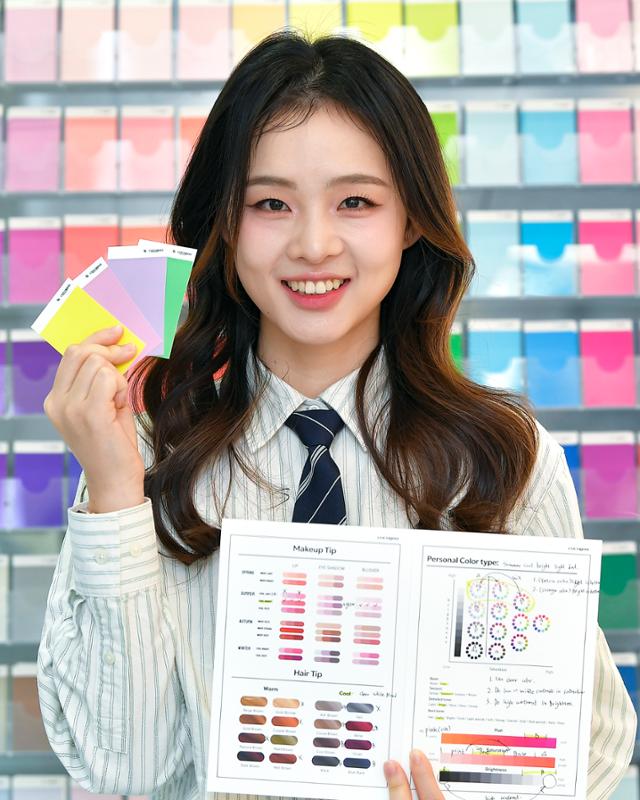
Alice, a tourist from China, holds a personal color analysis report after a makeup session at a studio in Myeong dong, Seoul, on Feb. 10. Korea Times photo by Lim Ji-hoon
Cosmetic dental procedures are also popular among foreign tourists. Dental clinics in Seoul’s Gangnam district are competing intensely to attract overseas visitors, with some offering “one day programs” that complete treatments such as teeth whitening and cosmetic reshaping in a single visit.
Alex, a 36-year-old Canadian who received laminate veneers at a clinic in Gangnam, said there is nowhere that performs procedures as precisely as in South Korea. “My mother and friends were amazed after seeing my teeth, and some even visited Korea to get the same treatment,” he said.
Seo Jae-won, director of TU Dental Clinic, said procedures such as teeth whitening are more commonplace in Korea than overseas, drawing large numbers of foreign patients.
“About 40 percent of our patients are foreigners,” he said.

A foreign tourist is fitted for glasses at an optical shop near Hongik University Station in Seoul on Feb. 9. Korea Times photo by Kim Jung-hyeong
Many tourists also visit Korea to buy eyeglasses. Lu Ching-ying, a 29-year-old tourist from Taiwan, said Korea offers a wide range of optical shops with affordable prices and diverse designs. “I bought glasses after getting recommendations on styles that are popular in Korea,” she said.
The owner of an optical shop near Hongik University said as many as 400 to 500 foreign customers visit each month. “We are planning to expand branches in busy commercial areas popular with overseas visitors,” he said.

A family of tourists from the Philippines poses for a photo in front of Hongje Falls in Seodaemun District, Seoul, on Feb. 9. Korea Times photo by Oh Seh-un
Climbing Mount Bukhan, ‘water-gazing’ at waterfalls and running along the Han River
Scores of overseas tourists are embracing aspects of everyday Korean leisure culture, from mountain hiking and bathhouse visits to “water gazing,” the quiet practice of watching flowing water.
Janice Tam, 36, hiked Mount Bukhan because she wanted to visit places where Seoul residents go to relax.
“The hiking infrastructure is well developed and easy for foreigners to access, and eating kimbap and ramyeon made it a wonderful experience,” she said.
To meet growing demand from foreign visitors, the Seoul Tourism Organization opened the Bukhansan Urban Hiking Tourism Center in 2022, followed by centers at Mount Bugak and Mount Gwanak.
Gil Gi-yeon, head of the Seoul Tourism Organization, said mountains are becoming a tourist destination for more foreign visitors due to easy access by public transportation and a wide range of course options.
Hongje Stream, a popular local relaxation spot, has also become a global attraction. Julia, a 21-year-old from Belarus, said she visited after seeing Hongje Falls on social media.
“It felt like I could connect with nature in the middle of the city, like how Koreans seem to fall into a meditative state while watching the waterfall,” she said.
Among the most popular spots, Han River parks are a must visit destination for foreign visitors, with eating instant noodles or having fried chicken and beer often appearing on travel bucket lists. Many visitors also rent bicycles or go for a run.

A Japanese tourist receives a saju reading from a fortune teller near Hongik University in Mapo District, Seoul, on Feb. 10. Korea Times photo by Kim Jun-hyeong
Fortune telling and PC cafes
The global hit Netflix animated film “KPop Demon Hunters” is drawing a surge of overseas tourists to traditional Korean fortune telling shops. Interest in Korean shamanistic elements featured in the series drove Google searches for “Korean saju” — a traditional system of interpreting a person’s fate based on the time and date of birth — up roughly fivefold late last year.
Along a street near Hongik University that is home to many fortune tellers, shops display signs in Japanese, Chinese and English. One shop said it hired three additional fortune tellers, each able to consult in a different language, about three years ago to accommodate the growing number of foreign visitors.
Shinki Motoko, 45, who had her saju read by a Japanese-speaking fortune teller, said she tried it out of curiosity after hearing that many Koreans enjoy it. “The explanations were detailed and thoughtful, and it left a lasting impression,” she said.

Chang Yoyu, 25, a visitor from Taiwan, shows T1 merchandise purchased at the T1 Basecamp PC Cafe in Mapo District, Seoul, on Feb. 10. Korea Times photo by Kim Jun-hyeong
For online gamers, Korean PC cafes offer an optimized gaming experience rarely found elsewhere. The T1 Basecamp PC Cafe in Mapo District is widely considered a pilgrimage site for global gamers visiting Korea because it is operated by T1, the team of the legendary gamer, Lee "Faker" Sang-hyeok.
As a devoted T1 fan, Miko, 29, from Hong Kong, traveled to Seoul to buy official merchandise. “I bought about one million won worth of items including a T1 uniform, jacket and accessories."

Kyle, left, and friends from the Philippines, eat cup noodles and drink banana milk at a convenience store in Banpo Hangang Park, Seoul, on Feb. 10. Korea Times photo by Na Min-seo
Convenience store food and Han River dining
Tourists are also reshaping how they experience Korean cuisine, with street and convenience store food gaining popularity. Visitors who once mainly sought out Korean restaurants now share “convenience store combo” recipes on social media, mixing items such as Buldak instant noodles, banana milk and rice cake recipes.
Some follow informal snack maps to track down favorites like egg bread, sweet beanpaste-filled fish bread and fried sugar-filled doughnuts called "hotteok."
Kyle, a 26 year old tourist from the Philippines, said she had long wanted to try convenience store instant noodles after watching Korean drama characters eat them on screen.
“I followed recipes trending on social media, mixing banana milk with coffee and trying different kinds of cup noodles,” she said. “It was delicious and fun.”
Eating instant noodles while sitting by the Han River has become something of a new symbol of Korean food culture. At convenience stores across the many parks on the banks of the river, lines of foreign visitors often form at noodle cooking stations.
As more foreign visitors seek to experience everyday Korean life, experts say greater efforts are needed to respond to the shift.
Kim Jae-ho, a professor of tourism management at Inha Technical College, said interest in contemporary Korean culture continues to expand under the influence of K-pop and Korean dramas, underscoring the need to diversify the ways Korea is presented to global audiences.
“In particular, there is a need for modern cultural content that resonates with foreign visitors, such as beauty and food,” he said.

Videos filmed at Korean convenience stores appear in search results for “Korean convenience store” on TikTok. Captured from TikTok
This article from the Hankook Ilbo, the sister publication of The Korea Times, is translated by a generative AI system and edited by The Korea Times.