Mini trains chug along tracks of Europe in Nowon
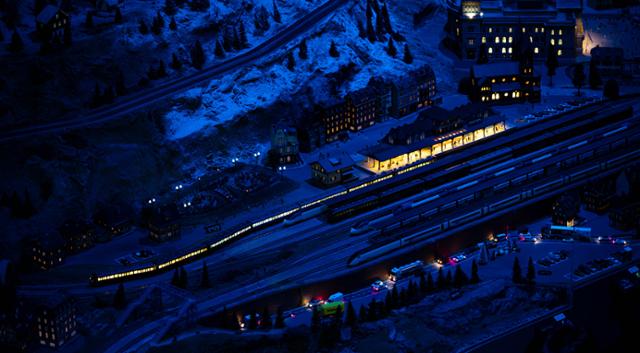
A Swiss train and a KTX high-speed train are displayed side by side at the “Interlaken Station” display in the Swiss Pavilion of Nowon Train Village in Seoul. Hankook Ilbo
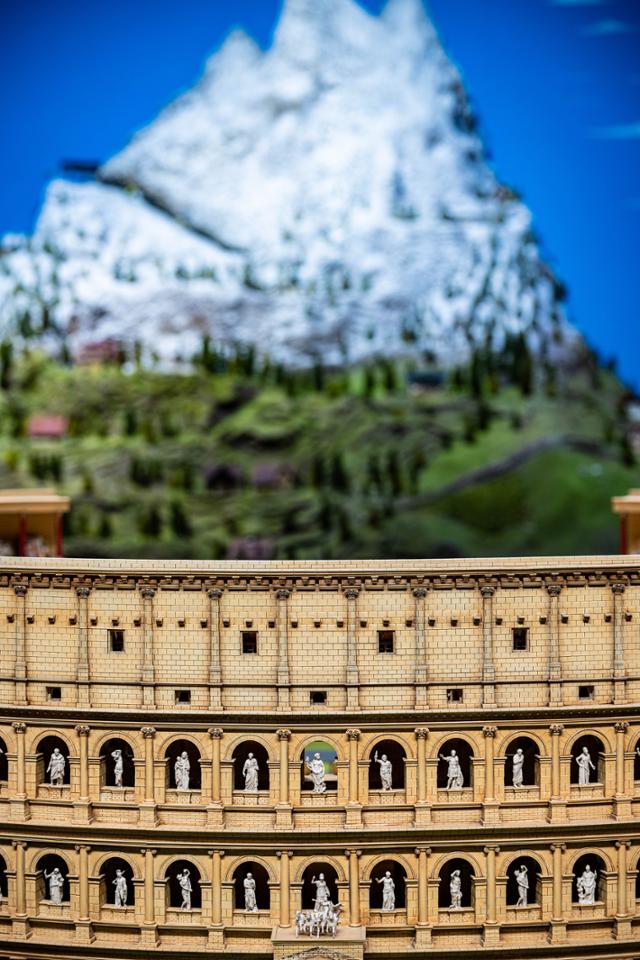
The Dolomites rise behind the Colosseum exhibit at the Italian Pavilion of Nowon Train Village at Hwarangdae Railroad Park in Seoul. Hankook Ilbo
As the sunlight that once lit up the Matterhorn fades, so does the pace of the trains running along the mountainside. Yellow light begins to spill from carriage windows, and villagers scattered along the slopes switch on their lamps one by one.
Just minutes after dusk settles in, the lyrical night view of a Swiss village starts to glow. A tram rests inside the station, but on the next track stands a familiar silhouette: a Korean KTX high-speed train.
This carefully crafted scene unfolds at Nowon Train Village, located inside Hwarangdae Railroad Park in Seoul’s Nowon District. Here, Switzerland has been scaled down to just over 1 percent of its original size, with miniature trains running through landscapes recreated in remarkable detail — down to individual wires.
Hwarangdae Station on the Gyeongchun Line served as Seoul’s last small rural station for 71 years before closing in 2010. Since 2017, the area around the former station has been transformed into a railroad park that has become a favorite low-key travel destination. Families with train-loving children, couples seeking an unusual date spot and railway enthusiasts alike now wander the grounds with ease.
A railroad park where retired stations meet retired trains
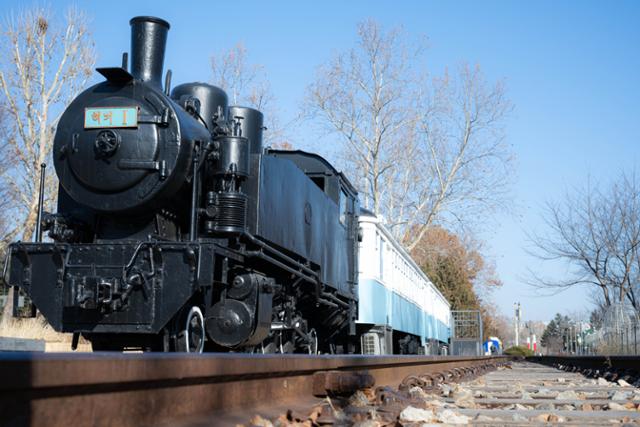
The narrow-gauge locomotive Hyeogi-1 on display at Hwarangdae Railroad Park in Seoul / Hankook Ilbo
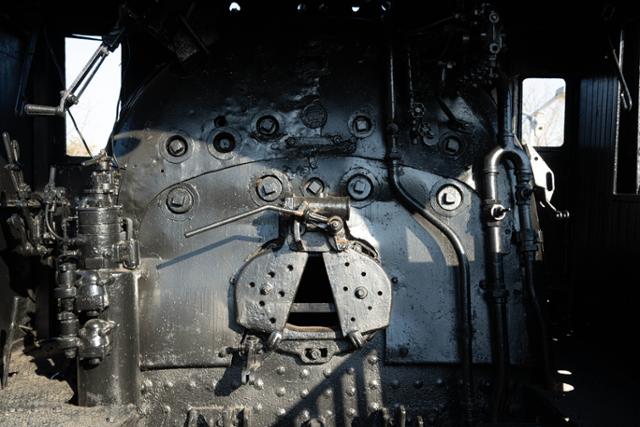
The coal chute of the Mika-5 No. 56 steam locomotive on display at Hwarangdae Railroad Park in Seoul / Hankook Ilbo
In the years immediately following the station’s closure, the site suffered from illegal dumping and parking, becoming a headache for the surrounding neighborhood. At the same time, its distinctive asymmetrical design and historical value led it to be designated as a registered cultural heritage site, effectively ruling out demolition or redevelopment.
That constraint prompted Nowon District to pursue an unconventional solution: filling a space that had completed its role with objects that had done the same. As a result, retired trains from around the world were brought to Hwarangdae.
Among them are two trains that once ran at Seoul Children’s Grand Park in the 1960s. One is the imposing steam locomotive Mika-5 No. 56, now displayed in front of the station.
It hauled freight along the Gyeongbu Line from 1952 until 1967, retiring with the arrival of diesel locomotives. Yet the sense of power conveyed by its solid mechanical structure remains undiminished by time. Its black body, exposed piping and rugged coal chute offer a raw, industrial charm distinct from today’s sleek electric trains.
The other is the narrow gauge steam locomotive Hyeogi-1. Narrow gauge refers to railway tracks narrower than the standard gauge of 1,435 millimeters; during the steam era, such lines often measured just 762 millimeters, roughly half the standard width. The name Hyeogi comes from “kyouki,” the Japanese pronunciation of narrow gauge.
Hyeogi-1 ran on the Suin Line between Suwon and Incheon, and on the Suryeo Line between Suwon and Yeoju, Gyeonggi Province, from 1952 to 1973. Despite being smaller and slower than standard gauge trains, it served as a backbone of short-distance rail transport in the metropolitan area. Today, the locomotive is displayed alongside two wooden passenger cars, where visitors can sit on the original wooden seats and soak in the atmosphere of a bygone era.
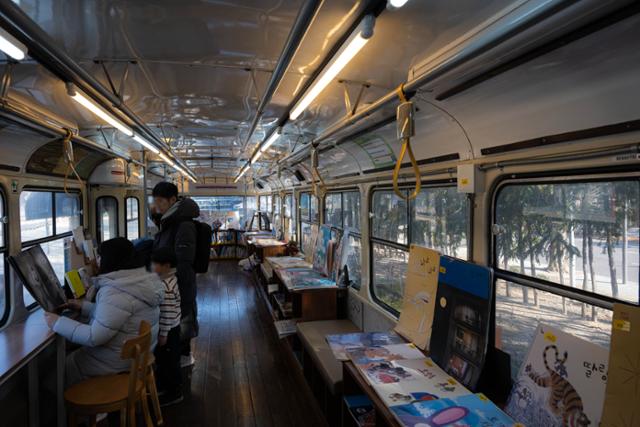
A parent reads to a child inside a children’s library created from a Czech tram at Hwarangdae Railroad Park in Seoul. Hankook Ilbo
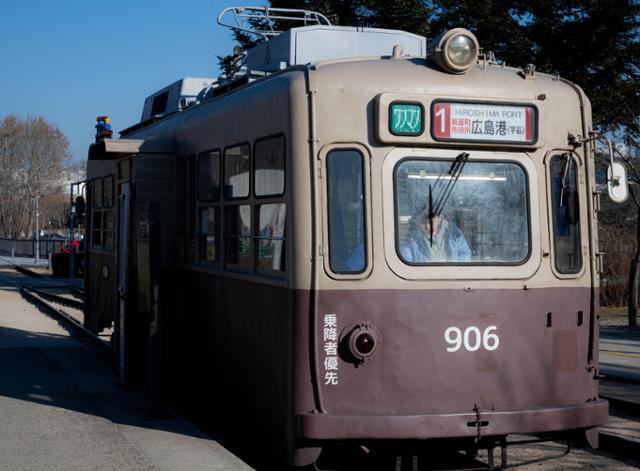
A child operates a Hiroshima streetcar on display at Hwarangdae Railroad Park in Seoul. Hankook Ilbo
Three trams — now rarely seen in Korea — are also on display. A red tram from Prague has been converted into a children’s library, where traces of Czech graffiti blend with picture books to create a warm, whimsical space. Parents reading quietly to their children add to the charm, and in spring, the area becomes a popular cherry blossom photo spot.
A donated Hiroshima streetcar was added the year after the park opened. Nowon District officials had initially traveled to Hiroshima intending to purchase it, but local authorities waived the cost after sympathizing with the park’s mission.
With both driver cabins open, the tram is especially popular with children eager to sit at the controls. Another tram, known as “the first tram of the Korean Empire,” features open sides with only a central compartment and was restored by the National Folk Museum of Korea before being installed at the park.
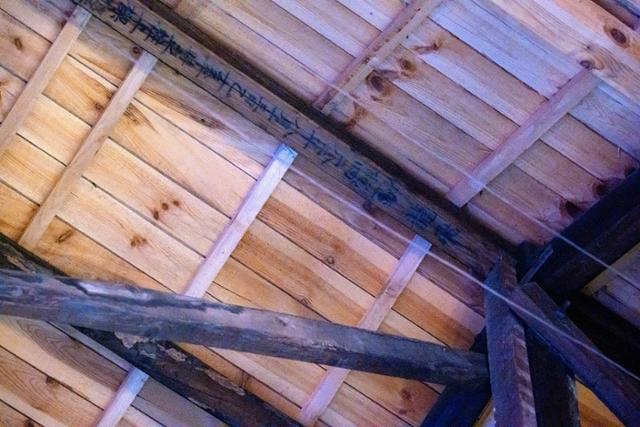
The preserved wooden ceiling of the Hwarangdae Station Museum at Hwarangdae Railroad Park in Seoul / Hankook Ilbo
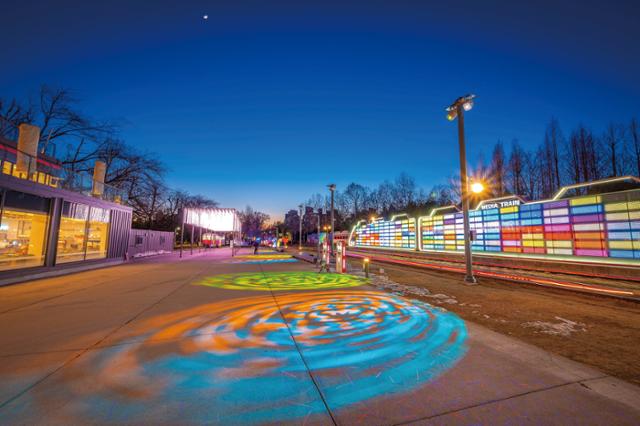
A nighttime view of Nowon Light Garden at Hwarangdae Railroad Park in Seoul / Hankook Ilbo
The former station building now operates as the Hwarangdae Station Museum. The old waiting room and ticket office have been preserved, and faint writing on the wooden structural ceiling remains, origins unknown. Exhibits inside include a scale model of the station in its heyday, Edmondson-style tickets and punch machines from the 1960s, and personal items donated by the station’s last stationmaster.
After dark, the area around the station transforms into a garden of light. Along roughly 400 meters of former track, the Nowon Light Garden illuminates themed displays that change periodically. Media facades are projected onto the station building, while an “Avatar Tree” near the train cafe glows softly, bringing warmth to what might otherwise feel like a quiet, abandoned station at night.
A mini European train village that delights all ages
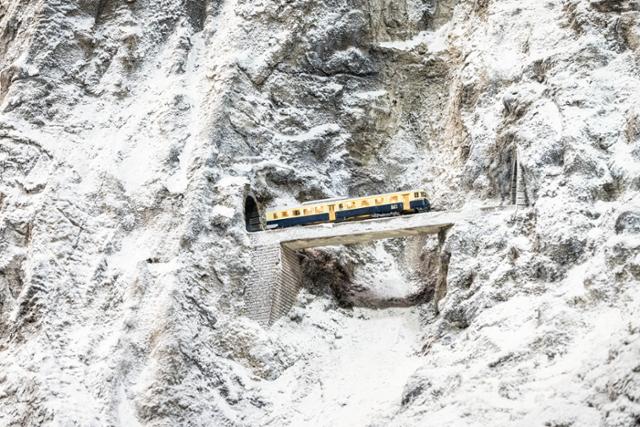
A model train runs through a mountain tunnel beneath the Matterhorn exhibit at the Swiss Pavilion of Nowon Train Village in Seoul. Hankook Ilbo
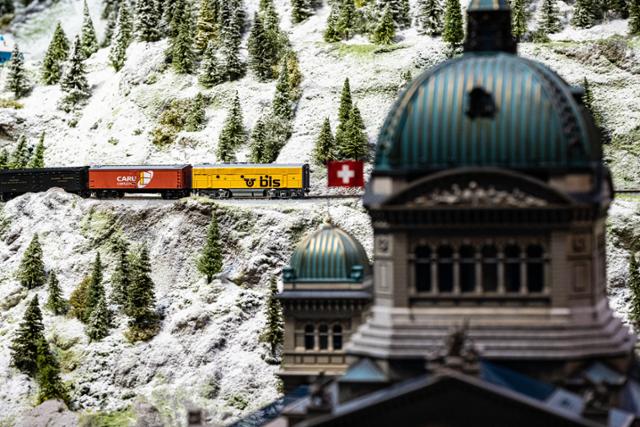
Model trains run at the Swiss Pavilion of Nowon Train Village in Seoul. Hankook Ilbo
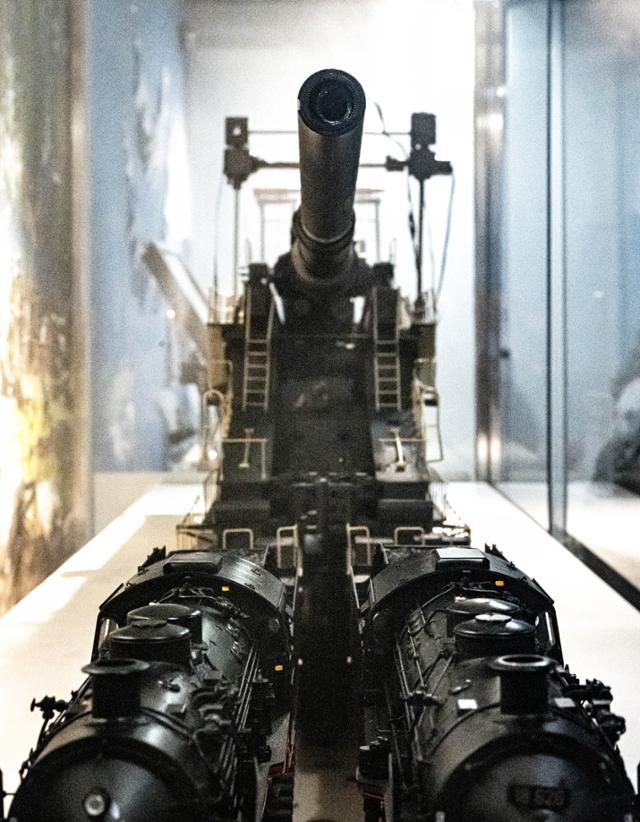
A model of the Schwerer Gustav railway gun is on display at the Swiss Pavilion of Nowon Train Village. Hankook Ilbo
Exploring the outdoor sections of the park should not mean missing the indoor exhibition. Nowon Train Village, which opened in November 2022, is a diorama museum showcasing running model trains set against various European backdrops.
The exhibits are built at 1:87 scale, the international standard for railway models. All of the trains actually move, and some controls are open for visitors to try.
At present, only the Swiss Pavilion (Hall 1) is open, with the Italian Pavilion (Hall 2) scheduled to open later this month. Inside the Swiss Pavilion are recreated Alpine peaks such as the Matterhorn and Mount Jungfrau, alongside cityscapes of Zurich, Lucerne and Geneva. More than 40 landscapes are featured, with 18 model trains running along 14 tracks stretching a total of 410 meters. Visitors can experience both day and night views, with the lighting switching every 10 minutes.
Visitors are especially encouraged to stop by the second-floor observation deck, where illuminated villages and winding mountain railways come into view. Children’s eyes light up as miniature trains make their way along zigzagging tracks, and parents, for a moment, find themselves feeling like children again.
On the side of the staircase leading to the second floor is a repair workshop run by Korea-Brass, a company that produces motorized model trains. When repairs are underway, visitors can watch the process through transparent windows.
The second floor also features a motorized model of the Schwerer Gustav railway gun — the largest cannon ever built — as well as a rotary train depot. Faithfully recreating every stage of operation, from shell loading to the firing sequence, the siege artillery gun remains one of the most popular exhibits.
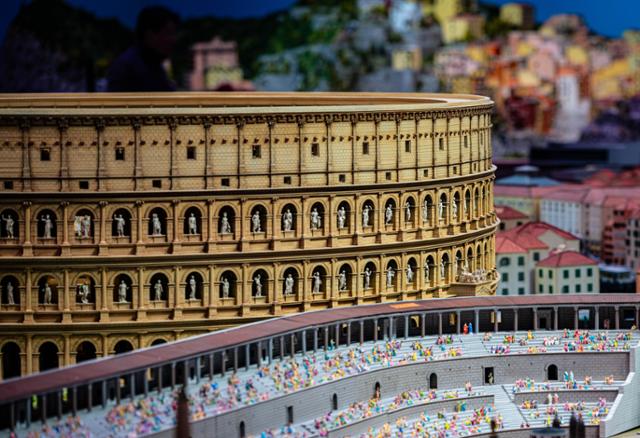
A model of the Colosseum is on display in the Italian Pavilion of Nowon Train Village at Hwarangdae Railroad Park, set to open later this month. Hankook Ilbo
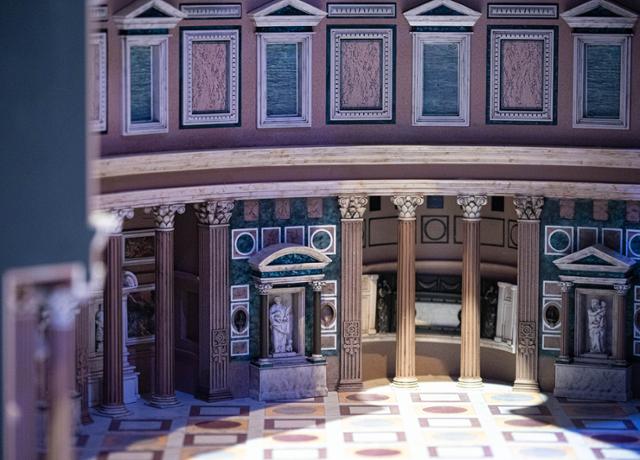
Lights illuminate the Parthenon exhibit in the Italian Pavilion of Nowon Train Village at Hwarangdae Railroad Park in Seoul. Hankook Ilbo

Light shines through the colonnade of the St. Peter’s Basilica exhibit in the Italian Pavilion of Nowon Train Village at Hwarangdae Railroad Park in Seoul. Hankook Ilbo
Since the year following its opening, Nowon Train Village has drawn about 100,000 visitors annually, establishing itself as a centerpiece of the railroad park. Building on the success of the Swiss Pavilion, the Italian Pavilion will open three years and two months after the museum’s debut.
The new pavilion is 1.5 times larger than the Swiss Pavilion, and while the total track length has been slightly reduced to 140 meters, the number of featured landmarks has increased significantly. It includes Italian landmarks such as St. Peter’s Basilica, the Colosseum and the Trevi Fountain, as well as a statue of Saint Andrew Kim Dae-geon installed at St. Peter’s Basilica in 2023.
The recreation of Venice and the Mediterranean involved the use of real water; transparent epoxy is usually chosen instead due to maintenance challenges.
As the Italian Pavilion places greater emphasis on historic landmarks, it also embraces more lifelike staging. Passengers on a cruise ship, crowds in the Colosseum and tourists in cliffside villages are all dressed in period-appropriate outfits and posed in scenes that feel convincingly real. To capture Italy’s on-the-ground atmosphere — in a country known for meticulous architecture — even the smallest exterior details of buildings have been recreated with care. The precision is striking: Tiny marble statues no bigger than a fingernail display delicate musculature and facial features that draw admiration.
The miniature studio said it designed and produced the pieces itself, based on photos taken during on-site research trips. Damaged sections of the Colosseum were restored to a form close to the original by cross-checking historical references. Excluding the design phase, production alone took more than a year.
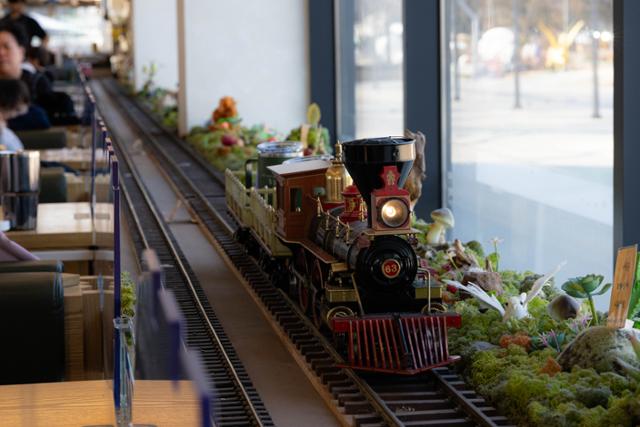
Drinks ordered at the Scenery with a Train cafe are delivered by rail at Hwarangdae Railroad Park in Seoul. Hankook Ilbo
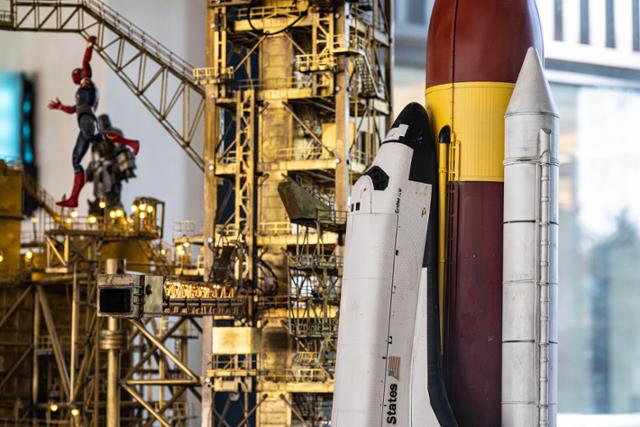
A space shuttle prepares for launch at the café “Scenery with a Train” at the railroad park. Hankook Ilbo
Another popular attraction is the Scenery with a Train cafe, known for a service in which a miniature train runs along tracks by the windows, delivering drinks directly to tables. After placing an order at the counter, customers take their seats, and a tiny train soon approaches with a whistle. It stops at each table for about 30 seconds before departing — just long enough to snap a photo and retrieve the drink.
In addition to the drink delivery train, a second track runs along the ceiling, and a space shuttle launch is staged every 20 minutes, adding to the cafe’s playful atmosphere. Drinks can be collected only on the first floor, but the cafe spans three levels, with the upper floors offering views over the entire park.
As the sun dips toward the horizon, children can be seen protesting that they don’t want to leave. Some break into tears, and soon others follow suit. Anyone who remembers throwing a tantrum outside a toy store as a child can’t help but smile at the scene.
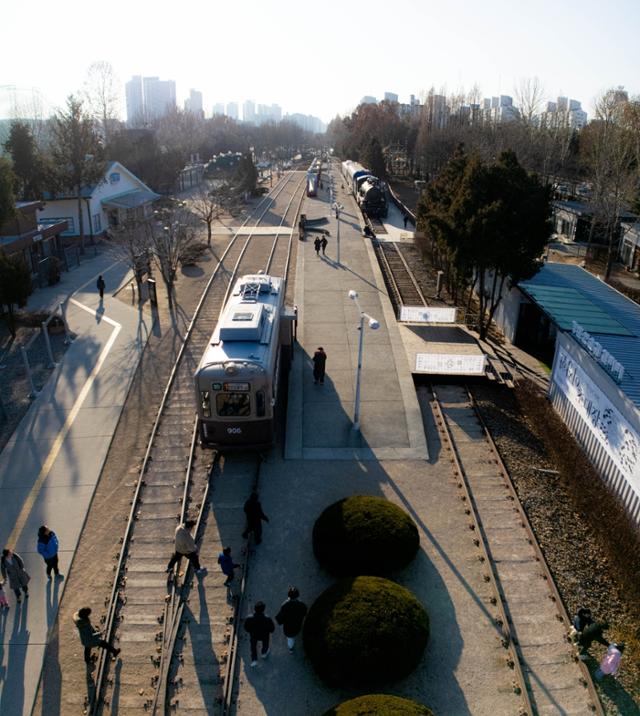
Families with young children visit Hwarangdae Railroad Park in Seoul. Hankook Ilbo
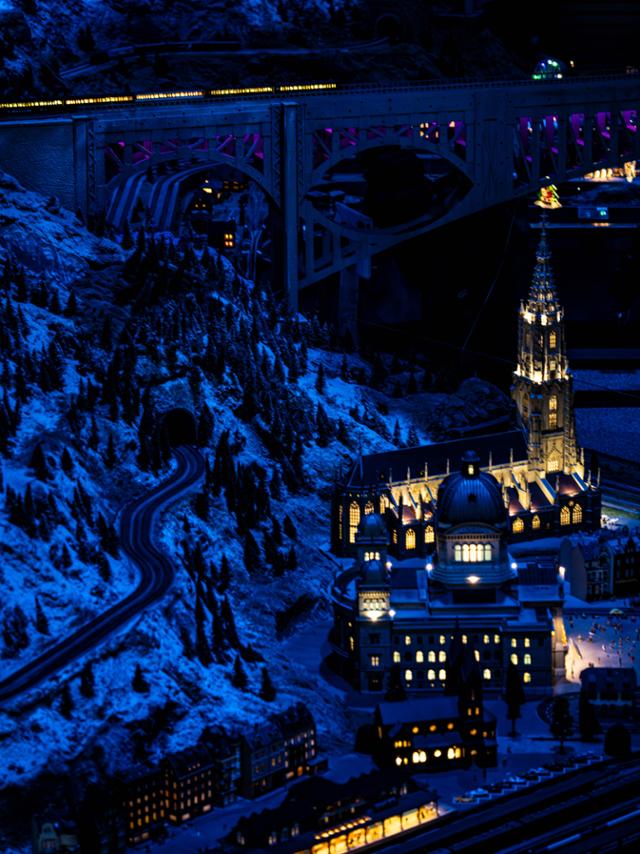
A nighttime view of the Swiss Pavilion of Nowon Train Village in Hwarangdae Railroad Park in Seoul / Hankook Ilbo
This article from the Hankook Ilbo, the sister publication of the Korea Times, is translated by a generative AI system and edited by The Korea Times.