Egyptian guide offers tours in Korean

Ezzeldin Elhassan Soliman is a veteran Egyptian tour guide with a Korean tour interpreter license. He has guided many Korean tour groups since he first started this job in 1999. Courtesy of Ezzeldin Elhassan Soliman
By Jung Da-min
For many Korean tourists who have traveled in Egypt with Ezzeldin Elhassan Soliman, one of the most memorable parts of the trip may have been this Egyptian tour guide's fabulous Korean language skills.
For this reporter who visited Egypt from late November to early December, there was an interesting moment when Ezzeldin was giving an explanation of an ancient drawing of a flail, an agricultural tool used for threshing wheat, which is called a “dorikkae” in Korean. The tour group was surprised and amused that Ezzeldin called the flail a dorikkae but got stuck for a moment when asked what it was named in Arabic.
Ezzeldin, a 54-year-old veteran guide with a Korean tour interpreter license, has guided many Korean tour groups since he first started this job in 1999. He said it was a miracle that he could be the first Egyptian providing Korean-language services to Korean tour groups, because all the travel agencies had turned down his job applications at the time, saying only Koreans were providing guide services to Korean tour groups.
“Looking back, God made three miracles for me to start the job in August 1999, when a Korean travel agency contacted an Egyptian agency to ask if there was a Korean guide for a Korean tour group. The Egyptian agency got it wrong, thinking the Korean agency was looking for an Egyptian guide who speaks Korean,” he said in a written interview with The Korea Times, Tuesday. “The Korean agency then asked the Egyptian agency to send the name and contact information of the guide, but the electricity line for fax service was under restoration after an explosion. This I called the 'miracle of fax.'”
When the Korean tour group first met Ezzeldin, tourists told him they were expecting a Korean but that it would be interesting to travel with a local guide who speaks Korean.
“There were two more miracles. One was that the 10 Korean tourists I met were without a Korean staff member from the Korean tour agency who would have reported the situation to the company right after he or she knew the situation. The other was that all of the 10 tourists had been so nice to me,” he said. When the Korean agency finally received the fax three days later, they called the tourists to ask if they were okay, and the tourists gave good feedback. And that was how he successfully debuted as the first Egyptian guide providing Korean interpretation to Korean tour groups.
Although he now speaks fluent Korean, learning the language was not easy in the beginning.
Before becoming a tour guide, he used to be an athlete representing Egypt's national karate team until 1994.
Ezzeldin said that his interest in Korea might have started from his family background. His father was a Chinese language professor at Ain Shams University in Cairo, and his younger brother was studying in Japan for a master's degree, after majoring in Japanese at Cairo University.
“Thanks to my father and younger brother who were studying languages of the East Asian region, I could have the valuable piece of information that no one from Egypt had formally studied Korean back then,” Ezzeldin said.
In early 1994, he applied for both Korean and Japanese language courses, each with the Korean Embassy and Japanese Embassy in Cairo. “On the same day I went to the Japanese culture center and failed to get accepted, I received a phone call from the Korean culture center to come. I wanted to study Korean hard.”
But learning Korean had been challenging for Egyptian students like him, as Arabic and Korean have different sentence structures and different systems of vowels and consonants. “In particular, Korean has 10 vowels while Arabic has only three,” he said.
After finishing the eight-month course, he went to Korea to study the language more for two years from 1995 to 1997.
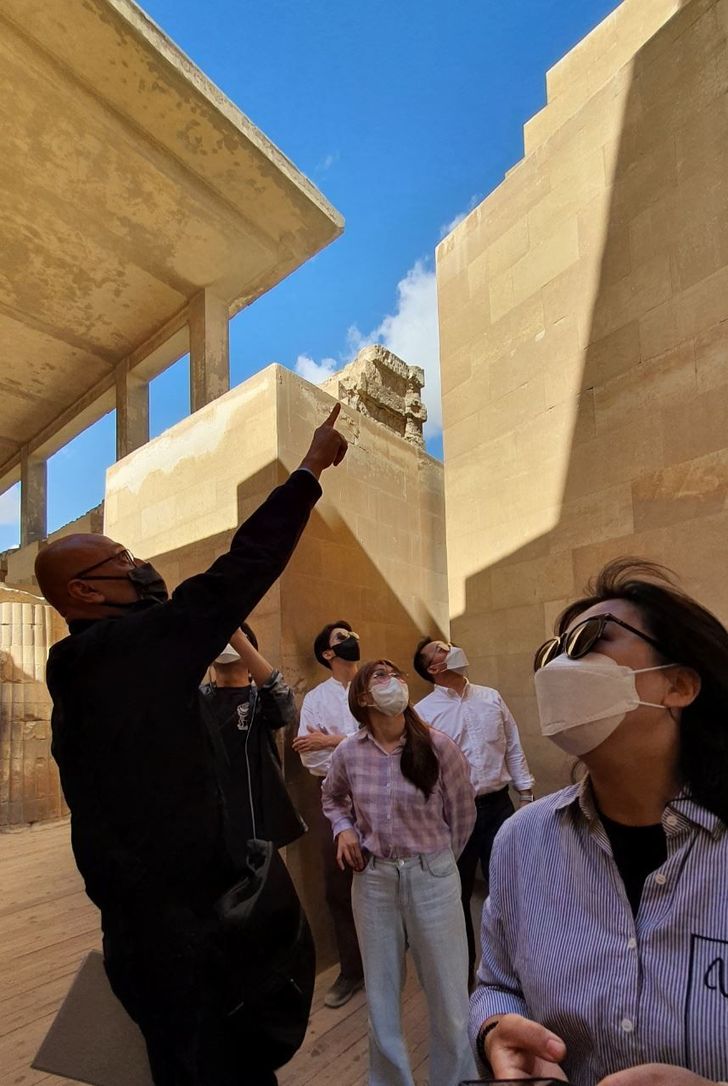
Ezzeldin Elhassan Soliman and Korean tourists at Saqqara Pyramid Djoser Mortuary Temple in Giza Governorate, Egypt, Dec. 1. Courtesy of Jeong Ju-young
There were few scholarship programs as Korea and Egypt were just starting to develop their bilateral relations. It was costly, as his monthly budget for studying and living in Korea had been three times higher than his father's monthly salary.
But thanks to his first Korean teacher, who offered him a radio job in local broadcaster KBS' Arabic department, he received financial support and was also able to study hard. In the last six months of his stay, he also received a scholarship from Korea Foundation, a non-profit public diplomacy organization.
After Ezzeldin, many other Egyptians have studied Korean, and many young Egyptian students now like Korean dramas and K-pop bands such as BTS.
“I recently met an Egyptian woman minister and she told me she had watched 'Squid Game,'” he said, referring to the mega-hit Korean series.
Ezzeldin said that he feels proud to be one of the few Egyptian guides offering Korean tour interpretation and he hopes more Koreans come to Egypt to see the different cultures of the various religions there, including Islam, Christianity and Judaism.
“Since Egypt has a history of about 5,000 years written in letters, Koreans who come to Egypt can learn a lot by looking at the ruins. They are mostly religious and include tombs, temples, mosques and Jewish and Christian churches. Since Egypt began to use letters in its early civilization, it is possible to study the religious changes of the country in a more interesting way than in other countries,” he said.