Remains of two Silla people found in castle wall of Wolseong Palace site in Gyeongju

Part of the excavation of Wolseong Palace and the west rampart. / Courtesy of Cultural Heritage Administration
By Kwon Mee-yoo
The remains of two Unified Silla era people were found in the ramparts of the Wolseong Palace excavation site in Gyeongju, North Gyeongsang Province, the Gyeongju National Research Institute of Cultural Heritage (GNRICH) revealed Friday.
The discovery came during excavation and academic research on the west rampart and the approach road between Gyerim Forest and Wolseong.
The bodies of the two men in their 50s found in the castle walls are considered the first case in Korea of "Insingonghui," or human sacrifice, in the process of building a rampart.
According to legend, an embankment or building would not collapse if a person was buried under a cornerstone.
The excavation of the west rampart of Wolseong was conducted in a bid to identify the palace gate site. The bodies were found between a base construction layer and an artificial ground layer for the rampart.
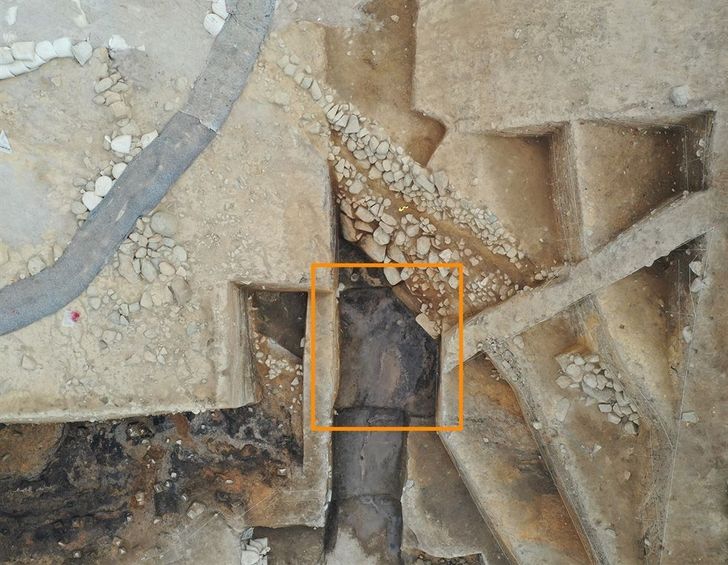
Human bones were found in the west rampart of Wolseong Palace. / Courtesy of Cultural Heritage Administration
“After this discovery, the limited scope of the research area of the gate site was expanded to its surrounds to find data related to Insingonghui and the detailed sequence of the rampart construction process,” a GNRICH official said. “As a result, it was found that there was a relation between Insingonghui and the rampart construction."
The road connecting Wolseong and Gyerim Forest provides crucial data on the network connecting the inner area of the royal palace to Gyerim, a national ritual place, and a vast building site in Hwangnam-dong.
In previous research, it was believed that one stone-piled moat existed, but it has been found that it is divided into two that have different construction methods.