W13.2 billion: Kim Whan-ki's 'Universe' makes history

Kim Whan-ki's 1971 diptych "05-IV-71 #200 (Universe)" fetched 13.2 billion won (HK$88 million) at the 20th Century and Contemporary Art Evening Sale by Christie's Hong Kong on Saturday. Yonhap
Blue dot painting sold for 13.2 billion won in Hong Kong auction
By Kwon Mee-yoo
Kim Whan-ki has done it once again, breaking his own record price for most expensive Korean artwork. His painting in question became the first art piece by a Korean artist to be sold for over 10 billion won.
Kim's 1971 diptych "05-IV-71 #200 (Universe)" fetched 13.2 billion won (HK$88 million) at the 20th Century and Contemporary Art Evening Sale by Christie's Hong Kong on Saturday.
The 254-by-254-centimeter painting consists of two canvases painted in Kim's iconic “Whanki blue” dotted style. The auction house described it as "painted with a thin calligraphic brush in the manner of traditional Asian ink paintings and epitomizes the peak of both spiritual and technical maturity in Kim's Pointillist works."
With "Universe" becoming the most expensive Korean art piece ever auctioned, Kim dominated the top 10 list of price ranking of Korean art, except for Lee Jung-seob's "A Bull" at ninth for 4.7 billion won.
Lee Hak-jun, Christie's general manager of Korean art, said Kim's painting exceeding the 10 billion won barrier is a sign that the work of the late Korean artist has joined the world's mainstream art market.
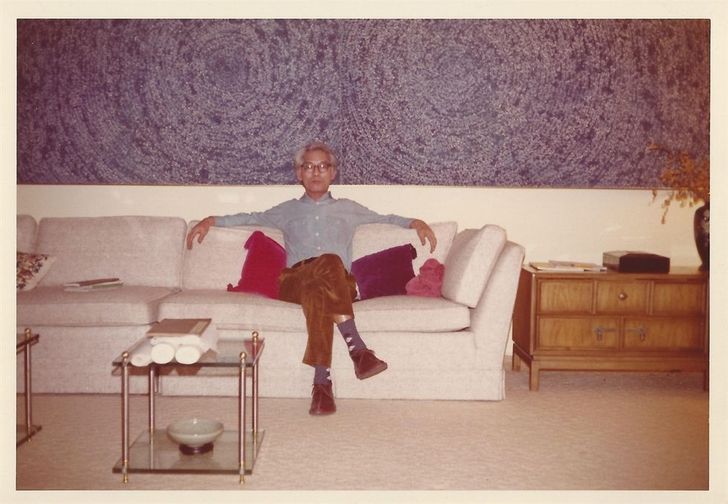
Kim Whan-ki sitting in front of "05-IV-71 #200 (Universe)" at Matthew Kim's house in 1972. Courtesy of Whanki Museum and Christie's Korea
The painting had been in the private collection of Matthew Kim and Kim Chae-kum for over four decades. The two were close friends of Whan-ki.
They first met in Busan, South Korea, in 1951, where they sought refuge during the 1950-53 Korean War. Matthew headed to New York and became a surgeon there and they reunited when Whan-ki went to New York in 1963.
Matthew and Chae-kum were enthusiastic patrons of Whan-ki and collected many of his paintings, with "Universe" being one of them. This is the first time for the painting to be auctioned after Matthew's original purchase in 1971.
According to Evelyn Lin, Christie's head of Asian 20th Century and Contemporary Art Department, Matthew put the painting up for auction only because he wanted Whan-ki to be treated properly in the art world.
After Kim's death, "Universe" was exhibited in Paris and South America before it was sent to the Whanki Museum in Seoul as a long-term loan, where it has been since August 2004.
Park Mee-jung, director of the Whanki Museum, said this painting is the largest among Kim's oeuvre and the only diptych.
"It is one of his latest masterpieces, created in yearning of his homeland's sky," Park said.
Art critic Seo Sung-rok spoke highly of Kim pioneering abstract art in Korea when modern art was unrecognized and poorly understood.
"He moved to New York at the age of 50. Kim's artistic world cannot be explained without mentioning his New York era when he continuously challenged himself," Seo said.
Art critic Yoon Jin-sup, who ignited the rediscovery of the Dansaekhwa (Korean monochrome painting) movement, said Kim's style certainly evolved in New York.
“In New York, he created his signature dot painting, combining abstract expressionism and Korean traditional ink-and-wash techniques. His works are influenced by internationally popular abstract expressionism, but have the spiritual quality of Korean art, placing him in an important position in art history," Yoon said.
Still, Korean modern art is considerably undervalued compared to the works of Chinese and Japanese artists of the same time. "Five Nudes" by Chinese artist Sanyu (1901-66), was auctioned for HK$266 million, which is over three times the price of Kim's piece.