Korean Empire's royal cuisine shows King Gojong's dreams, frustrations

On Sept. 20, 1905, King Gojong hosted a luncheon for Alice Roosevelt, which served 17 dishes with three different condiments. The Cultural Heritage Administration reenacted the royal banquet food with Shinsegae Chosun Hotel for “The Emperor's Dining Table of the Daehan Empire” exhibition at the Daehan Empire Historical Museum in Deoksu Palace. Courtesy of Cultural Heritage Administration
By Kwon Mee-yoo
Alice Roosevelt, the eldest child of U.S. President Theodore Roosevelt, was one of the most famous national figures of the early 20th century. She made a goodwill trip to East Asia in 1905 with an 83-member diplomatic delegation and stopped by the Korean Empire, which lasted from 1897 to 1910 when Joseon Kingdom struggled to survive amid opening of ports and contact with Western culture.
In her memoir "Crowded Hours: Reminiscences of Alice Roosevelt Longworth," she described her visit to the Korean Empire, including a royal banquet she attended at Deoksu Palace.
Despite recognizing that “Korea, reluctant and helpless, was sliding into the grasp of Japan," King Gojong tried to give the kid-glove treatment to this American princess as a diplomatic gesture. King Gojong hosted a Korean-style luncheon for Alice, his first luncheon with a woman.
"The Emperor's Dining Table of the Daehan Empire,” an exhibition held at the Daehan Empire Historical Museum in Deoksu Palace, gives a glimpse of royal cuisine of the Korean Empire, which were served in both Western and Korean traditional style, and how the country's dining style changed as it went through modernization. This is the second exhibition shedding light on the food, clothing and house of the Korean Empire.
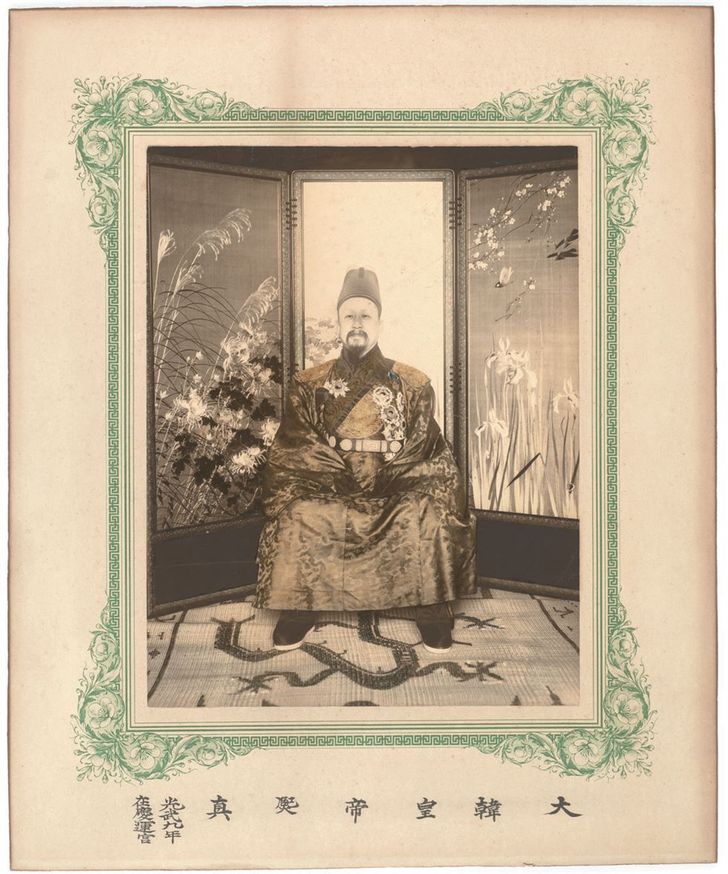
King Gojong's photo gifted to Alice Roosevelt / Courtesy of Cultural Heritage Administration
“The Emperor and his son, who became the last Emperor, led a furtive existence in their palace alongside our Legation. A few days after we arrived, we lunched with them there in the European part of the building. We were received in an upstairs room, and then the squat Emperor did not give me his arm, but took mine, and together we went in a hurried wobble down a very narrow staircase to an unnoteworthy, smallish dining room," Alice wrote in her book.
“We had Korean food, served in Korean dishes and bowls ornamented with the imperial crest. Those I used were afterwards presented to me, and at a farewell audience, the Emperor and Crown Prince each gave me his photograph. They were two rather pathetic, stolid figures with very little imperial existence ahead of them.”
During the Korean Empire, Western-style meal courses were served for banquets with foreign guests after the opening of ports. In the very early days of Western banquets, Korean and Western dishes were served together, but soon only Western dishes were provided in European style, thanks to German major-domo Antoinette Sontag, who was in charge of the palace's household affairs.
Isabella Bird Bishop, a British explorer who visited the Korean Peninsula a few times between 1894 and 1897, said she was "entertained in courteous fashion with coffee and cake on arriving" during her visit with King Gojong, and the dinner cooked in foreign style included "soup, fish, quails, wild duck, pheasant, stuffed and rolled beef, vegetables, creams, glace walnuts, fruit, claret, and coffee."
The Cultural Heritage Administration (CHA) re-created the royal cuisine of the period, including the banquet food served for Roosevelt, with chefs from the Shinsegae Chosun Hotel.
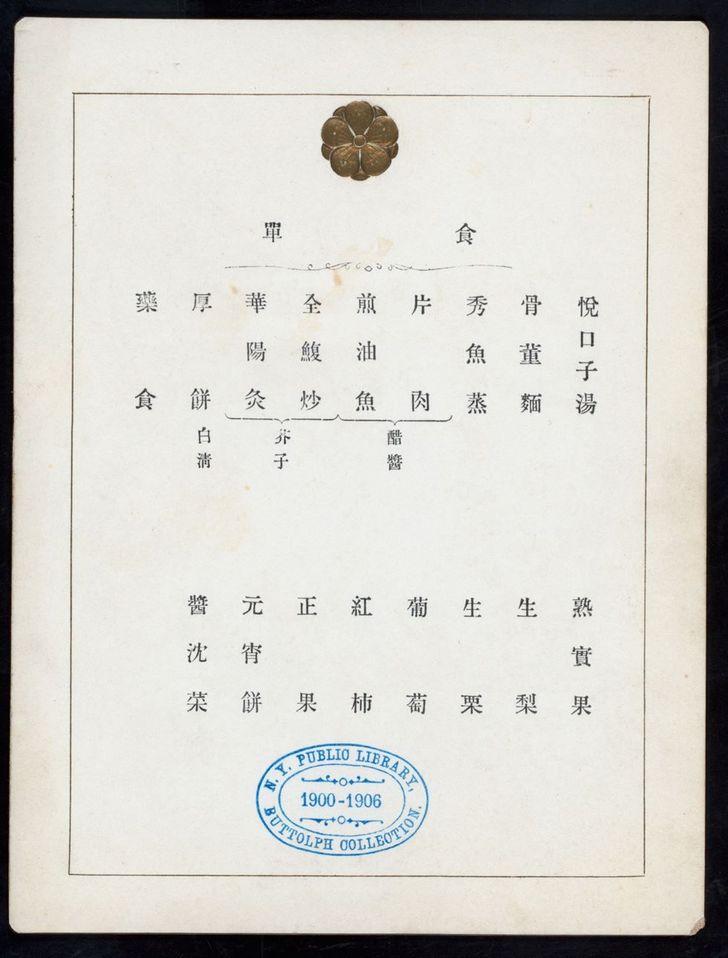
weekender p10) emperor's dining table /2019-10-02(코리아타임스)
The menu of the banquet Roosevelt attended is currently in the collection of the New York Public Library and Cho Hyung-hak, executive chef of Westin Chosun Hotel Seoul, supervised the re-creating of the imperial banquet.
At the Sept. 20 luncheon offered by King Gojong for Roosevelt, 17 dishes were served with three different condiments. The recipe and ingredients are based on the 1902 "Gojong Imin Jinyeon Uigwe," which had a list of dishes served for King Gojong's 51st birthday, and cookbooks published around the time using similar ingredients.
The menu begins with "yeolgujatang," or royal hot pot also known as sinseollo, which used a variety of materials such as beef tenderloin, pheasant, abalone, egg, shiitake mushroom and scallion to make it colorful.
"Goldongmyeon" is cold noodles mixed with pepper, perilla seed powder, sesame oil and soy sauce, garnished with beef and egg. Steamed gray mullet, boiled brisket slices, pan-fried fish fillet and boiled-down abalone were also served.
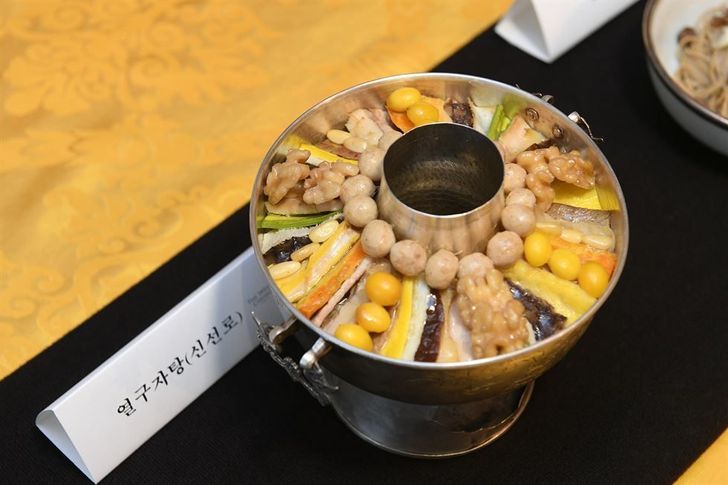
“Yeolgujatang,” or royal hot pot
Dessert included "hangwa," a traditional confectionery, and fresh produce of grapes, pears, persimmons and chestnuts.
"Suksilgwa" was made by boiling various fruits, ginger or nuts in water and then reforming them into original shapes, while "jeonggwa" is crispy and chewy treats made of candied fruit, roots and seeds.
“Though these dishes are plain-colored and look rather simple, they take much manual effort and require high-end ingredients,” the chef said.
The exhibit also gives enlightenment on general cuisine of the early 20th century Korea.
William Elliot Griffis' book "Corea, the Hermit Nation" describes Korean eating customs from a Western perspective.
"The meals are served on the floor on low sang, or little tables, one for each guest, sometimes one for a couple. The best table service is of porcelain, and the ordinary sort of earthenware with white metal or copper utensils. ... No knives or forks are used; instead, chopsticks, laid in paper cases, and, what is more common than in China or Japan, spoons are used at every meal," Griffis wrote.