Taiwan: sweltering, ancient, savory

Silvio Cioffi from Brazil, left, captures the scenery of Sicao Mangrove Preserve at Zhufagang Canal in Tainan during a boat tour while Eduardo Fabian from Paraguay, second from right, watches a tour guide demonstrating that the leafy species around the site are not poisonous, April 23. Korea Times photo by Ko Dong-hwan
By Ko Dong-hwan
The sweltering summer of Taiwan started in April. When eight journalists from different countries arrived in Taipei on April 20 for a press junket, the season's humidity and heat had already seeped deep into the air. Yung-chiang Chi, deputy director-general of the international information services department from Taiwan's Ministry of Foreign Affairs that arranged the program, told The Korea Times, “The best season to visit the country is between October and April.” So, with the comfort zone phase having just passed, the five-day “fam(iliarization) tour” began, with the reporters transported from Taiwan Taoyuan International Airport to The Grand Hotel in the city one by one throughout the day.
After a standing open show in the hotel lobby by a Russian traditional dance troupe, an ice-break among the participants was arranged at the hotel's boutique Golden Dragon Restaurant. Colleagues ― from Russia, Indonesia, Myanmar, Brazil, Paraguay, Greece, Tuvalu and South Korea ― maneuvered wooden chopsticks in each of their own styles eating Chinese food and compared Taiwan beer that was served to its international counterparts, including Russian vodka.
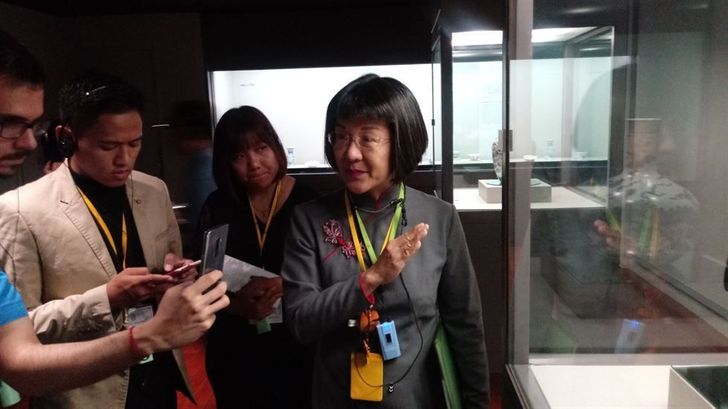
(From left) Eduardo Fabian, Baworo Yadika Tulus from Indonesia and Nan Lwin Yadanar Aung from Myanmar listen to a tour guide at the National Palace Museum in Taipei, April 22. Korea Times photo by Ko Dong-hwan
Edwin Shih-jen Hsiao, second secretary on home assignment under the Foreign Media Services Section of the ministry's department who led the group throughout the whole program, was busy explaining ingredients of each dish and spinning a center-top of the round table to make sure everyone got a fair share of the food and drinks.
Silvio Cioffi, an experienced travel writer from Brazil, was not shy of sharing his knowledge of the history of Taiwan, a country still disputed in China as a renegade province that in 1949 had its sovereignty claimed by Chinese military leader Chiang Kai-shek and his 2 million followers from the mainland in the aftermath of their defeat in the 1946-49 Chinese civil war. Near to us, a magician entertained senior patrons with tricks using banknotes and ropes.
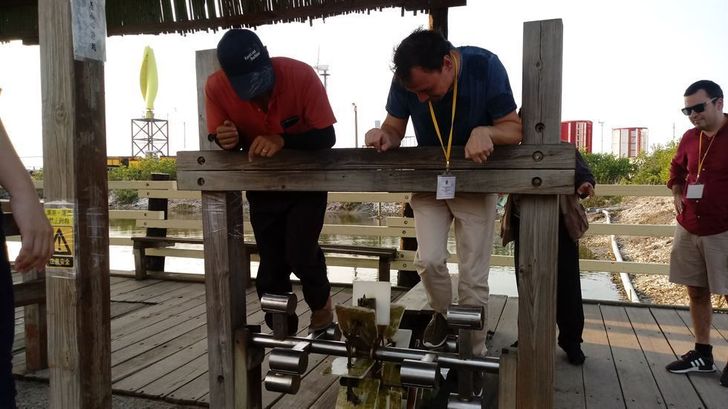
Alexander Zotin from Russia, second from left, steps on a saltwater pedal pump at Qigu Salt Mountain in Tainan as the site's employee demonstrates and Giorgos Tsiros from Greece, right, watches, April 23. Korea Times photo by Ko Dong-hwan
The party of eight kept vigilant before the exhibited ancient earthenware items and hand-crafted jades at the city's National Palace Museum and the geological wonders of extraordinary rocks by the seaside like the famous “Queen's Head” at Yehliu Geopark in New Taipei. Some reporters were upset that the museum tour had to be cut short because of the following power-lunch schedule with the foreign affairs department's top-ranking officials, including Director-General Amb. Henry Chen. A largely sprawling rocky site soaked with evening drizzle quieted the fatigued participants pulling themselves through the day's last assignment.
The writers, despite the raging, sultry weather and piercing daylight heat throughout the junket, seldom missed any chance of making the most of their journey. A boat ride at Sicao Mangrove Preserve at Zhufagang Canal in the southern Taiwanese city of Tainan had a zing of laughter when Giorgos Tsiros from Greece called a man on “lover's bridge” arching above the stream “a romanticizer waiting for his girlfriend.” At the city's Qigu Salt Mountain equipped with theme park elements including a sightseeing train, salt sculptures, DIY saltwater pedal pumps and a souvenir shop, the whole gang lost track of time feeling the rapture of the good old days of youth.
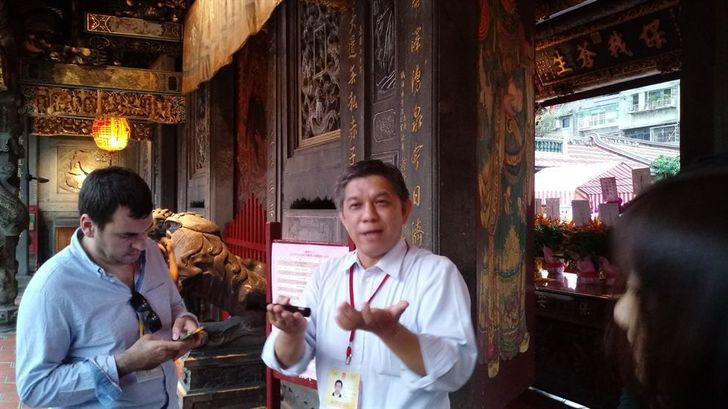
Wu Jameson, second from left, explains the exterior decorations at the entrance of Dalongdong Baoan Temple in Taipei next to Giorgos Tsiros, April 24. Korea Times photo by Ko Dong-hwan
Transport between destinations inside and outside cities on bus and bullet train gave a view of paddy fields and ocean water stretched yonder, old buildings with sketchy Chinese advertising banners and hundreds of scooters on city roads with some dangerously ridden by a family of three. An international sand sculpture exhibition at Fulong beach in New Taipei was quiet and peaceful, while global franchise restaurant Din Tai Fung Dumpling House below Taipei 101 was so crowded that the writers cheered and applauded when their number was called among the waiting patrons.
As well as the scenes of natural coziness and lively cityscape, the sacred Dalongdong Baoan Temple in Taipei preserves more than 10 deities surrounded by ancient architecture and decades-old vestiges of visitors with worries from all walks of lives. As for hundreds of candles burning that symbolize worshippers whose lives are being protected, one journalist quipped, “If that candle is blown out, will that person die?”
History can be forgiven but not forgotten, according to Wu Jameson, who has been a tour guide at the temple for six years. He said while lecturing about a wood carving wall decoration that symbolizes Taiwan's sovereignty from China, “China chases a beautiful girl but isn't nice to her but rude. It's a simple logic. I just dislike communism.”