Courtyard Namdaemun boasts outstanding location, features

The Courtyard Marriott Seoul Namdaemun opened in May 2016 as the third Courtyard property in Korea. / Courtesy of Courtyard Marriott Seoul Namdaemun
By Kang Seung-woo
The Korean hotel industry is notoriously competitive, a market crowded and saturated with a large number of traditional hotel powerhouses ― both domestic and international.

General Manager Christopher Johns
Despite the circumstances, the Courtyard Marriott Seoul Namdaemun, a three-year-old property, is getting noticed in the market thanks to its unique selling points that General Manager Christopher Johns believes can persuade customers to stay there over other neighboring yet high-profile hotels.
The hotel opened in May 2016 as the third Courtyard property here and it offers 409 guest rooms and suites.
There are three main selling points, the Australian said in an interview with The Korea Times.
“The first one I would say is its prime location. That is really a gateway for Seoul. With Seoul Station and easier access to Myeong-dong, you have top tourist attractions nearby as well as major corporate industries. So it is really in the center of what everybody can possibly need for travel.”
Korea's National Treasure No. 1 Sungnyemun, or Namdaemun, as well as Deoksu Palace and Gyeongbok Palace are adjacent to the property and it is also located within 10 minutes walking distance of Seoul City Hall.
Around the Courtyard Namdaemun, there are several other renowned hotel brands such as the Millennium Hilton Seoul, the Plaza Hotel, the Westin Chosun Seoul and the Four Seasons Hotel Seoul.
Johns said his hotel has a few more advantages over those hotels in terms of attracting customers ― namely its design, features and associates.
“From a 22-story atrium as well as our executive lounge, guests can see Namdaemun Market and Mount Nam as well as Myeong-dong area, and the well-appointed rooms are quite functional and really contemporary for today's travelers,” he said.
“Our associates have a real hospitality mindset. With 75 percent of our associates being millennials, they have a fresh understanding of hospitality and a new approach which will be a different design of older hotels.”
Johns assumed his first general manager job in January 2018. Prior to the appointment, he spent three years as a hotel manager at the JW Marriott Hotel in Bangkok.
As soon as he took the position, he focused the most on the hotel's sales unit.
“My main focus was working with the sales department to understand the team, the way they are deployed into the marketplace, what the marketplace is and how it operates now, and the sales strategy that we had in place,” Johns said.
And his efforts seemed to have paid off.
“The revenue per available room (RevPar) index is the way of measuring the success of a hotel in the market place, and last year, we had a double-digit percentage growth, so strategy definitely worked and we were No. 1 in the concept,” he said.
Seoul is regarded as one of the toughest hotel industries in the world, with some even saying it has already reached a saturation point, and the general manager is also bracing for market challenges.
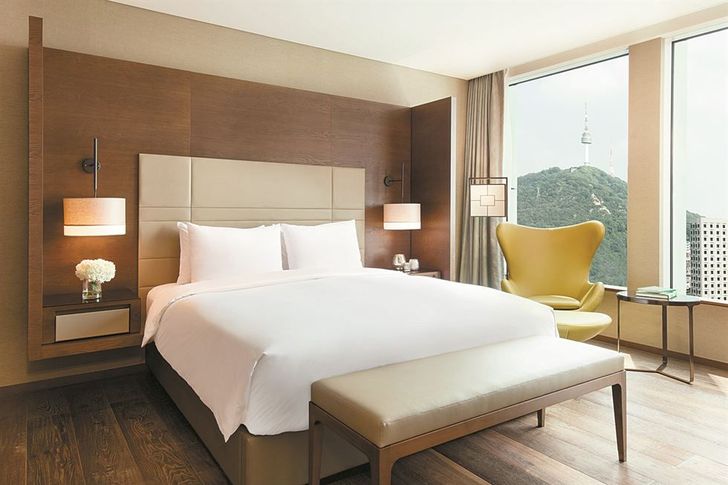
The property offers 409 guest rooms and suites. / Courtesy of Courtyard Marriott Seoul Namdaemun
“To diversify the market that we rely on, we have some special corporate tourism coming in and some meetings, incentives, conferences and exhibitions (MICE) business as well as wholesale to have the right balance. So we are not reliant on one market,” he said.
“To do that, we really need to understand what areas customers are looking for and be a partner with them on what their needs are and why they want to use the hotel. One of the things we say is we want to be the easiest hotel company to do business with in Seoul, so really working toward strong sales and a strong operational team that makes a company easy to do business with for us.”
Johns also boasted about his hotel's unique positioning in the market that can appeal to customers.
“We are in a unique position because we are a kind of a four-and-half-star hotel. I would say our facilities are more than four stars, but not quite five stars. So we can sort of target both five-star businesses, which is good and right for us, and our four-star premium business,” he said.”
“That's why we sort of think of sales as a four-and-half-star facility with five-star service and four-star price.”
Johns, who also worked for the Renaissance Seoul Hotel as the director of food and beverages from 2009 to 2011, said that compared to his first Seoul tenure, the Korean hospitality industry has dramatically changed.
“If you look at what has been introduced, more globalization of Seoul has happened. Therefore, hotels are becoming more global in what they are offering,” he said, adding that staff have become a lot better educated and their skill level is a lot higher.
“In the past, Korea was a little closed market and very local, but now it has definitely expanded and become much more part of the global village.”
While facing the expanding Korean market, Johns looked forward to seeing more opportunities in the future.
“I see how the market place has changed and how it has matured so much, how it has become fresh and vibrant and flourished so well. It continues to do well. So it is a very mature market with a lot of opportunities in Seoul,” he said.