INTERVIEW Wolfgang's popularizes dry-aged steaks in Korea

Wolfgang's Steakhouse Korea CEO Lee Dong-hoon poses at his restaurant in Cheongdam-dong, Seoul, Nov. 19, after an interview with The Korea Times. / Courtesy of Wolfgang's Steakhouse Korea
Steakhouse from New York has eyes on Busan, Jeju, Macau
By Park Jae-hyuk
Wolfgang's Steakhouse Korea, which has been popularizing dry-aged steaks here since the opening of its restaurant in Seoul in March 2015, has begun making efforts to expand here, according to the U.S. steakhouse brand's Korean operator.
In a recent interview with The Korea Times, CEO Lee Dong-hoon said the company is considering opening steakhouses in Busan and on Jeju in the near future.
The licensee of the New York-based restaurant's operations in Korea and Hong Kong is also pushing ahead with opening a steakhouse in Macau.
“We have had plans to open restaurants in Seoul, Busan and Jeju since we brought the brand to Korea. We are trying to figure out when is the best time to open Busan and Jeju stores,” Lee said. “As for the Macau restaurant, we will not rush to open a store there. But we have met operators of international hotel chains as the city has many hotels and resorts.”
Wolfgang's Steakhouse Korea is a joint venture between the U.S. headquarters and the Korean licensee. The two each hold 50 percent stakes in the company.
According to the CEO, the establishment of a restaurant in Hong Kong in June 2017 was part of the Korean licensee's efforts for business expansion.
“We were confident the brand would win the hearts of consumers in other countries, so we began searching for countries that did not have Wolfgang's Steakhouse,” he said. “Then we found out tax rates were low in Singapore and Hong Kong. The U.S. headquarters had already selected a licensee for the Singaporean market, so we convinced the headquarters to select us as a licensee for Hong Kong.”
The company's attempts for business expansion have been possible, because it successfully stabilized the operation of its Cheongdam-dong restaurant by popularizing dry-aged porterhouse steaks made with USDA prime beef.
“In the past, 99 percent of our customers made reservations before visiting our restaurant. These days, more than 20 percent of our customers visit without reservations,” Lee said.
The Cheongdam-dong restaurant had 11 billion won ($9.7 million) in sales in 2017 with a double-digit annual sales growth rate.
“Although the figure is slightly lower than the average sales of Wolfgang's Steakhouses worldwide, it surpasses sales of most restaurants in Korea,” Lee said. “We have also broken Korean customers' bias against beef imported from the United States.”
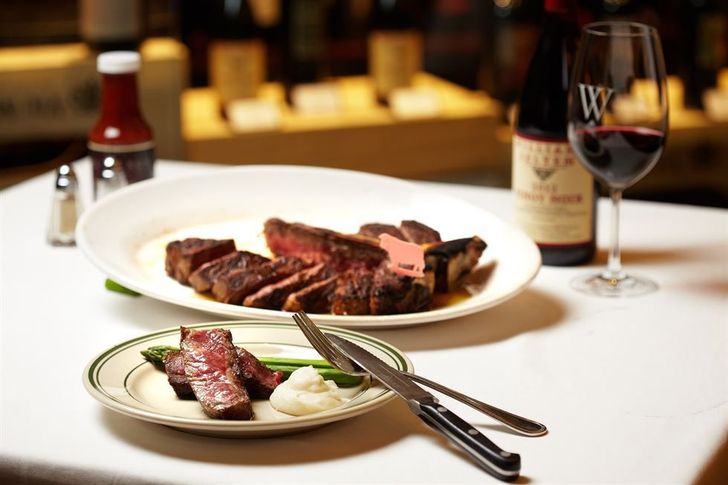
Wolfgang's Steakhouse Korea's dry-aged porterhouse steak / Courtesy of Wolfgang's Steakhouse Korea
Efforts for popularization
The restaurant, however, faced many difficulties during the early stages before Korean customers familiarized themselves with the authentic American-style steakhouse.
“Wolfgang's Steakhouse sticks to its principle of offering service of the same quality at its 19 restaurants across the world, under the motto of classic never goes out of style. President Peter Zwiener, founder Wolfgang Zwiener's second-oldest son, teaches this principle to workers at all of its restaurants,” Lee said. “It was not easy to follow the principle in the past as Korean customers wanted Korean-style services. However, the principle is now our competitive edge.”
According to Lee, Peter Zwiener visits Korea every quarter and stays for a couple of weeks to explain the menu and services in detail.
Lee emphasized the president is always discreet about the localization of restaurants outside the U.S.
“At first, we were not allowed to serve localized foods to our customers,” Lee said. “After researching the Korean market and visiting many fine-dining restaurants with us for about a year, Zwiener suggested coming up with Wolfgang Steakhouse Korea's own signature dish.”
As an example, the CEO introduced “broiled kimchi” made with “mukeunji,” which refers to kimchi that has been aged at least six months.
“Given that we specialize in dry-aged steaks, Zwiener asked us about aged kimchi,” Lee said. “We created the dish after 200 trial runs, and it now ranks third-most popular among our side dishes. It is the first food Zwiener eats when he visits Korea. It is also popular among our male customers in their 40s and 50s.”
Mushroom soup and Cheongdam salad are also among dishes not available at restaurants in other countries. The affordable value meal for lunch, “Taste of New York,” is part of Wolfgang's Steakhouse Korea's efforts for popularization as well.
Lee said the dishes are not the only things that cannot be seen at Wolfgang's other restaurants overseas.
“We have nine private rooms which cannot be seen at Wolfgang's Steakhouses in New York,” he said. “The president was skeptical over the private rooms, but I told him Koreans really like private rooms. Thanks to the private rooms, celebrities, politicians, businesspeople and diplomats can dine at our restaurant comfortably.”
However, Wolfgang's Steakhouse Korea did not remove a 15-seater bar near the entrance to introduce the aperitif culture. The Cheongdam-dong restaurant has a two-story wine cellar with 240 types of wine ranging from affordable to premium.
For successful year-end
The company has been going through the busiest season of the year, because its earnings from November to January account for 20 percent of its annual sales.
For customers who want to dine in private rooms during the peak season, it runs an early booking program.
Those who visit the restaurant at 11 a.m. any day can get a discount. As the restaurant does not close between lunch and dinner, it provides various benefits to customers who visit the restaurant between 3 p.m. and 4 p.m.