'Our blood is Korean, but our flavor is Latin'

Korean-Venezuelan chocolate makers Jon Kim, right, and his younger brother Dan pose for a photograph at P.Chokko Laboratorio in Seoul on Nov. 9. Korea Times photo by Shim Hyun-chul
Korean-Venezuelan brothers craft chocolates in their parents' homeland
By Kwak Yeon-soo
Korean-Venezuelan Jon Kim, 34, and his younger brother Dan grew up in Caracas, Venezuela. After graduating from high school, they went on to Pepperdine University and the University of Southern California, respectively, in the United States. Then both returned to their homeland, Venezuela, to start careers in marketing and accounting, respectively.
However, their home country was no longer the livable, safe one it used to be when their parents emigrated there to do business. Venezuela was in dire straits.
Since the early 2000s, Venezuela has been notorious for its high crime rate and the country has become one of the world's most dangerous places ― the murder toll in the country is even higher than that of some war zones, according to Jon.
“Venezuela wasn't a promising land for those who want to do business because the political climate was stressful and it had public security problems. The crime and kidnapping rates were off the chart,” he said. Jon recalls that it was heartbreaking to see such a beautiful country fall into turmoil.
Although Venezuela is a resource-rich country, it faces a crisis due to government mismanagement and corruption. Hundreds and thousands of Venezuelans are facing instability ― food and medicine are scarce and unemployment is high, which makes it harder for parents to send their children to school and get proper healthcare.
As a result, a massive exodus has been taking place, with people crossing the borders into the neighboring countries of Colombia and Brazil.
“If Venezuelans are going to starve in their own country, it's better to find an actual possibility in another country,” said Dan, who is now 32. “The reason we decided to move out is pretty much the same. We wanted to make the move before the place turned into a shithole.”
As young adults, they felt the need to grow personally and businesswise. Thus the two immigrated to Korea, their parents' homeland, in December 2014. Growing up in a fusion of cultures allowed them to gain a wide range of perspectives and made them natural connoisseurs of distinctive tastes and flavors.
However, after the two brothers moved to Korea, they couldn't distance themselves from their home country, Venezuela. For them, it seemed unpatriotic to leave.
“Our blood is Korean but our flavor is Latin. All you hear about Venezuela nowadays is bad things. We wanted to show people outside, the fact that Venezuela has good stuff too,” Jon said. “Through our market research, we had to bring the top-notch quality to be marketable. We wanted to show the best of the best of Venezuela. We eventually narrowed down our options to chocolate and rum, but saw more depth in chocolate.”
Jon explained that chocolate at this point is all blended and nobody knows where it is from or what type of cacao it is made with. Merchants try to cut the cost of chocolate by using less expensive, lower-quality cacao.
“It's hard to find chocolate stores where they make their own chocolate, so we saw a chance there. There was no competition and we were confident that we could push forward the chocolate culture. Growing up in Venezuela, we've learned that Venezuelan cacao is one of the most popular and premium in the world,” he said.
Compared to other international chocolate companies that look for basic taste in cacao, Jon claimed he and his brother focus on variety, just like specialty coffee and wine.
“The terrain and type of cacao is important but the post-harvesting process is also important,” Jon said. Their commitment to foster a culture of chocolate led them in their adventure to find the highest level of authenticity throughout the process, from cacao beans to chocolate bar.
From bean-to-bar
“Bean-to-bar” refers to the process of making a chocolate bar from cacao beans organically.

Harvesting Courtesy of Jon Kim
When cacao fruit is ripe, farmers harvest using machetes. Then the fruit is cut into two to reveal a dense white pulp, within which lie the coveted cacao beans.
The harvested cacao beans are placed in a fermentation box or fermentation room, where fermentation takes place. The cacao beans left from anywhere between two to 10 days to ferment. The quality of taste depends on the length of the process.

Fermentation Courtesy of Jon Kim
“The fermentation process allows the taste and aroma of the cacao bean to further develop, but there are companies that just wash it off because they think it's a waste of time,” Dan said.
The next step is drying. The cacao beans are usually sun-dried on a drying platform outdoors, where there is constant breeze and sunlight. While drying the cacao bean, it must be protected from rain and humidity. The drying takes between one and three days depending on the intensity of the sunlight and breeze.

Drying Courtesy of Jon Kim
“Many dry cacao beans using gas because it takes less time. But there's the danger of a gas leak, and if that happens, you can definitely taste the smoked gas flavor,” Dan said.
An even fermentation and drying process is important, but if you use a synthetic method, there is the danger the beans will be dried or fermented unevenly.
“The traditional and natural way is the best way. It's important to find farmers or cooperatives who know how to do it properly and have done it over a long period of time,” he said.
Once the drying is over, Jon and Dan import dried cacao beans. “It takes roughly eight months to get here, so time is tight for us to sell,” Jon said. “Dark chocolate can last for two years. But if you have proper storage, you can have vintage chocolate because cacao doesn't have an expiration date.”
After checking for mold, and smokiness, chemical flavors, bitterness and other criteria, the selected cacao beans are then placed in an oven where they are roasted to the roaster's preference. The roaster must be careful not to over-roast and ruin the flavor.

The roasted cacao beans are moved to a winnowing machine.
The beans are then moved to a winnowing machine where they are crushed and filtered so only the cacao nibs remain. “The image people have of chocolate is junk food. But many consider cacao nibs to be a super food. This shows that if you make the chocolate properly, it's good for you,” Dan said.
The cacao nibs are then placed in a conching machine, where they are finely ground into chocolate powder. Usually, conching takes around one to three days ― the longer the conching time, the smaller and smoother the particle size.
The chocolate powder is then tempered.

Tempering
Tempering is the process of heating and cooling the chocolate over a specific range so that it melts and becomes easier to mold, and also acquires a nice shiny texture.
Molding is the final stage where chocolate can be shaped to make a bar. Molding requires a mold in which the chocolate can be poured and cooled until it hardens into its desired shape.
“Each step has art and science to accentuate the taste profile for that chocolate. Even if the cacaos have similar origins, depending on how you process them, you taste a different profile. Thus, the maker matters,” Jon explained.
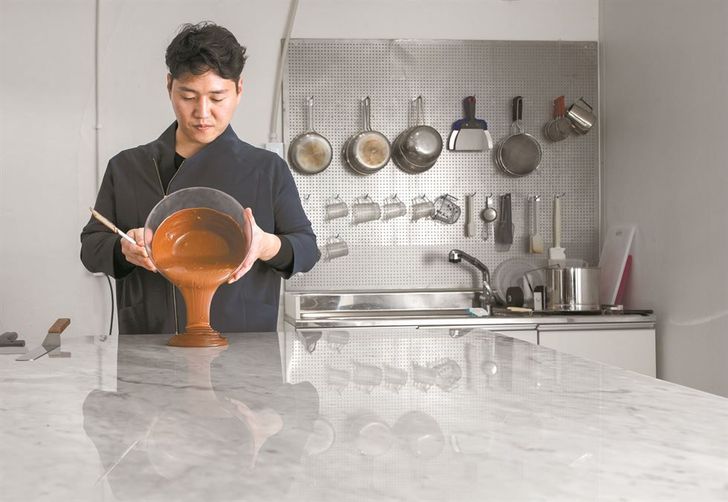
Dan Kim pours lukewarm liquid chocolate onto a marble slab to make chocolate bars. Korea Times photos by Shim Hyun-chul
Cacao hunters, chocolate makers
Jon and Dan refer to their store P.Chokko as laboratorio, a Spanish word for laboratory. “We, the cacao hunters and chocolate makers, discover and experiment with different ingredients in our laboratory. For instance, we blend flavors such as earl grey tea, coffee and spices to diversify the chocolate possibilities,” Jon said.
The difference between a chocolatier and a chocolate maker, he explained, is that while the chocolatier turns basic chocolate into bon-bons or chocolate cakes, the chocolate maker studies the varieties and quality of cacao. They consider quality and production excellence as top priorities.
The brothers expressed their wish to explore new regions and diversify channels for importing cacao beans. “It's risky for us to only concentrate on Venezuela. We've tried Ecuadorian cacao, the largest producer of fine flavor cacao in the world. Ecuadorians do good processing,” Dan said.
Jon and Dan shared their story of visiting the village of Chuao, famous for its cacao plantations, in 2015 in search of the best cacao. Although they couldn't import cacao from Chuao due to price issues and the villagers' policy of selling their cacao to a single provider, the experience encouraged them to bring in better cacao.
“We really want to open the eyes of customers so they not only look for chocolate but also yearn for something unique and of high quality. Seriously, you deserve better chocolate,” Jon said.
For more information, visit pchokko.com or call (02) 512-0565.