INTERVIEW Korea's food exports riding high on hallyu

Minister of Agriculture, Food and Rural Affairs Lee Gae-ho / Courtesy of Ministry of Agriculture, Food and Rural Affairs
Agriculture minister pledges support for exporters to overcome protectionism
By Nam Hyun-woo
Korea’s farm products and processed foods are becoming more popular as the world becomes aware of Korean culture. But at the same time, protectionism rising across the world is casting setbacks in exporting food.
Minister of Agriculture, Food and Rural Affairs Lee Gae-ho said now is the time the government to play a role — spurring Korean food’s popularity further in overseas markets and helping exporters overcome protectionist barriers.
“In Thailand, presenting Korean strawberries is a new trend for celebrating Valentine’s Day, while Malaysians and Indonesians are enjoying YouTube clips of cooking and eating Korean spicy noodles,” Lee said during an interview with The Korea Times.
“On the other hand, the global food trade environment is showing increased non-tax barriers, such as enhanced food sanitation and safety regulations, which are difficult for individual companies to cope with,” he said. “The government will help them overcome such difficulties by providing an export infrastructure.”
According to the ministry, the country’s fresh agricultural goods and processed food exports in the first half of this year amounted to $3.55 billion, up 7.9 percent from a year ago.
This was the largest figure for a six-month period in Korea’s history, and the growth rate outperformed the 6.6 percent for entire outbound shipments during the same timeframe.
Of notice was the sharp growth in fresh agricultural goods, which grew 27.5 percent from a year earlier. This was led by explosive surges in pears which increased 144 percent, grapes with 112 percent, and strawberries, 66 percent.
Such growth was attributable to Vietnam and other Southeast Asian nations, many of whose people pay attention to what their favorite K-pop idol wears, drinks and eats.
Agri-food exports to ASEAN stood at $667 million in the first half of the year, up 11.2 percent from a year earlier. Of them fresh agricultural goods, including fruits, jumped 48.7 percent.
The ministry quickly seized on the opportunity to get top stars to promote Korean foods in TV and other media. Park Hang-seo, a Korean football coach, “almost worshipped” by the football-crazed Vietnamese, is now advertising Korean foods there after successful outings of the Vietnamese U-23 men’s football team in a number of regional sporting events.
“This year, we can say Korean food exports are diversifying from their existing core markets of Japan, China and the U.S. to emerging markets such as ASEAN, India and Central and South America,” Lee said.
“To diversify markets further, the government is now researching emerging markets to explore new demand as well as cooperating with local distributors.”
One of Lee’s plans to expand food exports is nurturing organizations in charge of exporting each item. The ministry has already set up an export organization for mushroom and peppers and plans to establish respective organizations for strawberries, pears and tomatos.
“By unifying the exporting window, excessive competition between exporters can be prevented and the government can have tighter control on the quality and safety of food products,” Lee said.
Along with making export organizations, Lee said the ministry is putting its full effort into helping domestic exporters to overcome trade hurdles.
Of those, one of the most imminent is the U.S. Food Safety Modernization Act (FSMA). The act, dubbed the largest food system change in the U.S. since 1930, is aimed at changing U.S. food regulations from managing consequences to prevention. It gives the Food and Drug Administration new preventive tools regulating the way foods are grown, harvested and processed, and further authority on recalls.
One provision for very small businesses, which the majority of Korean food exporters are subject to, took effect in September, providing fresh requirements to domestic food exporters.
“The ministry has come up with detailed instructions for exporters which are facing the U.S. Food Safety Modernization Act,” Lee said. “We will continue to help companies, especially those exporting pears, kimchi and pastes, to cope with the new rules successfully.”
Also, he said the ministry is now educating food-exporting companies about the rules of target countries’ customs inspections and reject cases, by compiling a database that exporters can access.
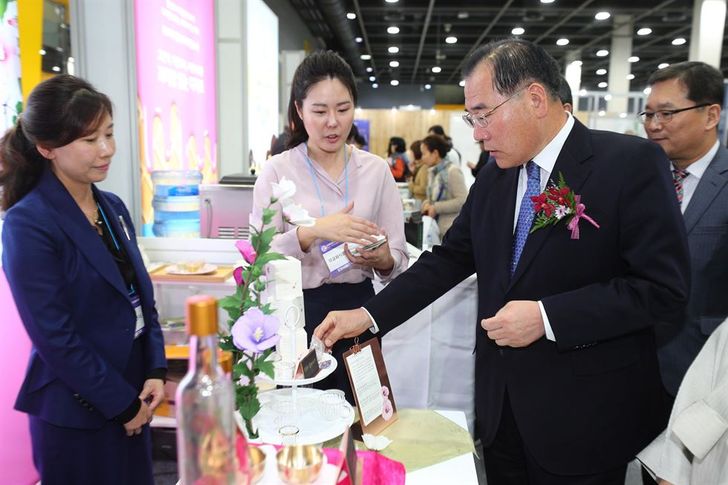
Minister of Agriculture, Food and Rural Affairs Lee Gae-ho checks a teabag at the 2018 Korea Food Show in Yangjae-dong, Seoul, Oct. 24. / Courtesy of Ministry of Agriculture, Food and Rural Affairs
Controlling rice price
While new opportunities and challenges appear outside of Korea, Lee is handling a series of thorny domestic issues, including the target price for rice.
The government has been setting rice price targets and paying subsidies to farmers if the actual price falls below this — the government will pay 831.5 billion won in rice subsidies this year, accounting for the majority of 1.05 trillion won in subsidies for all farmers. This is to stabilize farmers’ income amid the country’s declining rice consumption.
Regarding the current target price of 188,000 won per 80 kilograms, however, consumers and farmers are squaring off, with the former complaining rice prices have become too expensive recently while the latter saying a further hike is required for their survival.
“The rice price is very important because it is Korea’s staple food and affects the general consumer price,” Lee said. “Thus, it is about finding a balanced price, which provides a stable income to farmers and at the same time does not burden consumers.”
Since he became the minister, Lee has been stressing that 194,000 won will be the balancing point but faced opposition from lawmakers who are siding with farmers and calling for the price to be over 200,000 won at least.
“Consumers may feel rice became expensive recently, but I believe they will understand that rice’s influence on overall consumer prices is going down and the current price is not as high as it used to be in 2004 at 168,000 won and 183,000 won in 2013,” Lee said.
“At the same time, an excessive price target hike will incur oversupply and pressure on the state budget. So we had to consider overall conditions surrounding the rice price and concluded the balanced price was 194,000 won.”
The ministry requested the National Assembly to agree on 188,192 won, and Lee said he will make efforts to raise the target price to 194,000 won.