Express train Saemaeul-ho fading into history

A southbound Saemaeul-ho train on the Janghang Line going between Yongsan and Iksan, meets a northbound train at the platform of Cheonan Station, South Chungcheong Province, Tuesday. The train, once touted as a “moving hotel on rails” for its luxury cars and high speed, has fallen after the emergence of the KTX train in 2004. Those last remaining second-generation Saemaeul-ho trains will be retired at the end of this month. / Korea Times photo by Choi Won-suk
Train service to end after half-a-century operation
By Park Jin-hai
CHEONAN ― Cheonan Station is like a place where time has stopped running.
The old station where both the slow-moving Saemaeul-ho train and the cheapest and slowest Mugunghwa-ho train stop, has remaining tracks built as long ago as the 1920s and 1930s.
In one corner of the station, vendors sell local foods, while a group of older people sit in front of a TV watching the news on the upcoming inter-Korea summit and waiting for their trains to arrive.
Some read the information on the bulletin board that tells the history of the station, while an aged man in a fedora tries to slip coins into a payphone, which have almost disappeared from urban cities.
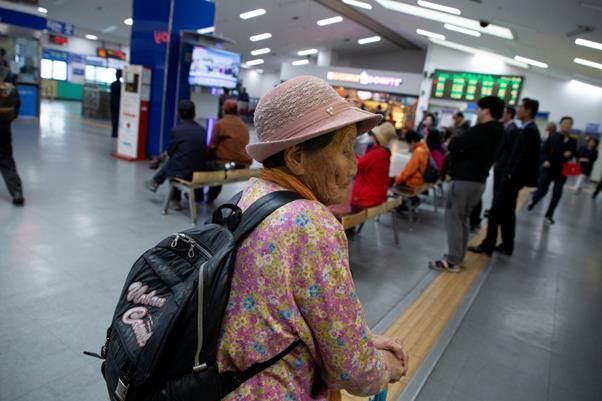
The majority of Saemaeul-ho passengers are old. Grey-haired passengers, some holding canes, sit in front of a TV showing news about the upcoming inter-Korean summit, waiting for the train's arrival, at Cheonan Station, in South Chungcheong Province, Tuesday. / Korea Times photo by Choi Won-suk
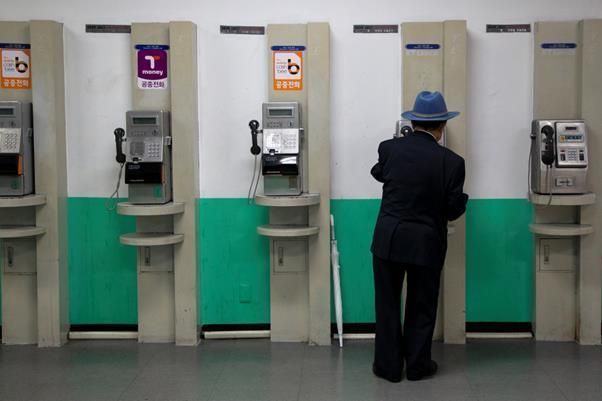
An old man wearing a blue fedora tries to put coins in the slot for a public telephone at Cheonan Station, South Chungcheong Province, Tuesday. Payphones have almost disappeared in urban areas due to the widespread use of smartphones. / Korea Times photo by Choi Won-suk
Now the last remaining second-generation Saemaeul-ho trains, which run on the 142-kilometer-long Janghang Line connecting Seoul's Yongsan Station through Cheonan of South Chungcheong Province to Iksan of North Jeolla Province, will stop operating at the end of April.
The last Saemaeul-ho train will arrive at Yongsan at 11:11 p.m. on April 30.
The Saemaeul-ho, whose prototype first-generation Gwangwang-ho began its express service in 1969, has been operating for a half century, building various memories for passengers of all walks of life.
Beginning with the Gwangwang-ho running at a maximum speed of 78 km/h, the Saemaeul-ho, which was named after a 1970s rural development project spearheaded by the Park Chung-hee government, has been upgraded over time. Its second generation, introduced in 1987, has a maximum speed of 150 km/h.
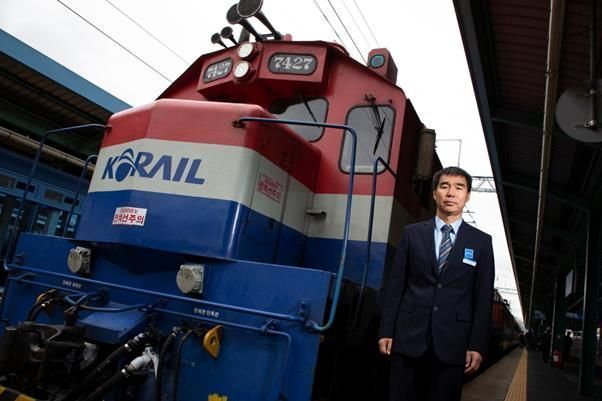
“Samaeul-ho with the dining car was the top-class luxury express train that only wealthy, upper-class passengers were able to ride back then,” says Jeong Yeong-chan, 52, station submaster of Cheonan Station in South Chungcheong Province, Tuesday. / Korea Times photo by Choi Won-suk
Upon hearing about the retirement of the express train, once nicknamed the “moving hotel above the rails” for its luxury, after 31 years of service, many people wanting to catch up with the last moments of the train hopped on board. All tickets for the last train's last journey sold out last month.
“Saemaeul-ho with the dining car was a top-class luxury express train that only wealthy, upper-class passengers were able to ride then,” Jeong Yeong-chan, 52, station submaster of Cheonan Station in South Chungcheong Province, said on Tuesday.
“Seeing the once state-of-the-art train age, ready for retirement and about to fade into history, I feel sweet bitterness.
“The train has a lot of wear and tear and being slow is no virtue in this era. It is not a take-or-leave issue since it is ending its durable life, but like many other people my age, I have mixed feelings about the train on which I have many good memories.”
The train cut Seoul-Busan travel time substantially to 4 hours and 10 minutes from the previous 6 hours. Yet after the 2004 emergence of high-speed KTX train with a maximum 300 km/h, which cut the travel time to 2 hours and 40 minutes, the Saemaeul lost its crown as the top-ranked train.
The first-generation trains all stopped operating by December 2007. The diesel locomotive second-generation trains have started to be phased out since 2012.
The Janghang Line, which has no infrastructure to operate electric railway cars, has kept diesel-powered trains running. After the Saemaeul train retires, the faster third-generation Saemaeul, ITX-Saemaeul, will take its place. Unlike other electric ITX-Saemaeul lines, the Janghang Line's trains will be pulled by diesel-powered cargo locomotives.
Mixed with regular commuters and families and friends who wanted to ride on the train before it goes, the Janghang Line Saemaeul-ho train bound for Iksan was fully booked and had some standing passengers, Tuesday.

“Watching the scenery from a train that will soon stop operating reminds me of the life path that blooms and withers,” says Yoo Jang-duk, 78, a retired professor traveling with his old tennis club buddies of 18 years. / Korea Time photo by Choi Won-suk
Yoo Jang-duk, 78, a retired professor traveling with his old tennis club buddies of 18 years, says people on average payrolls couldn't dream of riding it when it first started its service. “Wealthier friends bragged of their Saemaeul-ho travel then. The most pleasant thing was the comfortable and wide chairs with sanitized paper attached where you rest your neck. I'd never seen that before,” he said.
Watching a train that will soon stop operating, leaving behind its past glory, Yoo says it reminds him of life that blooms and withers. “Seeing it as new as a soft newborn baby, then seeing it enter the old years and left on the backburner and now ready to leave, the train reminds me of the life path that each and every person goes through,” he said.
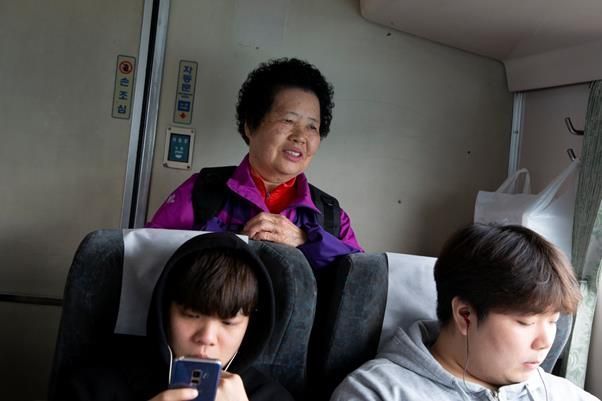
“My sons urge me to ride on the faster express buses, but I stick to the train when I visit relatives and family in my rural hometown,” says Kim Dong-sook, 74, from Bucheon, on her way to visit relatives in Yesan. She says instead of accident-prone buses she feels safer and more comfortable riding trains. “As old as I am with no income, cheaper transportation is best. Watching slowly passing rice patches that change color each season through the window is another big plus. It gives me great peace of mind,” says Kim, holding a standing ticket priced 2,900 won ($2.70), Tuesday./ Korea times photo by Choi Won-suk
Kim Dong-sook, 74, from Bucheon, on her way to visit relatives in Yesan, says she use the Saemaeul-ho mainly for economic reasons. Hearing it will stop operating and a better-equipped train will take its place, Kim, holding a standing ticket priced 2,900 won ($2.70), worries the new train may push up ticket prices. “As old as I am with no income, cheaper transportation is the best. Watching slowly passing rice paddies that change color each season through the window is another big plus. It gives me great peace of mind,” she said.
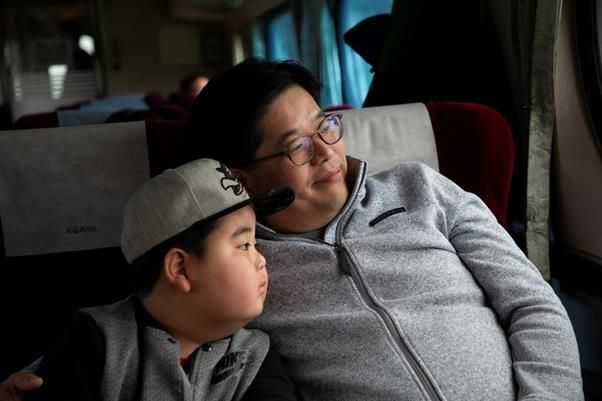
Kang Sung-joon, 45, takes a day off to ride on the train with his nine-year-old son and wife. “My son loves trains and wants to know everything about trains. After we heard the news that this train will stop operating, my family and I decided to find some time with the train,” the father says on his way to Janghang to visit an ecological park. “I'm sad, because it will be my first and the last Samaeul-ho trip,” his son says. / Korea Times photo by Choi Won-suk
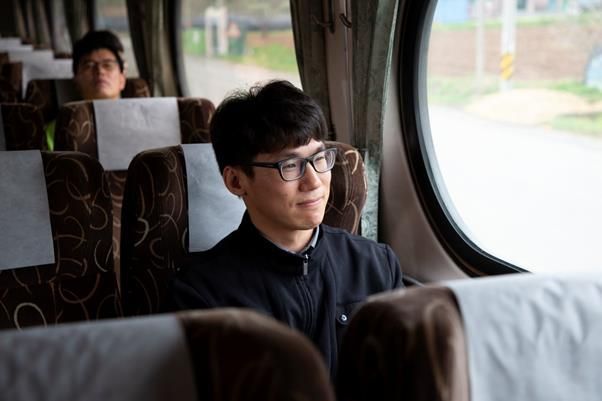
“The train is good for reading and gives more room for thinking,” says Oh Dong-jin, a 32-year-old graduate student, on his way to meet friends. “Compared to the whizzing KTX, the slow-moving Saemaeul-ho gives you better and more detailed views of what you are passing. Seeing old houses built in the 1970s and the 1980s out of the window, I wonder who lives in such places and my train of thoughts goes on and on. The slow train gives me more room for my thoughts and more leeway too.” / Korea Times photo by Choi Won-suk
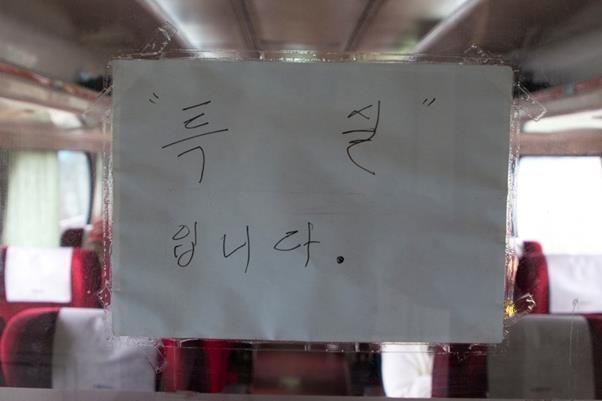
A sheet of paper notifies customers one train car is for VIP-seat passengers only on the Saemaeul-ho train bound for Iksan, Tuesday. / Korea Times photo by Choi Won-suk