Tiny island undergoes beautification project

The Gapado Fishery Center, which includes a restaurant, a store and a haenyeo seafood grill, is part of the Gapado Project that promotes the sustainable development of Gapa Island, 2.2 kilometers south of Jeju Island. / Courtesy of Hyundai Card
Gapado Project pursues sustainability through art
By Kwon Mee-yoo
GAPA ISLAND -- Upon arriving at Gapa Island, about 2 kilometers south of Jeju Island, visitors are greeted by a low-built terminal that resembles the tiny and flat island, whose highest point is 20.5 meters above sea level.
About 180 residents live on this island, mostly involved in the fishing industry. While Mara Island, seven kilometers south of Gapa Island, enjoys popularity for being the southernmost point of South Korea, Gapa Island has remained rather quiet, its residents merely making a living off the sea.
In recent years, Gapa Island established a small distinction for its forage barley fields, hosting the annual Gapado Green Barley Festival to attract more tourists. However, visitors who come here usually spend one or two hours exploring the island and then leave, since the island does not have much to offer.
Jeju Self-Governing Province and Hyundai Card joined hands for the Gapado Project, breathing new life into the tiny island though art and design in a sustainable way.
"I visited Gapa Island a few years ago when my wife told me there is a really beautiful island south of Jeju. Being beautiful is great, but many beautiful islands fell into a vicious circle, rapidly developed as tourist attractions then abandoned," Hyundai Card CEO Ted Chung said at an opening ceremony of the project on April 12. "So we tried to put Gapa Island residents at the center of this project. This project is not just for Gapa Island, but this model could be an answer for other development projects."
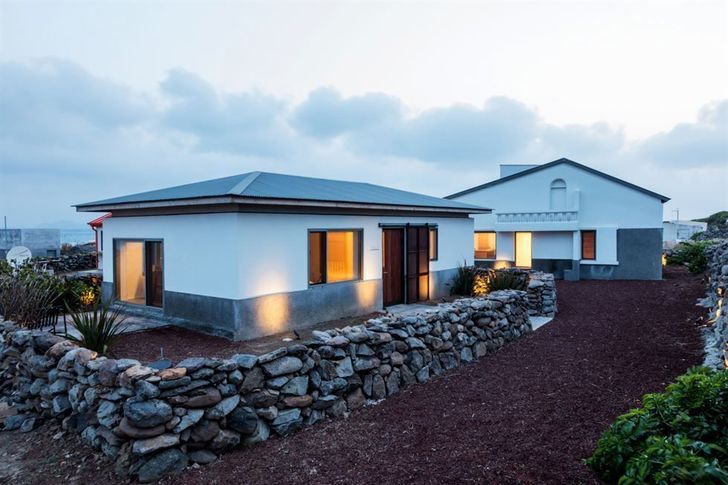
Gapado House, made of remodeled abandoned houses on the island, offers accommodation for tourists. / Courtesy of Hyundai Card
The Gapado Project consists of three major principles _ economy, ecosystem and culture _ to sustainably develop the island. Newly constructed buildings will be a source of income for residents, and artists will produce artworks inspired by the island. The project also aims to restore the island's vegetation by removing concrete paving.
Architect Choi Wook of ONE O ONE architects, who participated in the 2006 Venice Architecture Biennale, took charge of the architectural design.
"I've been working on this project for seven years. Once, the leader of the haenyeo association asked me whether I know that spring, summer, fall and winter exist under the sea," Choi said. "I realized understanding the life of the islanders and harmonizing the scenery in and out of the sea is the key in designing buildings for this island."
The island once had over 1,100 residents in the 1980s, and the population decrease has left many uninhabited houses behind.
So the architect tried to remodel vacant buildings in a way that fits the landscape. "Constructing a new, high building would completely destroy the island's scenery," Choi said.
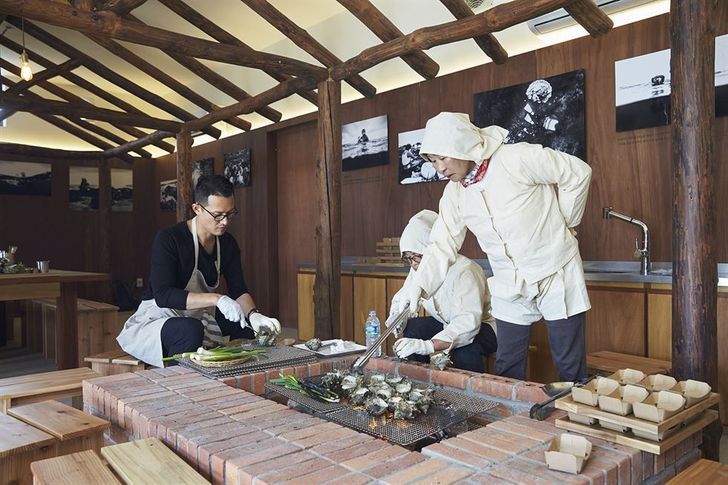
Haenyeo, or female divers, offer grilled seafood at the Gapado Fishery Center. / Korea Times
Gapado Snack Bar and Archive Room is an example of the revamp. Located right by the sea, the small bar provides a breathtaking sea view with a menu offering local delicacies such as murex and abalone.
Choi also designed six pension houses by redesigning existing buildings. Titled Gapado House, the six unique accommodations aim to encourage visitors to stay overnight on the island, spending more time exploring what it has to offer. These individual pension houses are equipped with large windows instead of televisions to embrace the landscape.
The island also has a large population of haenyeo, or female divers. At the Gapado Fishery Center, visitors can taste seafood freshly caught and grilled by the haenyeo who were inscribed on UNESCO's Intangible Cultural Heritage list in 2016.
The architect made the buildings in a humble way with accessible materials. "These buildings will stay here and the residents should be able to repair them easily with what they have available," the architect said.
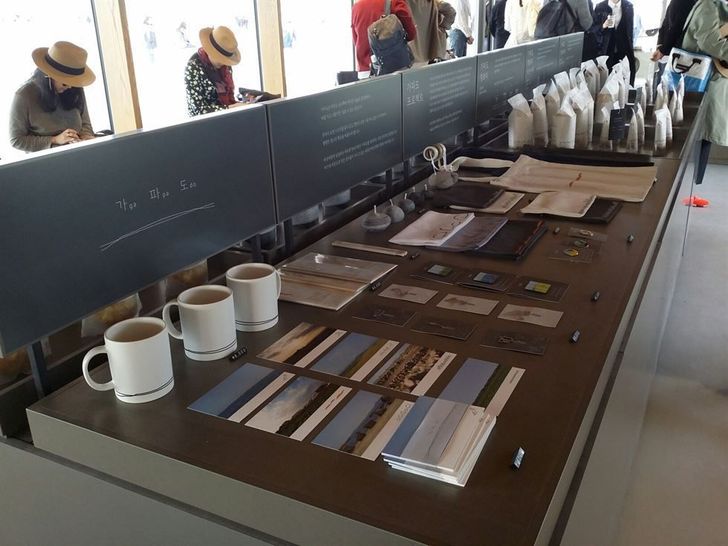
A range of Gapa Island souvenirs are available at the Gapado Terminal. / Korea Times
Artist in Residence
While the Gapado Project promotes cultural and artistic value for sustainable development of the island, there are no large-scale sculptures or public artworks installed on the island.
Instead, a highlight of the Gapado Project would be the Artist in Residence (AiR) building. The three-story-tall structure was an abandoned condominium construction site that was canceled in the late 1990s when Korea was hit by a financial crisis.
"Gapa Island looks whale-backed when seen from the outside. Now it looks like a submarine with a periscope raised, with the appearance of the AiR, the highest structure on the island," architect Choi said.
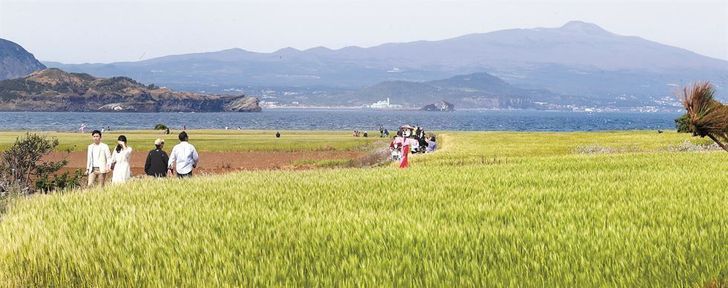
Gapa Island, known for its barley fields, holds the annual Gapado Barley Festival from April to May. / Yonhap
The AiR provides a creative space for domestic and international artists to immerse themselves in the beautiful and tranquil environment of the island and gain new inspiration.
Currently, Korean artists Chung So-young and Yangachi and international artists COMPANY, Eliana Otta Vildoso and Jane and Louise Wilson are staying on the island.
The AiR has a gallery space, studios and lodgings for each artist. The exhibition space now introduces the AiR program and will later feature works by the resident artists.
Liu Jienne, curator of the Museum of Modern and Contemporary Art, Korea, and member of the advisory committee which selects the artists in residency, said, "In the long view, the artists will promote this island to the world through their artworks. This is different from just putting huge amounts of money into a publicity budget, but making the dream of Gapado Project come true."
Martino Stierli, chief curator of architecture and design at the Museum of Modern Art (MoMA) in New York, said the Gapado Project suggests a local way of living through architecture and transports the idea into a modern language.
"We have been thinking about the growth of cities, but this project is about how to deal with a landscape that is not the center of urban regions," Stierli said.