Eat, drink, be merry in Boracay

The view from Crystal Cove, one of the main stops on Boracay / Courtesy of Tourism Promotion Board Philippines
By Choi Ha-young
BORACAY, Philippines ― Sunshine, beaches and scuba diving with a variety of tropical fish that look like “Nemo” are never enough to describe a trip to Boracay, a beautiful tropical island in the Philippines.
Once you arrive on Boracay, you should take off your shoes to feel the soft sand of the island’s iconic White Beach, complete with palm trees that go perfectly with the glorious sunset that welcomes tourists.
Boracay is full of diverse leisure. You can enjoy snorkeling for a glimpse below the sparkling sea. Or, to explore the deeper water with colorful coral, starfish and sea creatures, take a 30-minute scuba-diving course.
Don’t worry if you aren’t a good swimmer. Once you learn the basic breathing skills and safety measures, you can discover the creatures that hide behind the sea anemones and feed them.
After all the activity, you can revive your aching muscles with a relaxing massage. Skilled therapists use warm lava stones and coconut oil.
The two massage parlors ― Lim Spa and Lava Stone Shop ― are air conditioned, with shower booths for those who have just come from the sea.
.jpg?w=728)
Sailing at sunset
.jpg?w=728)
Visitors enjoy dinner at a restaurant.
The beach becomes more dynamic as time goes by. For example, at around sunset, you can sail out on a peaceful yacht to enjoy the view from the sea.
Visitors can also explore the island by buggy car, or visit other islands ― the Philippines has more than 7,000 ― by boat.
.jpg)
Buggy car
Restaurants along the coast provide diverse types of food, from Chinese and Japanese to hamburgers ― enough to satisfy a variety of tastes.Some leisure boats are equipped with over-the-water meshes, where you can sit and get a tan as you relax above the emerald green water.
I recommend milk fish, also known as bangus, and also bulalo, a beef soup that tastes like the Korean dish galbitang, or short rib soup.
Of course, tropical fruits such as mango, coconut and banana are a must.
As the sun sets, try a bottle of the local San Miguel beer as you gaze out at the beach.
Once night falls and the lights come on, there’s plenty more to enjoy. Most of the bars have outside seating, where you can enjoy the spectacular night sky through clear and clean air.
If you are lucky enough to catch a full moon, you will be able to stroll in the moonlight. If you get caught in a tropical shower, it will merely make your trip more memorable.
Now, let’s head for the bustling, colorful, historical capital city of Manila.
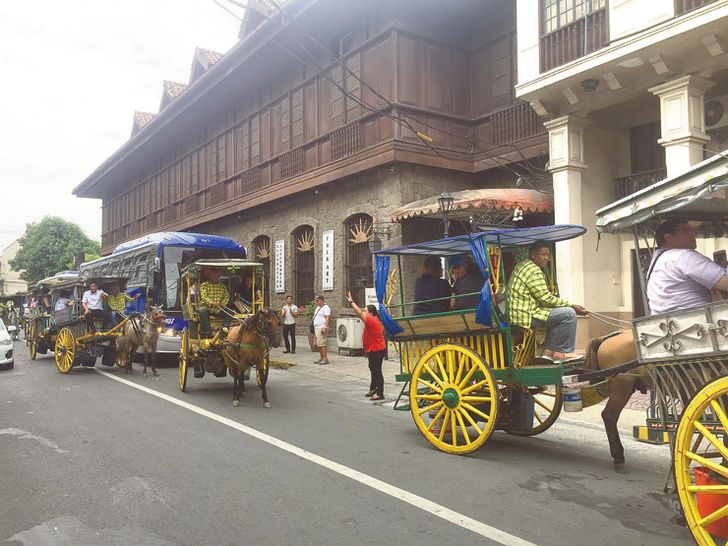
Calesa tour to look around the traditional district, Intramuros in Manila
Manila: a multilayered history
Riding in a carriage, called a “Calesa tour” here, you can learn the multilayered culture of the city’s Intramuros district, which reflects the nation’s colonization under Spain, the United States and Japan.
Spain ruled the Philippines for 300 years, spreading Catholicism across the nation.
Evidence of the ordeals the city has faced is seen in Manila Cathedral, officially established in 1571. It survived the 1945 Battle of Manila, which involved the worst urban combat in the Pacific theater of World War II. U.S. bombings and Imperial Japanese Army massacres killed over 100,000 civilians.
The multilayered cultural influence is also seen in the “pineapple” ornaments in this historic cathedral.
“The Chinese believed the fruit attracted good luck,” explained city tour guide Alvin Bolo.
Rizal Park, where there is a monument to anti-Spanish national hero Jose Rizal, shows the fierocity of the struggles against Spanish rule. The Spanish military executed the nationalist activist in 1896. Even today, anti-Spanish sentiment lingers.
Filipinos have relatively positive memories of American rule (1898-1946), under which there was education for the people, which explains why they now speak English rather than Spanish.
Outside the city’s traditional district, visitors can find a very developed, modern area of skyscrapers and shopping malls.
Spend some time at Mall of Asia, and stop by the Kultura souvenir shop inside. There you can buy aromatic oils, dried mango, banana chips, natural cosmetics and unique accessories, all of good quality.
The tour program was part of the Philippines Embassy’s annual program in coordination with the Department of Tourism to provide an understanding of the nation’s world-famous tourist attractions and cultural assets. So far, the program has taken in Bohol, Cebu and Palawan.
“The Philippine Embassy, in coordination with the Department of Tourism, has been organizing annual familiarization tours for foreign diplomats based in Seoul and Korean businesspeople, in order to showcase and promote the beauty of the Philippines,” Philippines Ambassador to Korea Raul Hernandez told The Korea Times.
“Through these annual visits, we hope our delegates gain an understanding of the Filipino people and experience our great tropical weather, world-famous beaches and amazing sights,” he said.