INTERVIEW Korea pursues two-track strategy in tourism
KTO chief vows strategic expansion in Southeast Asia
By Kim Jae-kyoung
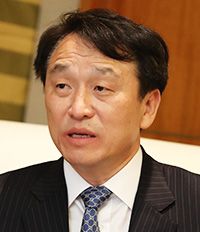
Jung Chang-soo
SINGAPORE ― The Korea Tourism Organization (KTO) will beef up its two-pronged growth strategy by developing Southeast Asia as a key market, while seeking to sustain growth in China, according to CEO Jung Chang-soo.
His approach is seen as a strategy aimed at diversifying incoming tourist markets following China’s retaliation against the deployment of an advanced U.S. missile defense system, and ensuring sustainable growth of the nation’s tourism industry.
“We have to develop new markets not to reduce dependence on China but to ensure sustainable growth of Korean’s tourism industry and emerge as a global tourism power,” Jung said in an interview.
“Southeast Asia is a market with great potential for Korea because of its geological proximity and Southeast Asian people’s strong interest in Korean culture and food.”
In order to strengthen its regional networks and promotional capabilities, the KTO signed a contract with eight international travel agencies in Singapore, Saturday, to launch the Korea Tourism Alliance.
He said that under the alliance initiated by its Singapore office, the KTO will act as a bridge between partners from tourism markets in Southeast Asia and attract more high-end tourists from the region.
“This is the first time that we’ve signed a formal alliance with travel agencies abroad. It is our initiative to diversity target markets and move toward quality tourism,” he said.
“Since Singapore is a gateway to Southeast Asia and a tourism hub, I believe that this move will provide a great opportunity to promote Korea as a destination of choice for leisure and business travelers in this rapidly growing market.”
Singapore’s population is just 5.6 million but the city state is considered the most high-end market of Southeast Asia.
For the first three months of this year, travelers from Singapore jumped 16.3 percent year-on-year, while those from six other Southeast Asian countries grew 14.1 percent.
He said although Chinese tourists have been falling sharply in the wake of China’s tourism curbs in response to the deployment of a U.S. Terminal High Altitude Area Defense battery here, it is important to prepare for a rebound in Chinese tourists.
“The size of our tourism industry has been growing on a massive inflow of Chinese tourists. A sharp drop in travelers from China could hollow out the industry for a while,” he said.
“Accordingly, if we fail to manage to fill the gap, chances are we will lose out when Chinese tourists return. A high dependence on China does not necessarily mean we should not seek to expand the market.”
Europe’s interest in PyeongChang
The former chief of the Incheon International Airport Corp. said the PyeongChang 2018 Winter Olympics will boost its move to improve the national brand value and diversify markets.
Jung, who led a Korean delegation to host promotional events in the European cities of Vienna, Helsinki, Frankfurt and London from April 24 to April 27 before visiting Singapore, is upbeat over the success of the Winter Olympic Games.
“We gave a detailed briefing to Authorized Ticket Resellers (ATRs), Olympic Committee members, tourism companies and media about the Olympics preparations and Korea’s tourist attractions,” he said.
“What is most encouraging is that many of them who had no desire to attend the Olympics showed a strong willingness to visit Korea after the briefing. I believe many Europeans will visit Korea during the Olympics, which will help the country not only diversify markets but also enhance quality tourism.”
Jung proposed the creation of a triangle tourism belt connecting South Korea, Japan and China to make Northeast Asia an international tourist destination.
He said now is the right moment because there will be three Olympic games in the region, starting 2018, every two years _ the 2018 Winter Olympics in PyeongChang, the 2020 Summer Olympics in Tokyo and the 2022 Winter Olympics in Beijing.
“Tourism should be a belt, not a point. I strongly believe that if the three nations cooperate in tourism it will create synergy and attract more tourists from Europe and the Americas to Northeast Asia,” he said.
Jung stressed that along with efforts to attract more tourists from abroad, the government should boost the domestic industry by improving infrastructure and offering a variety of incentives for travelers.
“Foreigners will never go to a place where locals do not go. In this regard, it is crucial to develop new tourist attractions and encourage Koreans to travel more to attract more foreign tourists,” he said.