Where does the hate come from?

A solitary cell at the Seodaemun Prison History Hall in Seoul / Korea Times photos by Jung Min-ho
Prison museum traces Koreans who suffered under Japanese rule
By Jung Min-ho
The issue of sex slaves has long been a source of animosity between Korea and Japan, but it is certainly not the only one.
For 35 years of Japanese occupation (1910-45), many Koreans were senselessly tortured and killed. Seodaemun Prison History Hall in western Seoul provides a vivid image of this painful past.
There, visitors can see horrendous torture devices that Korean independence fighters had to endure ― in many cases ― to the death. For those who survived, this is a living memory they can never forget.
With their photos, video testimonies and background information of how they ended up in the infamous prison, their stories are very personal.
For those who want to understand more about the animosity between the two nations from the victim’s perspective, this is the place to go.
The Japanese government built the prison in 1908 as part of a larger system to hold Korean independence activists from across the country. Started with a capacity of 500 people, the place was expanded to hold more than 3,000 by the end of 1919 as an increasing number of people joined independence movements.
This information can be found on the first and second floors of the Exhibition Hall, in which visitors can explore the prison’s overall history from its birth to 1987, listing some of the important events and key figures during the critical times.
Yu Gwan-sun, a female independence activist and key organizer of the March 1 Movement for the nation’s independence, is one of the best-known prisoners who died there. Due to complications from torture and beatings, she perished at the age of 17.
At the Memorial Hall, visitors can see portraits of thousands of people who lost their lives during their struggle for independence.
After passing through the hall, visitors can reach the basement floor, where Japanese police officers interrogated, tortured and killed such activists.
The museum says newcomers were sent to a temporary detention room immediately so they could hear the screams of anguish from the nearby interrogation rooms. It was part of a psychological game played by the Japanese officers to readily get the information they wanted.
.jpg?w=728)
An interrogation room equipped with torture devices
Visitors can see instruments of torture and learn how they were used on the prisoners. One of them is called a “narrow room,” in which a person was put in between narrow walls so they could neither sit down nor stand up properly. Another is a tiny “thorny box,” in which a person was placed surrounded by inward-facing needles and the box with the prisoner inside was shaken.
It is uncomfortable and distressing to see the suffering of those who were there only for the love for their country. It feels as if the whole place all but shouts for their pain to be heard.
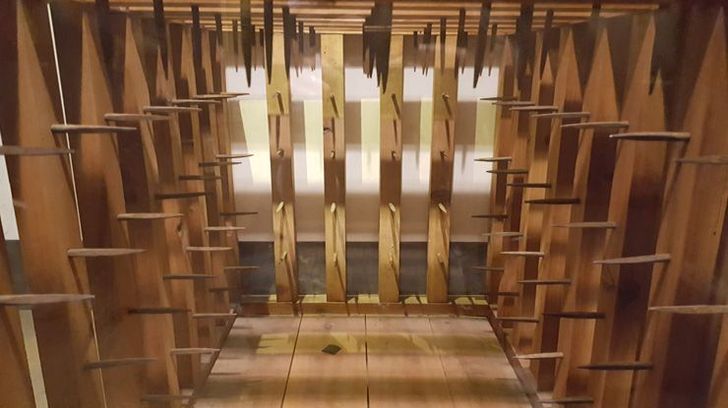
A box designed for inflicting pain
For the younger generations, their stories are also a warning of the dangers of blind nationalism, which could resurface in the future.
Visitors can also watch the video testimonies of survivors ― both men and women. They say how the gruesome experience in the prison changed their lives.
At the Central Prison Building, visitors can learn the system of the prison, including how the guards monitored and controlled all the facilities as well as how the prisoners ate, worked and slept there.
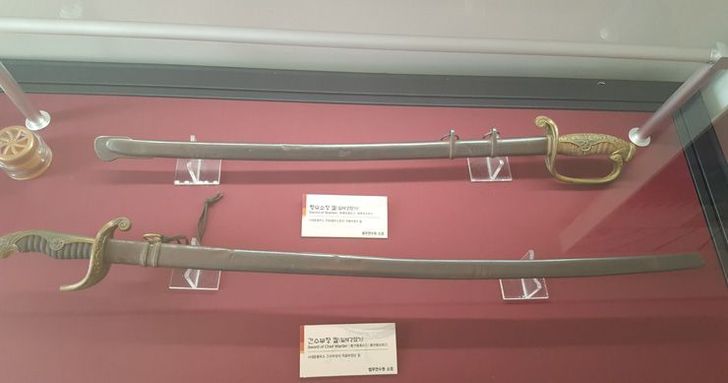
Swords used by Japanese warders
The Engineering Work Building was the place to exploit the prisoners, who had to work day and night to produce various goods, including military supplies for the Japanese soldiers.
The Women’s Prison was the place where Yu Gwan-sun was kept until she died in 1920. The building was torn down after Korea’s independence in 1945 and rebuilt in 2011. Some of the prisoners’ items, such as socks and shoes, have been recovered and displayed there.
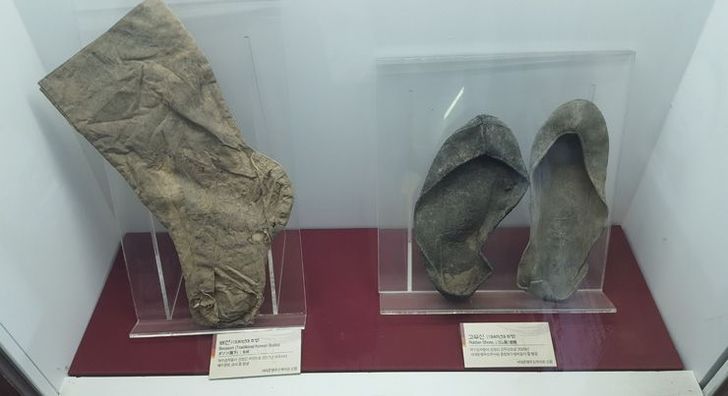
A sock and a pair of shoes found near the Women's Prison
Another tragic aspect of the prison’s history is that it did not end with liberation from Japan. Korean dictators who seized power later continued to use the building to lock up those who fought for democracy. Former President Kim Young-sam is one of its best-known inmates who was imprisoned there after the country’s independence.
The prison finally disappeared into the mists of history in 1987, when Korea said farewell to the era of its authoritarian political system by revising the Constitution to allow the people to elect their President through direct votes.