Korean music stands up at candlelit rallies

Kim Violin of NST and the Soul Sauce drags his bow across his instrument as the band covers Bob Marley’s “Get Up, Stand Up.” They appeared at the Hayaharock stage in front of the Admiral Yi Sun-sin statue in Gwanghwamun Square, Seoul, at midnight after the main protest on Nov. 26. / Korea Times photo by Jon Dunbar
By Jon Dunbar
Performing for a crowd of 1 million people was "unreal," says Jun Bum-sun.
Jun, whose band Jun Bum Sun and the Yangbans released their first album "Revolution Songs" this year, grew up watching Metallica's 1991 live show in Moscow in front of 1.6 million Russians at the end of the Soviet Union.
"I could only imagine that kind of thing happening in Korea once North Korea gets liberated," Jun told The Korea Times. But then it happened last weekend. It wasn't as rowdy as I expected though. Just a million candles staring at you. But when I asked them all to shout at President Park ... That's when I realized, 'Damn, this is really happening.'"
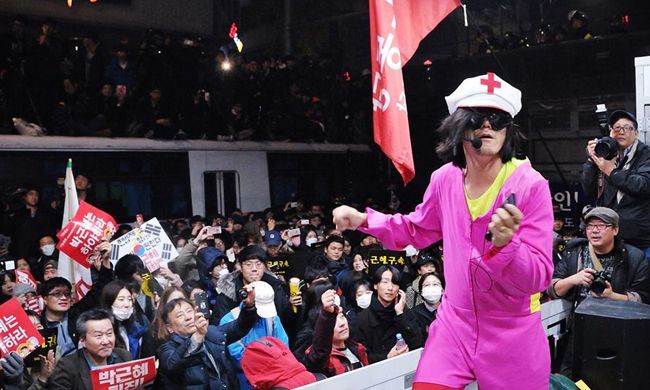
The Yangbans played on a stage at Gwanghwamun, central Seoul, Nov. 12, the first protest to break 1 million participants, according to organizers. They joined countless other bands of all genres — rock, hip-hop, punk, metal, reggae, adult contemporary, folk, jazz and traditional Korean — in the series of protests against President Park Geun-hye that at times closely resembled a massive — albeit peaceful — music festival.
If the Saturday rallies are considered a single multi-day event, they set the world record for the largest concert in history. If not, many individual rallies would certainly breach the top 10 largest concerts ever held.
The total number of reported participants at all Seoul protests so far is 8.2 million, though this number doesn’t account for people returning for multiple rallies. The largest individual protest on Dec. 3 had 1.7 million, according to organizers. However, this number is cumulated over the course of the whole day and such large crowds can’t be expected to be crammed within hearing range of even the largest stage at one time.
.jpg?w=728)
Kingston Rudieska perform at the Hayaharock Stage on Thursday, Nov. 17. / Korea Times Photo by Jon Dunbar
In contrast, Korea's biggest music star, Psy, held a free concert in Seoul Square four years ago in front of 80,000 to 100,000, which was touted as a record-breaker. But Psy has likely avoided these ongoing rallies, as his label YG Entertainment was connected to Cha Eun-taek, a K-pop video director who has been uncovered as one of Choi Soon-sil's associates.
The Yangbans shared the main stage with punk band Crying Nut, Busan band Ska Wakers, folk singer-songwriter Jeong Tae-choon, adult contemporary singer Lee Seung-hwan and rapper Cho PD. The latter two also released their own songs supporting the protest movement.
Crying Nut, who introduced mainstream Korean audiences to punk music through their World Cup 2002 performances, accepted the invitation to play at the rally after careful deliberation.
"We had a long band meeting about participation in the performances," Crying Nut keyboardist Kim In-soo said. "We performed in solidarity, but it took time to agree because of our differences of opinion. Ultimately we decided to stand up for legal justice."
For Jun, the decision was much easier. "I actually contacted them first," he said. "I felt like I had to say something about this embarrassment that my dear Ms. Park has created."
According to Crying Nut, they did not receive payment for playing, nor did they expect any.
"Many musicians really wanted to appear on stage even though they didn’t get paid," said Lee Dong-yeun, a professor at Korea National University for the Arts (K-ARTS). "This spontaneous participation indicates their outrage."
Lee, a member of the NGO Citizens' Network for Cultural Action since 1999, helped set up a series of concerts under the banner Hayaharock, a portmanteau of an impeachment chant and "rock."
Offering a full schedule of diverse musical acts outside the heaviest protest times, they kept the fire burning and helped many more artists raise their voices. The stage for Hayaharock was set up in a highly symbolic location between the Admiral Yi Sun-sin statue and the Sewol protest tents, amid a newer tent village inhabited by activist artists who have been transforming the area.
Participating bands included influential underground rapper MC Meta, psychedelic rock band Galaxy Express, rockers Huckleberry Finn, punk band Rux, rockabilly band Streetguns, Beatles tribute Tatles and electro-rockers Goonam, among dozens of others.
"With different music genres and styles, we could with one voice call for the resignation of President Park," Lee said.
"Participants at any rallies or protests have various styles and methods to express their anger. Some people want to shout slogans and also want to dance or sing. Dancing and singing is a kind of style for fighting."
Following the first Hayaharock show on Nov. 12, more concerts were held on weekdays, and then Hayaharock public concerts appeared in nine cities across the country, including Daegu, Daejeon and Busan, but as remote as Gangneung and Jeju City.
A complete list of all participating musicians would be impossible to compile. As well as the official main stages, many smaller and more mobile performances were organized. Percussion teams marched the streets, and DJs and singers rolled through on trucks.
Hahn Vad, the colorful front man of urban guerrilla electronic act Yamagata Tweakster, was one of many underground performers who appeared on the back of a Labor Party truck organized by the party’s Culture and Arts Committee on Nov. 12.
"With this little music I want to raise people who are desperate to dance and fight,” said Hahn, whose musical career has seen him aligned with many political causes.
He also appeared at the Nov. 26 and Dec. 10 rallies and performed in Gwangju Dec. 2. His guerrilla-style shows have mainly been held close to the police line defending Cheong Wa Dae.
"So far, there have been no big problems with the police during the rallies," he said. “I will continue to perform near the police, who may want to join in dancing. Or they may be dancing together in their minds.”
Hahn Vad of Yamagata Tweakster performs on a Labor Party truck for a concert organized by the party’s Culture and Arts Committee, in front of the police line at Gwanghwamun Station on Nov. 12. / Courtesy of Hyunreen, Culture and Arts Committee head
Where are K-pop idols?
Protesting comes naturally to underground musicians and well-established musical veterans. Even traditional Korean genres such as nongak have long traditions of political activism here. But K-pop remains completely apolitical by nature.
Psy and YG weren't the only K-pop entities to steer clear of the protests. No currently active K-pop idol groups are known to have performed in person at any of the rallies, although recordings were played and participants sang their songs.
"K-pop boy and girl groups are usually subordinated by the main big companies, so they cannot join in even if they really want to," said Prof. Lee. "Even a few idols' will to participate in social issues is likely to be broken by the system. Busy schedules and lack of will are a mechanism to legitimate the idol system of subordination."
Many thousands of politically energized Koreans may have also expanded their musical horizons through witnessing in-person performances by the musicians not held back by music industry control.
For Galaxy Express bassist Lee Ju-hyun, participating in Hayaharock on Thursday, Nov. 17, was a simple decision. "It looks like fun," was all he said, adding he had no reservations about taking part.
Likewise, Prof. Lee said he was unconcerned with additional punitive measures, even though his university is run by the culture ministry.
"Because I have already been stamped as a leftist professor and theorist for a long time, and also have been blacklisted by Cheong Wa Dae, I no longer feel any fear," he said.
The Yangbans as well saw no downside to participating. "I mean, only 5 percent of this country still support the President," Jun said. "Even from a purely marketing-strategy point of view, it was a good idea to perform there. Popular music, like politics, is supposed to be democratic, you know?"
Along with various other far-reaching political and social changes, the protests may steer Korean popular music in a new direction.
"In this era of post-truth politics, where Trump and Putin and Xi and Abe and Park and Kim rule the Pacific world, where Merkel's Germany ironically seems like the last bastion of the free world, rock and roll will surely find a greater audience," said Jun. "No wonder Metallica is back!"