Museum archives 60s star cartoonist Park Ki-jeong

A political cartoon drawn by cartoonist Park Ki-jeong / Courtesy of Korea Manhwa Museum
By Baek Byung-yeul
Cartoonist Park Ki-jeong, 81, is a rare figure in Korea’s “manhwa” (comic book) scene, as he found success both as a graphic artist and a political cartoonist.
Park made his comic debut in 1956 with “Song of Star” as well as publishing a political cartoon in a daily newspaper in the same year.
His breakthrough came in the 1960s when he gained a huge following with a series of sports comics such as “Challenger” and “Wrestler.” “Poktanah” revolves around a Korean spy in the Japanese army during the Japanese occupation in the early 20th century. He also criticized decisive moments in modern Korean history while working as a full-time political cartoonist for local daily JoongAng Ilbo for 33 years from 1978 to 2011.
While working as a cartoonist, Park dedicated himself to protecting the rights of his fellow cartoonists by establishing an association of cartoonists in the 1970s.
To commemorate his 60-year-long career, the Korea Manhwa Museum in Bucheon, Gyeonggi Province, is currently holding an exhibition shedding light on his career.
Titled “Park Ki-jeong’s Challenger,” the exhibition is comprised of four parts — a comic book author, a political cartoonist, a defender of the rights of cartoonists, and a creative artist.
“Park is a pioneering cartoonist in Korea as he marked a new era in the comic book industry as a comic book author and as a political cartoonist,” said the exhibition’s curator Jurney Suh. “By displaying his works chronologically, we would like to show how his whole life has been dedicated to the creative activity of cartooning.”
The curator said preparing for the exhibition didn’t take so much effort as Park had already donated his early works to the cartoon museum last year.
“We already interviewed him in 2009 while we were in the process of recording the history of the country’s early cartoonists,” Suh said. “And he also donated 100 books of his early works to our museum last year. That really helped us develop exhibition ideas.”
.jpg?w=728)
Cartoon characters from Park Ki-jeong’s works are on display. / Korea Times photo by Baek Byung-yeul
Comic book author
The first section of the exhibition shows Park’s early life as a creator of comic books.
Ever since he published “Song of Star” in 1956, Park released more than 100 titles before becoming a full-time political cartoonist in 1978.
“Park was one of the top cartoonists in the 1960s when the country’s cartoon business was in its heyday,” Suh said.
As the curator explained, Korea’s comic book industry enjoyed its glory days in the 1960s and Park was at the center. One of his hits is “Challenger,” which deals with a young boxer Huni. After losing his parents, Huni leaves for Japan and learns boxing while working at a restaurant. He decides to become a boxer there as he thinks it is the only way to escape discrimination.
“Challenger” was released in 45 volumes from August 1964 to November 1965. The series was reissued in five volumes 40 years later in 2006.
Suh said Park has the distinction of covering a wide range of genres ranging from sports comics to romance comics.
“According to Park, he never read comic books while creating his own to avoid tracing others’ works. He also dealt with diverse kinds of themes ranging from sports to romance as he had a slew of ideas,” the curator said.
Cartoon critic Kim Jong-ok said Park’s cartoons also are original for adopting characters with different personality traits. “There is no good and evil in his cartoon works. At that time, many comics revolved around a good-natured protagonist and his or her bad opponents. But Park gained huge popularity because he described characters with different personality traits.”
‘Drawing political cartoon is like running 100-meter dash’
The second part of the exhibition shows his works as a political cartoonist.
Though he had been drawing both comic books and political cartoons since the beginning of his cartoonist career, he became a full-fledged political cartoonist in 1978.
While he focused on creating distinctive stories and attractive characters when creating comics, he paid more attention to criticizing political and social issues with his caricatures.
Park compared his job as a political cartoonist to running the 100-meter dash while making a comic book is like running a marathon.
“Park used to listen to classical music while drawing comics but he never listened to anything when drawing political cartoons as he was required to finish a piece in a short time,” Suh said, adding he was acclaimed for “exaggerating certain features of key news figures in his caricatures.”
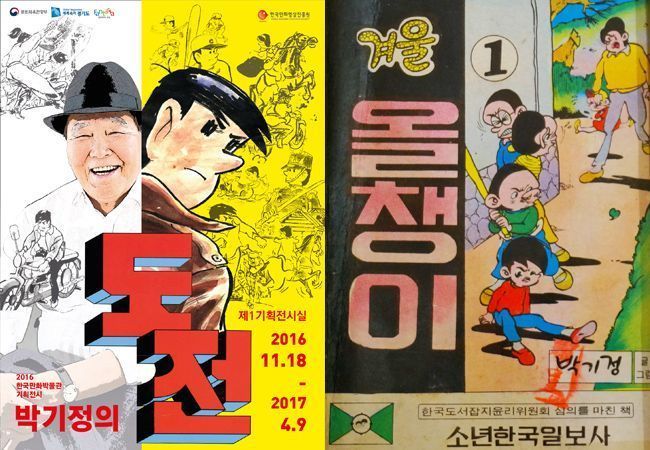
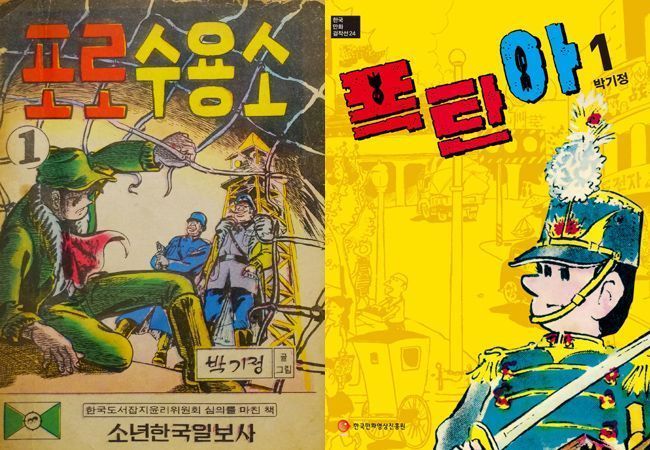
Posters for cartoonist Park Ki-jeong’s cartoon exhibition / Courtesy of Korea Manhwa Mus
Protecting cartoonists’ rights
Park also dedicated his life to protecting the rights of cartoonists. Though the country’s comic book industry enjoyed its heyday in the 1960s and ‘70s, creators suffered under various problems such as unfair contracts and preliminary government reviews.
To protect himself and his colleagues, Park established a cartoonists’ association, which is now called the Korea Cartoonist Association, in 1968. Serving as its inaugural and third president, Park banned cartoonists from plagiarizing others’ works. He also persuaded Chang Ki-young, founder of the Kids Hankook Ilbo, a sister paper of The Korea Times, to jump into the comics publishing business in order to break price fixing among existing comics publishers.
In this section, cartoonist Kim Kwang-sung displays his own comic drawings explaining how Park endeavored to protect cartoonists’ rights.
The last part shows Park’s endless creativity as he continues to draw comics at age 81. Last month, his other hit series “Poktanah,” released in 60 volumes over two years from 1964 to 1966, was reissued. While reissuing “Poktanah” Park redrew 33 pages to focus more on the romance between protagonist Tan and his lover Hanako.
The exhibition goes until April 9. The Korea Manhwa Museum is located near exit 5 of Samsan Gymnasium Station on Line 7. Tickets cost 5,000 won. For more information, visit komacon.kr/comicsmuseum or call (032) 310-3090.