Sokcho, where mountain views and seascapes merge
.jpg?w=728)
Sokcho Tourist & Fishery Market
Watch the sunrise by the beach and reach new heights at Mt. Seorak
By Lee Hyo-won
.jpg)
Driving through Sokcho, Gangwon Province is a sight to behold, as dramatic mountain ranges frame corn fields before an expansive seascape overtakes the view. Here, Mt. Seorak dramatically tapers off into the horizon of the East Sea, exemplifying the unique topography of the Korean Peninsula. It is, moreover, the ultimate destination for the greedy traveler who can savor everything from strolling along the beach to mountain hiking while experiencingeclecticepicurean excursions in between.
First Sunrise on the Peninsula
With December around the corner, the autumn days are growing ever shorter — so get a head start in Sokcho. The sunrises in this eastern coastal city about seven minutes faster than Seoul, and the numerous beachside resorts, condos and hotels boast spectacular views. For this reason, Sokcho and other neighboring cities/towns are top destinations for watching the New Year sunrise.
Some of the most interesting seascapes often unfold, however, at night. Brightly lit fishing boats illuminate the horizon as they hunt for squid, while ROK military vessels can occasionally be spotted. The latter serves as a reminder of how Gangwon Province is the only divided province, wherethe Demilitarized Zone (DMZ) cuts through to separate North and South Koreas.
The Goseong Unification Observatory, which is the closest local observatory to North Korea,can be reached an hour from Sokcho Harbor. The facility attracts more than 1 million visitors each year, providing naked-eye views of Mt. Kumgang in the North. Visit www.tongiltour.co.kr for more information.
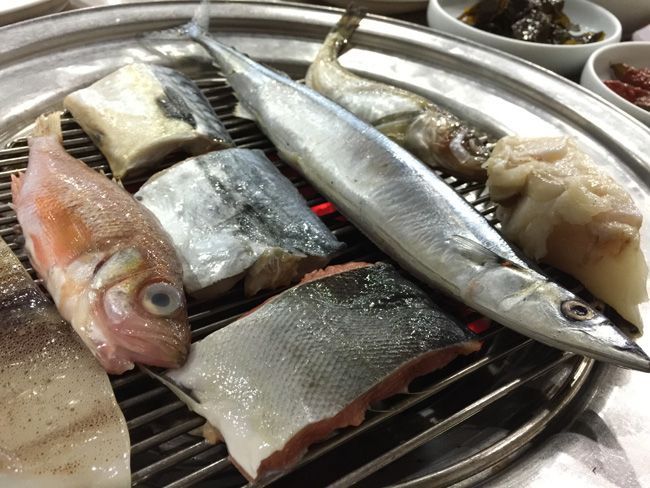
88 Saengseon Gui
Shaky Bridge of Mt. Seorak
Early European travelers to Korea observed that the country resembled "a sea in a heavy gale," due to the string of mountains that cover over 70 percent of the land. Among these is Mt. Seorak, a national park and UNESCO-designated biosphere preservation district.The mountain stretches over an area of 373 square kilometers with the highest peak reaching 1,708 meters.Sokcho is among a handful of cities that Mt. Seorak straddles, but itis the most popular entry point into the park’s best-knownranges.
For first-time visitors wishing to enjoy natural scenery without breaking too much sweat, there is a cable car that going up toward Gwongneum Fortress. The six-minute ride is followed by a 20 to 30-minute walk to the fortress, which provides panoramic views at an altitude of 1,200 meters. Cable car tickets cost 5,500-8,500 won.
Those looking for a moderately challenging hike but are short on time should take the Biryong Falls route, a 2.4-kilometer trek (one-way) that takes about two hours (round-trip). This course takes hikers past a bamboo forest, some rocky ridges and a beautiful string of ponds formed by water flowing through the valley.
The initial walk through the woods can be deceiving in terms of what lies ahead: Yukdam Falls comprising of six waterfalls and a deep pond that are stranded together like a jade necklace. Before you reach the namesake Biryong Falls — meaning "flying dragons" — there is the notoriously shakyBiryong Bridge, which, suspended high up across the rugged ravine, wobbles mercilessly with each step. This short, yet dynamic, course is not for the weak-hearted.
There are various other courses for more serious hikers including multiple-day excursions. Visit english.knps.or.kr/Knp/Seoraksan.
.jpg?w=728)
Kim Yeong-ae Halmeoni Dubu
Omnivore's Paradise
The best part about being in a seaside mountain town is the bountiful food options, ranging from fragrant mountain herbs to freshly caught "hoe" (raw fish).
Indecisive omnivores should head to Sokcho Tourist & Fishery Market (httep://sokchomarket.com; Korean only). It will be hard to miss the long lines for Mansuk Dakganjeong, which has several branches within the market alone. The famous chicken nuggets come caramelized in two flavors, savory or spicy (17,000 won). Visit https://mansuk.kr (Korean only). Meat lovers with an appetite for blood sausage will find themselves at home at Jinjja Sundae, which serves the stuff in a variety of ways, from deep-fried “jeon” to spicy “jeongol” stew.
Seafood aficionados are not to miss 88 Saeongseon Gui, a portside place located at a 10 minutes’ walk from the market. It’s far from fancy with sticky floors but proudly serves an assortment of fresh catches du jour ranging from mackerel and squid to halibut and trout, all grilled to smoky perfection over charcoal. Solo travelers, however, should beware as the establishment takes orders for two servings or more. Call (033) 633-8892.
Sokcho is also famous for hot springs and fresh water, and naturally, some of the best“dubu” (tofu) as water quality is widely known to determine the taste of bean curd. On the way to Mt. Seorak, stop by Kim Yeong-ae Halmeoni Dubu. The time-honored “granny” restaurant serves a single set menu (8,000 won) comprising of cottony, white dubu, “kongbiji” (ground soybean) stew and an array of piquantside dishes. Serves breakfast and lunch only. Call (033) 635-9520.
The writer is former Korea bureau chief of Louise Blouin Media's Blouin Artinfo. She is the Seoul correspondent for The Hollywood Reporter and contributes to CNN, WWD and Cathay Pacific's Silkroad magazine.