Korea Racing Authority boosts horse riding industry

oung members of the horse riding club by the Korea Racing Authority get on horses at the LetsRun Park Seoul, Gwacheon, Gyeonggi Province. / Courtesy of Korea Racing Authority
By Baek Byung-yeul
Horses and people have been inseparable for thousands of years before modern modes of transportation were invented less than a century ago.
For Koreans, horses have long been a symbol of power and an important means of transportation.
Nowadays, horses are not only valued for transportation but for sport and companionship and their importance is ever growing.
Recognizing this, the government revealed its plan to boost the horse riding industry in 2013 by building more horse riding courses, up to 500 by 2017, according to data provided by the Ministry of Agriculture, Food and Rural Affairs.
Still, there is a pessimistic view that horse riding is regarded as an exclusive hobby of the affluent, but the government expects that some 2 million people will enjoy horse riding by 2017, up from the current 700,000 per year.
This will mean that total sales from the horse riding industry will reach 3.6 trillion won ($3.24 billion) by next year, from 2.8 trillion won in 2012, and generate more jobs, pushing the number of people working in the industry to more than 30,000.
From equestrian therapist to trainer, KRA offers career development program
As part of the government plan, the state-run KRA has been offering a career development program introducing possible positions in the horse riding industry to middle and high school students since last year.
Although there has been criticism that the KRA launched this program to dispel its “unethical image” for building off-track betting centers throughout the country in recent years, the career education curriculum is well organized to serve its original purpose — cultivating more talent to make a contribution to the industry.
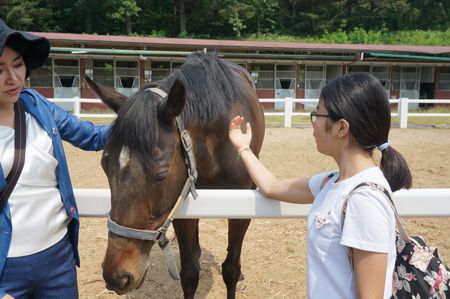
Lee Jung-min, left, an instructor of the career development program, gives a middle school student instructions on how to touch a horse at the LetsRun Park Seoul in Gwacheon, Gyeonggi Province, Saturday. / Korea Times photo by Baek Byung-yeul
At the KRA’s “LetsRun Park Seoul”, whoever is interested in shaping their future in the horse riding industry can join the program, which takes place twice a day. The program is developed by KRA instructor Lee Jung-min.
“Invigorating the horse riding industry can bring many positive effects to the country ranging from creating more jobs and increasing farmers’ income to promoting sound leisure programs. The whole program is designed in cooperation with the KRA and the government,” Lee explained before starting her Saturday class on June 6. Three groups consisting of four middle school students and their parents took part in the Saturday afternoon class.
Lee said a series of reservations were abruptly cancelled due to fears of the deadly Middle East Respiratory Syndrome (MERS) infection.
Since launching in June of last year, about 4,000 students from 270 schools have taken part in the course. They were mainly middle and high school students.
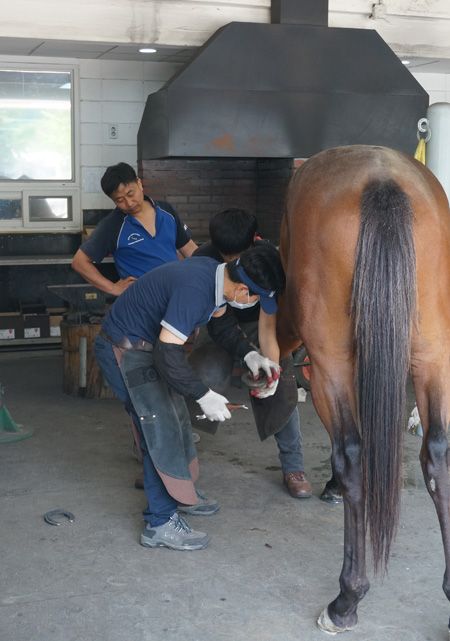
Farriers replace the horseshoes of a racehorse at the LetsRun Park Seoul in Gwacheon, Gyeonggi Province, Saturday.
“This was more than we expected. All we did was send an official notice to each school in the country, but so many students, mostly middle and high school students and their guardians, visited here last year.” Lee said.
Starting at the drug test lab, attendees later visit a clinic, a training center, a swimming pool for the weight control of racehorses, a smithy where farriers make and replace horseshoes for racehorses, and a horseback riding course, during the three- to four-hour long session.
As the entire program is conducted at an authorized area inside the park, it is required that participants take a safety lesson for about an hour. During this lesson, Lee holds a brief session on the horse industry.
“The very first thing you should know is that horses can bite or kick you anytime, so you are required not to make any noise or do something that may bother them unless you want to get kicked,” Lee said.
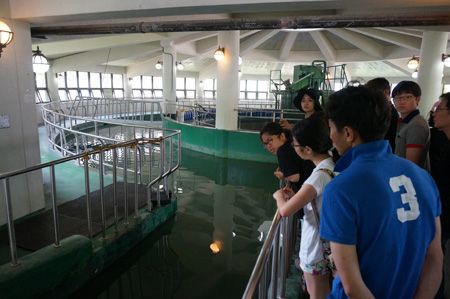
Participants of the career development program tour a swimming pool for horses at the LetsRun Park Seoul in Gwacheon, Gyeonggi Province, Saturday.
After a brief lesson on the horse riding industry and the safety codes at the park, participants are given a chance to communicate with horses by feeding them. Under Lee’s instructions, they were allowed to give the horses a lump of sugar.
“It was the first time in my life to actually touch the horses, and it was a unique experience. They were really cute,” a middle school girl said.
After feeding the horses, the students and their parents move to a clinic to take a look at the medical facility, equipped with a various kinds of tools used for surgery.
Another interesting part was touring a smithy. Lee explained that racehorses usually change their horseshoes once a month and the whole process should be conducted by first-class farriers. There are only five first-class farriers in the country.
“Replacing horseshoes is a very complicated process. It takes about 15 years to become a first-class farrier and to become one, you have to pass an exam controlled by the government,” Lee said. “You guys are lucky to see them changing horseshoes. It is very rare to see this scene.”
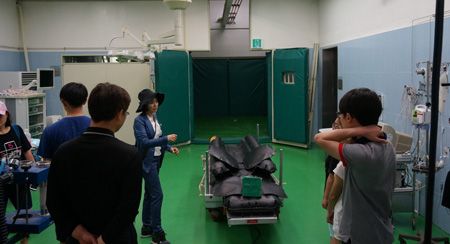
Lee Jung-min, third from left, an instructor of the career development program, introduces a surgery room for horses at the LetsRun Park Seoul in Gwacheon, Gyeonggi Province, Saturday.
The instructor who used to work at the non-government organization said she has seen cases where several of the participants mapped out a career in the industry after taking this program.
“Since we launched the program last year, I’ve heard that it has quickly become one of the more popular career development programs among career counselors.
When teachers visit here with their students, many of them say this program is well organized so that participants can actually watch what kinds of jobs they might be doing through the industry,” Lee said.
A middle school girl who would like to be a horse therapist said taking part in the program was a precious experience as she could learn what she will do in her future.
“I applied for this program myself as I want to know what exactly I will do as a horse therapist. Though I didn’t meet with a horse therapist, I was offered to glimpse into the horse industry. That was a valuable advice for me,” she said.
The career development program in the horse industry runs two daily sessions (starting at 10 a.m. and 1 p.m.) from Wednesday to Sunday, from June through November. One session takes three to four hours and admission is free. Reservations can be made online only at the KRA’s official web page at
For more information, call (02) 509-2468.
The LetsRun Park is located at Seoul Racecourse Park Station, Subway Line No.4.