Captivating gourmet tour for foreign foodies

Participants on the “night dining tour” take pictures in front of a shop for “kkultarae,” a snack made of fine strands of honey and maltose, in Insa-dong, Seoul, Friday.
By Yun Suh-young
“Everybody look carefully. Dip the meat into the sauce that you prefer, place it on a leaf and fold it,” said food curator Kim Jin-wook, explaining how to enjoy “ssam,” a combination of meat and other ingredients eaten wrapped in leafy vegetables at an outdoor restaurant, Friday.
In front of him were a dozen tourists who signed up for the four-hour “night dining tour’’ program, organized by O’ngo Food Communications, a company that specializes in food tours for foreigners.
The group listened carefully and did as instructed. Ssam proved to be a fun and unusual experience for first-timers.
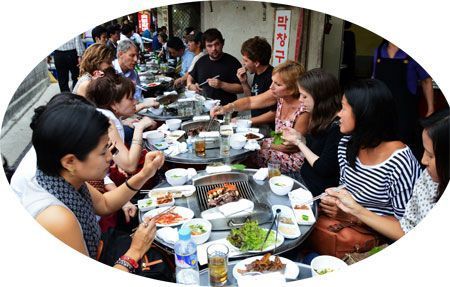
Participants dine at a restaurant where “galmaegisal” (pork skirt steak) was served with leafy vegetables as part of “ssam,” in Jongno, central Seoul, Friday.
“Is it okay to dip the meat into all three of those?” asked Joyce, a Filipino participant on the tour, referring to the salt and pepper, sesame powder, and bean flour sauce next to the ssamjang (soy bean paste).
“Yes, you can do as you like,” said Kim.
Joyce dipped the meat into all three sauces and savored the taste. “Umm, it’s good.”
“Wait, what was this leaf called?” asked Celine, another participant.
“Sesame leaf,” Kim told her.
The participants said that they were enthusiastic to learn and experience what "locals eat’’ in Korea.
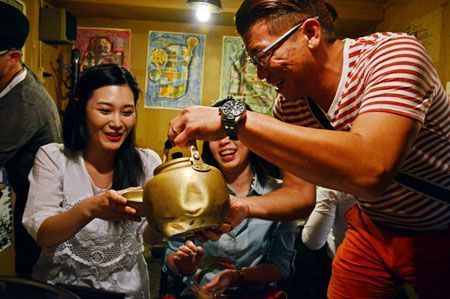
Lennon, a tourist from Singapore, right, pours makgeolli, or traditional peasant wine, with both hands to a trainee tour guide after learning how to do it properly.
“It’s great that I can see a real part of Seoul through this tour. We get to eat where the locals go to eat and walk along the streets of Seoul at night. These are things that I don’t get to see or eat when I’m on a business trip because we’re taken to fancy Korean restaurants that serve courses,” said Rodney, an American based in Hong Kong, who participated in the tour with his wife.
“I come to Seoul often on business trips and eat Korean food but I never really knew what I was eating because I wasn’t told.”
Joyce, who was on a tour with five of her friends, said, “We love Korean food and often dine out at a Korean restaurant in the Philippines. But it’s our first time in Korea and we really wanted to go to where the locals ate.”
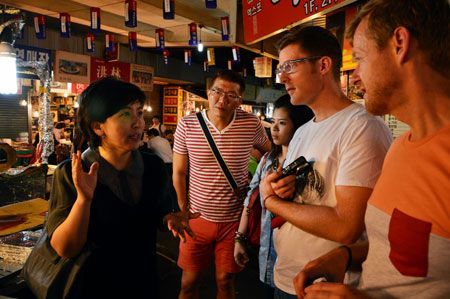
Jia Choi, president of O’ngo, explains to the tour group what is sold at Gwangjang Market and its history at the market in central Seoul, Monday. / Korea Times photos by Yun Suh-young
After the “ssam,” the group went to eat “tteokbokki,’’ rice cakes chopped into small pieces and stewed in red chili sauce or soy sauce and other ingredients. The third course was tofu with kimchi, the Korean staple side-dish of fermented cabbage, and “makgeolli,” traditional rice wine. The final course was to visit Gwangjang Market where there are all sorts of delights from gimbap (seaweed rolls) to bindaetteok (fried mung bean pancakes).
The restaurants O’ngo takes its participants to aren’t always the same. It changes flexibly depending on the number of people participating and the availability of the restaurants. But still, the type of food served and introduced are pretty similar because there are certain foods that the tourists tend to enjoy as much as the locals. Of course, with the menu, food allergies or religious avoidances are taken into account.
On Monday, on another night dining tour, the menu was ssam, makgeolli and tofu, binddaetteok and bingsu (ground ice flakes with red beans) for dessert.
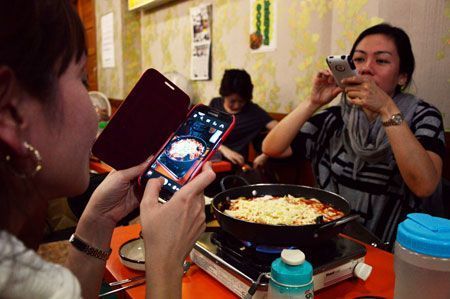
Tour participants take photos of “tteokbokki,” or small rice bars stewed in red chili sauce or soy sauce with other ingredients, at a restaurant in Insa-dong, Monday.
On the Monday tour, Jia Choi, president of O’ngo, joined the tour and personally explained how to eat the food as well as the history and culture behind the different types.
“In most other tours, the guides just tell tourists what the food is called but not much more. But it’s important to tell them the historical and cultural backgrounds of the food as well as the table manners and etiquette of Korean culture,” she said.
“Tour participants are really curious about various aspects of Korean culture. I think food is a great medium to introduce our culture. It’s the most important part of our lives and besides, it’s fascinating.”
Choi established O’ngo Food Communications in 2008. It all began when she guided a private tour for a foreign VIP upon request from the Korean government. They didn’t want a big tour agency to guide the tour. Choi singlehandedly completed the tour and the result was a success. The positive feedback she received got her thinking that she could start a business with this niche market item.
It began with one tour in the beginning but now the company runs several ― the street food tour, night dining tour, fish market tour, Korean beef dinner and traditional market tour and region tour, which was added recently where they tour the eateries by region (for instance, to Jeonju to eat bibambap, or rice mixed with meat, vegetables and red pepper paste).
O’ngo also runs Korean cooking classes in groups or individuals. The cooking programs are very well received and are visited by foreign chefs and food researchers. Choi, who has a PhD in food and nutrition as well as being a licensed chef, teaches cooking for the professional course. Two other chefs teach the beginner and intermediate courses.
The night dining tour, which this reporter accompanied, was a four-hour program that began at 6 p.m. The walking tour began in Insa-dong’s traditional street and stopped at four different venues around central Seoul so that the visitors could taste several types of food. The format of moving from one place to another was adopted from the Korean “hoesik” culture in which workers go to one or two more places to drink and eat snacks after dinner.
“In Western culture, it’s ladies first, but in Korea, it’s eldest first. So when you’re pouring drinks for someone, it goes from oldest to youngest,” said Choi, pouring makgeolli for the eldest of the tour participants, at the second place they stopped at for a drink.
“Also, when receiving, remember to hold the cup with both hands because it’s a way of showing respect.”
Another tip she gave to the five-member group was “not to hold the rice bowl with your hand.”
“In Japan, the culture is to hold the bowl on their hand while they eat. Here in Korea, it would be considered rude to do so. So be careful,” she said.
Luke, a tourist from Australia laughed as he wondered whether he was impolite all throughout his stay here because that’s how he’d been holding the bowl all along.
“Those who participate in the tour are people who like eating and are not picky about food. These people are usually open-minded and have high level of curiosity. Many of them are highly educated and sometimes ask unexpected questions that take us aback,” said Choi.
Having attended both tours, it seemed that the satisfaction level of this fresh-concept tour was very high among the participants.
“When we came to Korea on group tours before, we never got the chance to go around like this and receive such detailed explanation,” said Vanessa from Singapore.
Her husband, Lennon, said he “really, really enjoyed the tour.”
“I especially enjoyed the Gwangjang Market. I wished we stayed longer there and tasted other local food. It was great to mingle with the locals. One came up to me and asked me where I was from,” he said.
Luke added, “It’s hard to order when we’re at a local market because we don’t know what they are. This tour made it easier for us.”
President Choi was convinced that Korean culture could be widely spread through Korean food.
“Sometimes, food industry people are among the participants of the tour. Once, after tasting vinaigrette red-chili pepper paste, one of the participants asked me how he could import it to his country. It was very rewarding to connect him with the producer,” said Choi. “There are plenty of routes along which to spread culture through food.”