'Visit JW Marriott throughout your life'

The signature lobby of JW Marriott Seoul Gangnam, near Shinsegae Department Store and Banpo Bus Terminal.
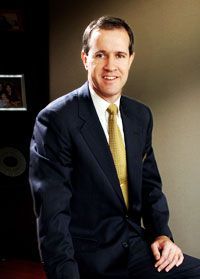
Richard Saul, general manager of JW Marriott Seoul
By Kim Ji-soo
JW Marriott Seoul in Gangnam has been reinforcing the main tenets of Marriott culture that helped it win several awards last year.
In March, the hotel announced that it received the Aon Hewitt Consulting’s 2013 Best Employer Award. It also won recognition for best environment for women to work in.
“The way that the hotel was set up was that we’ve brought a lot of Marriott ways and values which by nature is about diversity, gender and fairness ... and over the years, this has been continuously reinforced,” said Richard Saul, as a way of explaining the reason behind the award.
The 48-year-old general manager explained that these core Marriott ways are critical as the hotel aims to become the best or one of the best in Korea.
“We really want to drive the luxury that is the JW Marriott. Luxury not in the material sense but in the level of service. We will try to elevate the level of service so that it feels more personal and includes everyone’s preferences. It will be supported by technology but mainly delivered by our associates, the staff,” said Saul, who is from Australia.
Located near Banpo Bus Terminal with access to three subway lines and roads, JW Marriott Seoul is one of Marriott’s signature properties in Asia. He realizes that the hotel is part of the city, and is well supported by the local customers. And as part of Seoul, the 12-year-old hotel remains a big challenge and a responsibility as it is a big buiness and dynamic.
During his past year at the helm, he has driven a core message so that his staff remain well-attuned to the business goals.
“I am always saying please take care of each other ... It’s logical to want to take great care of your guests. But you cannot really do that in a hotel without taking care of each other,” said Saul.
“If we don’t help each other, the guests will hit roadblocks,” he said, and “Taking care has to be colleague-to-colleague.”
Business-wise, the hotel sees about 80 percent international guests and about 20 percent domestic guests.
For this year, the hotel is aiming to raise by 32 percent its room sales for MICE or meetings, incentives, conventions and exhibitions group bookings. The hotel is the official hotel for the Air Show that will be held at the end of October in Cheongju, North Chungcheong province.
The strength of JW Marriott is that the hotel continues, every year, with renovations, to maintain its modern, up-to-date look.
Its fitness center, which had new treadmills installed last year, has about 3,000 members. The swimming pool will undergo a renovation this year.
A veteran hotelier, Saul doesn’t feel the cultural gap with Korea. He had been in various countries and its varying weathers ranging fromnative Australia to Shanghai,China.
“It’s all about having the right clothes,” he said jokingly, and the different people who help.
However, he found the language difference challenging.
“Korea is definitely modern Asia. I would like to see the level of English mirror that.”
If the level of English becomes a priority, a whole level of internationalism would come with it without overwhelming Korean culture.
It would certainly help tourism, business and employment opportunities, and help Korea export culture.
He is also hoping for more action to spark the economy and to advance Seoul’s tourist-destination appeal.
Another JW Marriott will open in Dongdaemun this year to provide its signature service but in a more exclusive way. When the JW Marriott opens in Dongdaemun, it will be the sixth Marriott establishment in Korea.
“We are an approachable luxury. We would like people to come here throughout their lives, from 1st birthday parties, weddings and anniversaries.”