The portable museum

How technology continues to reshape museum experience
By Kwon Mee-yoo
The mobile Internet era has dramatically changed the way people work, play and communicate. It is now beginning to influence the access and consumption of art as museums and galleries compete to provide new software applications and other interactive programs for touch-screen smartphones and tablets.
With its sophisticated mobile
the Korean Art Museum Association allows mobile users to enjoy works of artistic excellence without missing out on the beautiful spring weather.
The website also provides useful location-based functions that help the user find the nearest art museum along with a brief description of each institution and what is currently being exhibited there. The service is only available in Korean for the moment, but a version in English is being considered.
Other decent mobile applications include "Mu:um’’ and "Artday,’’ where the latest exhibitions are frequently updated along with in-depth information about Korean artists.
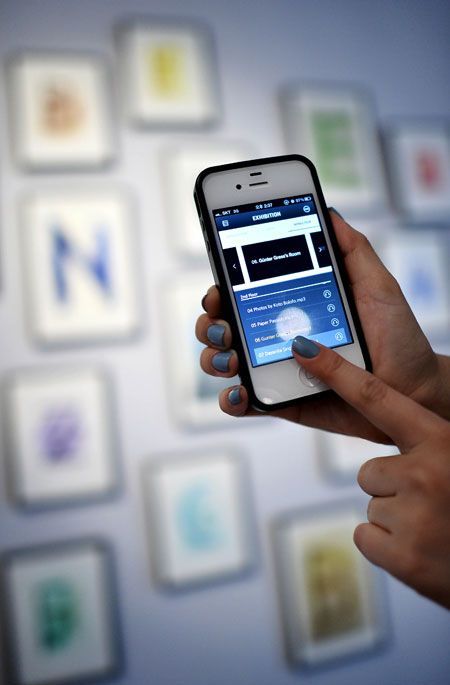
An increasing number of museums and galleries are introducing new software applications and other interactive programs for touch-screen smartphones and tablets. / Korea Times photo by Shim Hyun-chul
As useful as they are on the move, the portable Internet devices can do a lot more at the site of the exhibit. Museums, in particular, are imprinting QR codes on exhibition labels to enable smartphones to double as handheld guides.
Daelim Museum’s mobile app seems to be better than the rest. It provides an on-screen glimpse of its current exhibition, "How to Make a Book with Steidl’’ with high-quality images and interactive features and also a virtual ``coupon book’’ that lets users apply for prize events when they visit the museum physically.
The exhibition ― highlighted by the artworks of German book designer Gerhard Steidl, artists Robert Frank and Jim Dine, and iconic fashion designer Karl Lagerfeld ― seems like an ideal match with mobile applications.
The software provides an audio guide that explains Steidl’s collaboration with authors and also features Gunter Grass, the Nobel Prize-winning author of "The Tin Drum,’’ on how book designing interweaves with the writing process.

A visitor at the Seoul art gallery Plateau uses her smartphone to access information about Gim Hong-sok’s sculpture, “Canine Construction,” enabled by a QR code imprinted on the exhibition label. / Courtesy of Plateau
The app recently added a new section titled "Story," where the museum's deputy director Kim Shin contributes regular columns on creative designs and other subjects. The first piece published on April 4 was a fun and revealing story of how movie directors began to sit on folding chairs.
Daelim’s mobile app seems well-received. Kim Ji-won, a visitor to the museum, avidly listened to the guide while browsing photos of artist Koto Bolofo that documented the Steidl studio.
"I missed the docent tour, but downloaded this application instead. The photos are self-explanatory, but it is interesting to know more background. It is easy and free to follow the mobile audio guide,’’ she said.
Leeum in Hannam-dong, Seoul, takes advantage of state-of-the-art technology more actively. Park Min-sun, a Leeum spokeswoman, said the museum considers digital technology as critical to fully express the artistic value of the works that are exhibited there.
The museum truly rewards those who bring the the latest smartphones equipped with high resolution screens as some of its items are displayed with QR codes on the label. The mobile images from the works that were displayed at its previous ``The Court Painters of Joseon Dynasty’’ exhibition were truly stunning.
Its current exhibition, "Opulence: Treasures of Korean Traditional Craft’’ is even better represented on mobile devices, including 360-degree panoramic photos that allow users to view artifacts from any direction including from behind. The 12th-century gilt-silver bottle and gold buckle from the ancient Nangang Commandery (108 B.C.-313 A.D.), which are the highlights of the exhibition, look just as impressive on handheld screens.
"We first thought elderly people would like the magnified images on phone screens, but tech-savvy youngsters and children love them as well. We are getting good reviews for our efforts to marry technology and art," Park said.
"The information technology is progressing every day and this has us constantly testing new technology for new exhibits."
The National Museum of Contemporary Art, Korea (NMOCA) recently launched its mobile application providing multimedia content for selected exhibits. Currently, the works of Moon Kyung-won and Jeon Joon-ho, the artist duo that won the 2012 Korea Artist Prize, and three other artists are in service. The catalogues are rich with photos and interview clips with the artists.
The museum is also collaborating with NHN, the country’s biggest Internet company and operator of top search site Naver (
), to improve its mobile service.
“There are many great museums in Korea, but only a few people visit the places physically. Internet and technology can assist making art more popular,” said an NHN official.
NMOCA might experiment a way to connect its mobile service with Naver’s Museum View service, which uses its photomap and other location-based data to allow users to peek at what is being exhibited in each museum before they choose where to go.
"People can arrange their visit and look into information on artworks beforehand. As more people are exposed to art information, more people will go to the museum to see the actual artworks,’’ said the NHN official.
"The museum can be viewed anywhere in the world and we hope it will contribute to promoting Korean art internationally.’’
Internationally noted art institutions are also replacing their traditional audio guides with smart phone applications. The Solomon R. Guggenheim Museum in New York now lends iPods to visitors and visitors can use their own iPhone to download the museum's application as well.
The application has basic information on the museum, an explanation of the permanent collection and special exhibitions and rich descriptions for both adults and children. The app is free and available from Apple's App Store, so visitors can download and prepare for their visit in advance.
Kim Kanatani, deputy director and Gail Engelberg director of education at the Guggenheim Foundation, said smart phone applications are one of many different ways to tap into people's tastes.
"Some people prefer listening face-to-face docent guides while others like to use their own smart device. The audio guide throws out rhetorical questions and it could spark conversation on artworks,’’ Kanatani said.