Maritime Epicurism in Autumn
By Chung Ah-young
Staff Reporter
Autumn is called the season of ``cheongomabi'' in Korea, meaning ``the season of high skies and plump horses.'' But it's not only the appetite of horses that grows; people eat more as well.
Autumn is the high time to indulge in the pleasures of seasonal foods, especially, delicacies of the sea.
In Korea, autumn is the best season to have ``jeoneo'' (gizzard shads), ``daeha'' (king prawns) and blue crabs, which are most plump around this time of year.
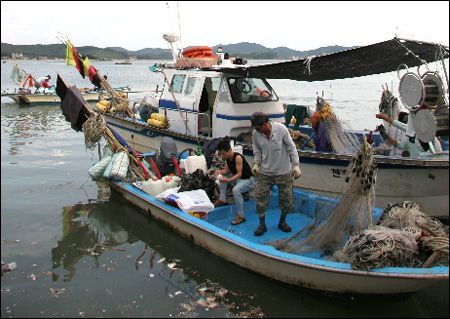
According to Taean County, South Chungcheong Province situated along the west sea, this year was a bumper year. Fishing boats were rushing out to sea when September set in after the closed seasons of July and August, and they returned home with their holds full to the brim.
Why not hit the ports to enjoy fresh seasonal seafood? Nothing beats sharing and enjoying a seafood feast.
Gizzard Shads (Jeoneo)
There is an old saying in Korea that the aroma of gizzard shad is so appetizing that it brings back the daughter-in-law that ran away.
Another old saying, ``a gizzard shad's head is equivalent to 54 liters of sesame seeds,'' meaning the fish's high nutritional content and great taste is comparable to that of sesame seeds.

In Korean, it's called ``jeoneo,'' meaning that it's shaped like an old Chinese coin.
Gizzard shads exhibit the typical herring body shape with an oblong body that is compressed sideways. Usually they have bright silvery blue backs, silvery sides and a dusky white belly.
It lives close to the seashore at a depth of 30 meters. It hibernates in the south, and spawns in the north.
The fish are born in spring and usually get fat in summer and prepare to hibernate from autumn.

In spring, a gizzard shad has 2.4 percent fat per 100 grams but in autumn the fat content rises to six percent and its bones become softer.
Summer gizzard shads have less fat and winter gizzard shads have tougher bones.
There are three ways to eat the fish -- raw, grilled, and seasoned. If you are a true seafood lover and want to taste it in its freshest state, eat it as sashimi. Dip the raw fish into Korean soybean paste and have it with dried seaweed and kimchi (traditional Korean side dish).
Or mix the raw fish with garlic, onions, carrots, cucumbers, sesame leaves and vinegar-flavored hot pepper paste.
But grilled gizzard fish is second to none, sprinkled with salt and grilled over an open flame.
Another tip for eating gizzard fish is to ferment it in salt, known as ``jeotgal.''
Many epicures may be hitting the roads to enjoy the gizzard shad festivals. The Seocheon Gizzard Shad Festival will be held on Sept. 29-Oct. 12 in South Chungcheong Province. For more information, call (041) 952-9123.
The Jangheung Gizzard Shad Festival will be held in South Jeolla Province on Sept 22-24. Various cultural events and native local foods will be offered. For more information, call (061) 863-7071.
Boseong Gizzard Shad Festival will kick off in South Jeolla Province on Oct. 2-3.
One kilogram of gizzard shads cost 30,000 won.
King Prawns (Daeha)
Sizzling king prawns on the grill is also something to savor in the fall. Chungcheong provinces and coastal areas in the west are renowned for ``daeha.'' Particularly, Cheonsu Bay on the West Sea and Boryeong are the major habitats and producers of the prawns.

The region annually produces about 35 percent or 1,140 tons of the prawns out of the annual local productions of 3,274 tons.
The prawns are born in spring and they grow to full size in August and September.
Compared to the foreign productions, the prawns that grow in the West Sea are less salty.
Usually, the prawns taste the best when grilled at the ports upon being caught.
Prawns are an extremely good source of protein, yet are very low in fat and calories, making them a very healthy choice of food. They are also rich in chitosan and vitamins.
The daeha festivals will be held throughout South Chungcheong Province until next month.
The festivals will start on Sept. 15-Nov. 4 at Namdang port in Hongseong, which is home to 140 raw fish restaurants along the coast.
The Anmyeondo Daeha Festival will open late September to continue through early October on Anmyeon Island, South Chungcheong Province. For more details about the festival, call (041) 673-5271.
Also, Muchangpo Beach in Boryeong, South Chungcheong Province, will hold a king prawn festival over the same period. For more information, call (041) 936-3561.
Shrimp costs 22,000 won for one kilogram.
Blue crabs (Ggotge)
Fishermen are surely enjoying their biggest boom this year. According to the National Fisheries Research & Development Institute, the size of the blue crab catch this year has witnessed a three-fold increase from the same period last year. The months of July and August are the spawning season for the crabs, and during this period, fishing is forbidden.

The institute said that this year's seawater was one or two degrees (Celsius) warmer than last winter, attributing to a more abundant catch.
Accordingly, the price of blue crabs has fallen to that of 10 years ago. Blue crabs cost about 9,000 to 12,000 won per one kilogram.
Among the blue crabs, female crabs taste the best when eaten in spring, while male crabs are good for eating in autumn.
Like other seafood, blue crabs usually caught in the West Sea especially around Taean County in South Chungcheong Province are cooked in various ways. One way to enjoy the crabs is as ``gejang,'' or marinated in soy sauce.
Unusually blue crabs are most often eaten steamed with water, vinegar and seasoning.
Blue crabs have about 15 percent in edible meat, which is high in vitamin B. Crab meat alone contain a full day's serving of vitamins.
Taean County, which is surrounded by the sea, boasts of the highest quality and decent sized blue crabs with thick blue shells, distinguishing them from crabs in other regions.
The crabs are on sale at major ports in the region.
Right, Red hot steamed king prawns is a seasonal delicacy. /Korea Times Photo Right, Gizzard shads served up on a plate, and below live gizzard shards.