Korean culture has shifted from 'han' to 'heung': CICI founder

Choi Jung-wha, the founder and president of the Corea Image Communication Institute (CICI) / Korea Times photo by Choi Won-suk
CICI to celebrate 20th anniversary
By Dong Sun-hwa
Over the last 20 years, the culture promotion advocacy group, the Corea Image Communication Institute (CICI), has witnessed some of the most historic moments in Korean culture.
Since its launch in 2003, the CICI has organized a series of events like the Korea Cultural Quotient (CQ) forum to bring together opinion leaders, who can promote Korea and facilitate cultural exchanges worldwide. Its annual awards ceremony, the Korea Image Awards, also kicked off in 2005, honoring those who have played vital roles in shaping the cultural industry. This year marks the 20th anniversary of its establishment.
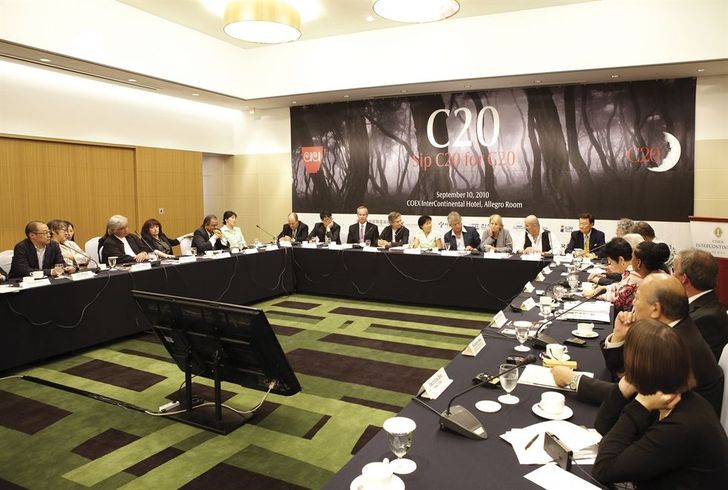
A scene from a forum organized by CICI in 2010 / Courtesy of CICI
As a longtime observer of Korea's cultural scene, Choi Jung-wha, the CICI founder and president, has seen a dramatic shift: “Han” used to be the defining characteristic of Korea and its content in the past, but today, “heung” has taken over.
Both “han” and “heung” are fundamental elements of Korea's identity, which have long been recurring themes in literary and creative works. “Han” refers to an emotion of unresolved grief, resentment and frustration, while “heung” means collective energy and utmost joy.

Choi Jung-wha, the founder and president of the Corea Image Communication Institute (CICI) / Courtesy of CICI
“South Korea first began with the sentiment of 'han,'” Choi, a professor emeritus at the Hankuk University of Foreign Studies, told The Korea Times. “As far as I remember, it came under the spotlight of the world in the early 2000s, when news about North Korea's possible nuclear development made the headlines. Knowing that this can threaten their own national security, many countries across the globe became more concerned about various issues related to Korea. Simply put, it was actually our national crisis that triggered people's attention.”
However, Choi pointed out that the game has completely changed today. K-pop, K-drama and other cultural content made in Korea have become the first thing that crosses people's minds when they think of the country, and it is all linked to the feeling of “heung,” according to her.
“These days, Korean culture is drawing global attention with its bright and positive energy,” she said. “Our sentiment of 'heung' is dominating.”
Awardees in 20 years
Such a change is noticeable from the list of the awardees of the Korea Image Awards, which are comprised of the Korea Image Stepping Stone Award, the Korea Image Stepping Stone Bridge Award, the Korea Image Cornerstone Award and the Korea Image Budding Youth Award.
In the early stage of the awards' history in the 2000s, the awardees included former United Nations Secretary-General Ban Ki-moon (2007); sports stars who won gold medals at the Olympics such as weightlifter Jang Mi-ran (2009), swimmer Park Tae-hwan (2008) and figure skater Kim Yuna (2008); and classical musicians who won internationally acclaimed music competitions, including maestro Myung-whun (2005) and pianists Kim Sun-wook (2007) and Cho Seong-jin (2009).
Those figures represented the country in the fields that Koreans used to evaluate highly for “elevating national status,” such as leading an international body, topping a sports event or global art competitions that not many Koreans or Asians had won previously.
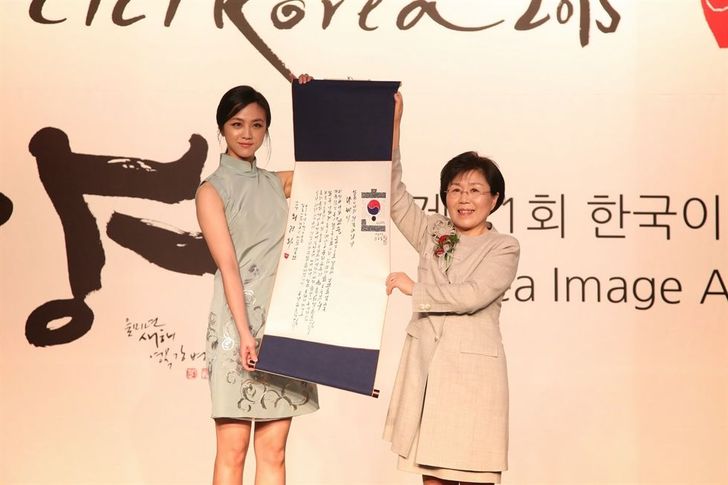
CICI founder Choi Jung-wha, right, poses with Chinese actress Tang Wei, during the Korea Image Awards in 2015 in Seoul. Courtesy of CICI
From the 2010s, different sides showed among the awardees, especially since Psy was recognized in 2013 for his megahit, “Gangnam Style,” in that more individuals, companies and content related to “hallyu” (Korean wave) received the awards. They include YouTube (2013) that allowed Psy's video “Gangnam Style” to go viral; AmorePacific (2015) that represents Korean cosmetics; Chinese actress Tang Wei (2015) who helped with cultural exchanges between Korea and China; CJ Group (2018) which is an entertainment behemoth; the Korean language and the Hangeul alphabet (2019) which a growing number of people in the world try to learn; and U.S. music magazine Billboard's K-pop columnist Jeff Benjamin (2020).
Entering the 2020s, this trend has been solidified, along with the rise of global streaming platforms. In 2022, Netflix hit dystopian series “Squid Game” director Hwang Dong-hyuk and Netflix itself won awards for spreading a positive image of Korea and bridging Korea and the world. And this year, “Squid Game” lead actor Lee Jung-jae is being recognized with the Korea Image Stepping Stone Award at the awards ceremony slated for Jan. 11.
“Lee, the first Korean to receive an Emmy, captured the quintessence of Korean content with his performance in 'Squid Game,' while expanding the hallyu craze by directing the action movie, 'Hunt,'” the CICI said in an earlier release.
According to Netflix, over 142 million households around the world have watched the series. Thanks to its success, Lee became the first Korean actor to win an Emmy, one of the U.S.' four major awards for performing arts and entertainment.
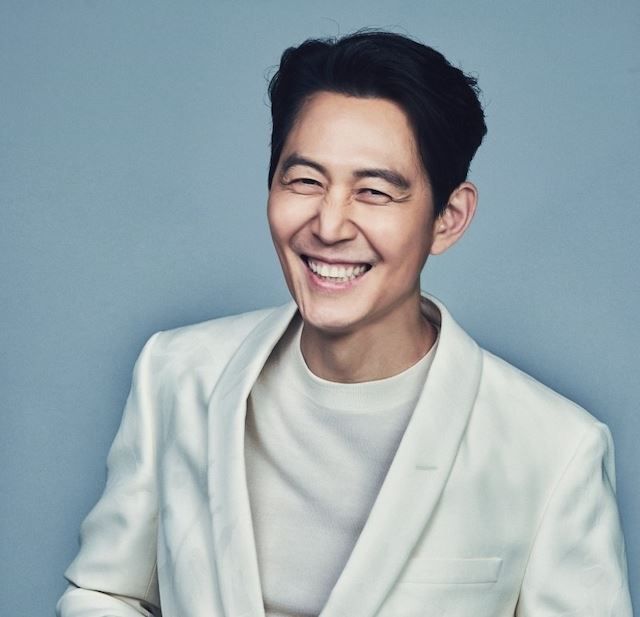
Actor Lee Jung-jae / Courtesy of Artist Company
“It feels so rewarding,” Choi said. “About 20 years ago, hardly anyone knew about Korea and its gems. When I traveled around the world, not even one person asked me if I was from Korea. When I tried to invite opinion leaders to our forums, they said they would come to Korea only if they had time after visiting China or Japan. But we are seeing a visible change today. These high-profile figures consider Korea as their major destination and for our upcoming Korea Image Awards, 63 ambassadors to Korea will join us. We will also give an award to some luxury fashion houses based in Europe ― such as Louis Vuitton and Chanel ― which have tapped Korean celebrities like Jennie of K-pop girl group BLACKPINK as their global ambassadors.”
The CICI did have a tough time earlier in the COVID-19 pandemic, as it could not host in-person events to promote Korea and seek cultural interactions. However, Choi turned this crisis into an opportunity by launching a YouTube channel titled, “Choi JW Rendez-vous.”
“I might not have started a YouTube channel if I had not experienced the pandemic,” she recalled. “But I did not have any other ways to continue my mission. I later realized that communicating with people on YouTube is a wise idea, and now, I am utilizing both online and offline environments.”
Explaining that the success of hallyu has stemmed from the creativity and uniqueness of our content and the cutting-edge IT technology that prompted the dissemination of our products, Choi underscored the significance of cooperation in making it more sustainable.
“So far, the government, companies and creators have mostly been walking their own paths,” she said. “But I believe now it is the time for all of them to join forces, help one another and create synergy. This approach will enable our cultural industry to experience something more entertaining in the days ahead. The CICI will also keep working hard and pursuing hallyu's sustainability.”