INTERVIEW KOCCA helps link K-content creators to investors

Jo Hyun-rae, president of the Korea Creative Content Agency, speaks during an interview with The Korea Times at the agency's office in downtown Seoul, Tuesday. Korea Times photo by Choi Won-suk
Content agency's role increases as Korean culture rises in prominence in global market
By Lee Gyu-lee
In the fast-paced, rapidly evolving content industry, Korean content, from music and TV dramas to webcomics and fashion, has been growing its presence in the global market more than ever. And as the country's content business has pushed toward new horizons, the role of the Korea Creative Content Agency (KOCCA), a state-run organization under the Ministry of Culture, Sports and Tourism, has become more crucial in serving its purpose to promote Korean culture content overseas.
“The Korean content industry is a very competitive market … And its local consumers are really known to be picky. So Korean creators and producers have endured the competition and suited the tastes of those picky audiences,” Jo Hyun-rae, president of KOCCA, said during an interview with The Korea Times, held at the agency's office in downtown Seoul, Tuesday.
“This couldn't have been possible if they didn't put themselves up for the endless trials and errors. Because you would know if it works only when you try it … And the role of the government and institutions like KOCCA is to provide as many opportunities as possible for those creators to go through trials and errors.”
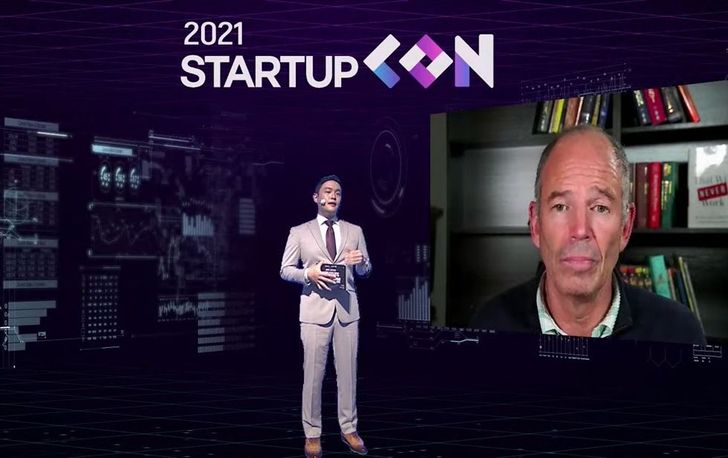
Netflix co-founder Marc Randolph, on the screen, speaks during the 2021 Startup:CON, an annual conference held by the Korea Creative Content Agency, in October 2021. Courtesy of KOCCA
In the global streaming era, the primary focus of local content creators has been reaching global audiences. And to meet their needs, the agency has carried out different programs to assist creators and production companies to enter the global market.
“Simply, our role is to access the area where the industry needs help and to fill it in. For example, people in the field have needed marketing experts, especially those who know overseas marketing. So we have started a program this year to train about 100 people to put into the field and work with the sectors,” Jo noted.
Along with its overseas business centers in nine countries to provide closer proximity for global audiences and buyers to Korean content providers, KOCCA organizes the annual conference “Startup:CON,” which includes a pitch competition for startups to present their businesses to international companies for possible investments and networking.
“Companies that wish to jump into the global market may not be familiar with overseas markets, so we provide the information that they need,” he said. “The content business is all about experience. So we help close the gap between local and global businesses by giving local companies opportunities to present their content at worldwide exhibitions and conferences, like MIPCOM and BCWW, opening up a platform to interact with global investors.”
MIPCOM (International Co-Production and Entertainment Content Market) is an annual global media content trade show held in France, and BCWW (Broadcast Worldwide) is a similar one held in Korea.
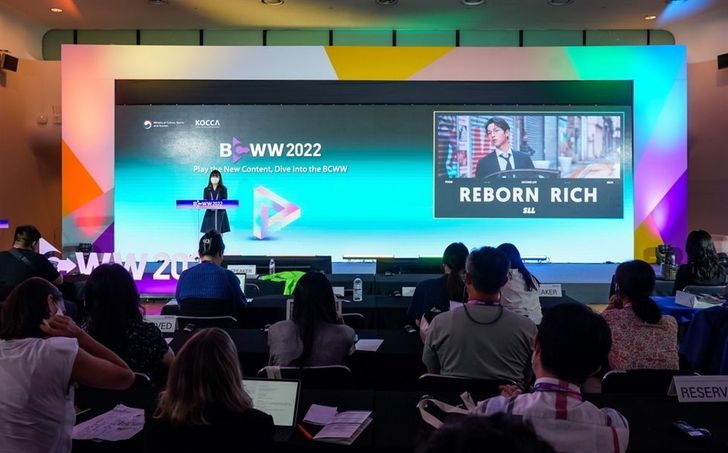
A speaker showcases production company SLL's upcoming series “Reborn Rich” at the 2022 Broadcast Worldwide (BCWW), held in Seoul from Aug. 31 to Sept. 2. Courtesy of KOCCA
With streaming platforms getting involved in content production, intellectual property (IP) has become a more complex issue. Questions arise on which parties ― creators, production companies or investing streaming platforms ― are entitled to claim copyright.
“Nowadays, if you have good IP, it can be applied to different content, like games, webcomics, series or films. It can also be used to make characters and merchandise and expand to offline manufacturing businesses for additional revenue,” the president explained.
He shared that production companies and creators can maximize the return on their IP by financing projects without streaming platforms' investment, which will also leave them with greater bargaining power in the long run.
“A lot of money is required to make content. And to help creators get enough budget, KOCCA has provided various aid to fund them. Not only that, but we also bridge the content industry with our investment fund business,” he said, adding that the agency helps production companies seek investments from financial firms and others by providing networking and consulting.
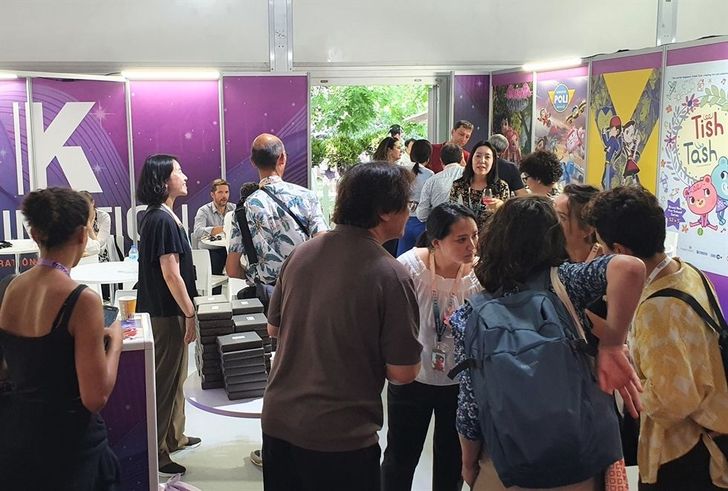
A picture of Korea Creative Content Agency's booth at the Annecy International Animation Film Festival and Market, held in June in France. Courtesy of KOCCA
One of its related programs is to assess the financial value of given content before production, by reviewing factors like actors, scripts and producers. The production companies then can use the assessment to appeal to investors. The recent action comedy film "The Roundup" is a beneficiary of the program.
Developing immersive content and implanting advanced technology for virtual, augmented or extended reality (VR, AR, XR), is one of the key areas that KOCCA has been working on in the past couple of years.
“The media industry has been evolving continually to incorporate new technologies to approach its consumers, and the consumers also have been constantly looking for something new,” Jo said. “Since COVID-19 led online concerts to debut, Korean firms have used the chance to present their pop culture-related concerts to the global market. It was an opportunity for K-content to expand overseas.”
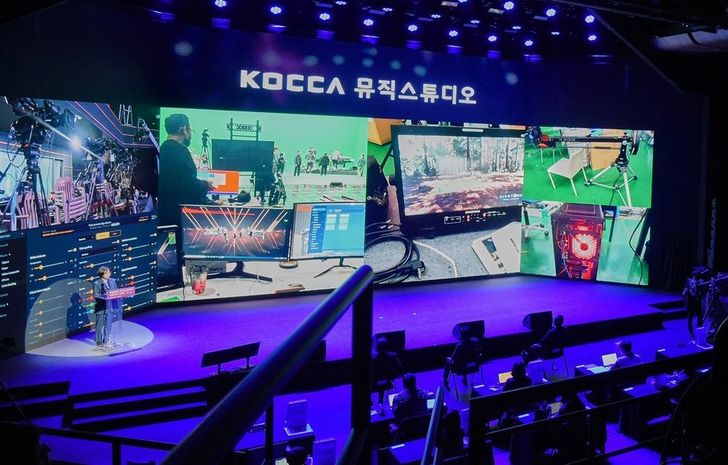
Projected images of KOCCA Music Studio that specializes in online immersive performances / Courtesy of KOCCA
Quoting PwC's report that projects the global XR market to value about 520 trillion won ($476.4 billion) by 2025, the president said that the agency is investing in the potential that might open up to an immense, lucrative market in the future.
“No one is sure whether immersive content or new technology-related content will succeed or fail. But there are economic predictors on its possibility, and we are taking the risk with our eyes on that possibility. It's about who is willing to put themselves up for the challenge: Whether you are going to sit around and wait until everyone around you becomes a success or you are going to take your chances to go neck and neck in that field,” he said.
“Small and medium-sized enterprises don't have enough resources to do that. It's new territory; a new challenge. So utilizing our taxpayers' funds, we are allowing them to try to have their trials and errors to prepare for the future, whether it would be a success or not.”