Grand Prize Cryptocurrencies walking regulatory tightrope

Kim Jung-hyun

By Kim Jung-hyun
Before plummeting in value, cryptocurrencies were collectively worth over $800 billion, nearly doubling the value of Samsung Group. While the bubble has since burst, cryptocurrencies are still regarded as being pivotal to the Fourth Industrial Revolution. Prior to their sudden rise, cryptocurrencies started out as secure digital currencies untethered to financial institutions that could be used anonymously across the globe.
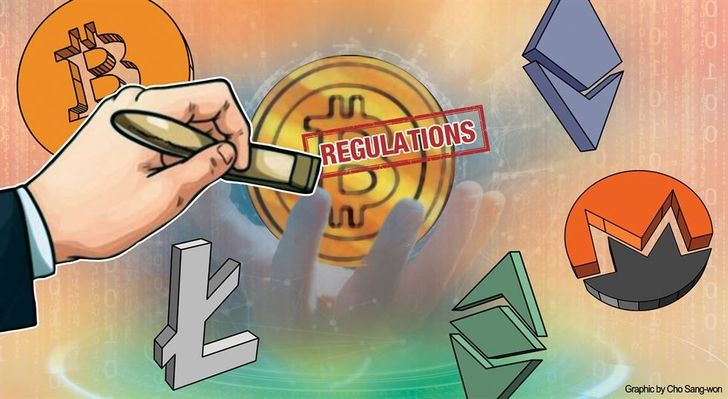
However, given their extremely high volatility, cryptocurrencies are seldom used for everyday transactions. They have consequently become either risky investment assets or a tool for money laundering. Furthermore, because the only intrinsic value of cryptocurrencies is their utility, they are prone to price manipulation and speculative investment. All things considered, swift regulation is sorely needed to protect investors while steering the industry away from the black economy and towards innovation.
The obvious first target of regulatory action is coin exchanges. Currently, the largest problem regarding cryptocurrencies is that everything from transactions to digital asset management is handled by independently established exchanges. This was initially thought to provide users with more security and freedom.
In reality, investors are left exposed to a higher risk of fraud and digital theft. Multiple exchanges have been trading in their own markets, creating a conflict of interest. Many offer ICOs they have a stake in and drum up interest to raise prices.
Additionally, coin exchanges are more prone to security breaches than traditional financial institutions. Digital theft of cryptocurrencies has reached over 1.2 billion dollars since May 2017 while an increasing number of exchanges have had a breach in user data. Given people of all walks of life bought into the initial promise of cryptocurrency and invested heavily, such vulnerabilities put the general public at risk.
There are currently few criteria for establishing an exchange. This explains their prolificacy and vulnerability; out of the 100 plus exchanges operating in South Korea, only one has been certified by the ISMS for user data protection. Therefore regulation must begin by establishing an approval system for new exchanges while setting stringent operation guidelines for existing ones.
The Japanese government, for instance, mandates all exchanges register with the financial services agency. This has been instrumental in curbing speculative investment while holding exchanges responsible for the protection of their users' digital assets. Moreover, imposing harsh penalties against reckless behavior will spur exchanges to shore up security flaws and act in the best interest of their users.
Another problem arises from the nature of cryptocurrency transactions. As transactions in cryptocurrencies are anonymous and untaxable, they have been used to funnel funds into the underground economy. One of the most widely traded cryptocurrencies, Monero, was specifically engineered to have an encrypted ledger that makes users untraceable.
Left unchecked, cryptocurrencies will veer away from their intended goal and fuel the black economy. South Korea has already taken action against illegal transactions by banning anonymous accounts and ordering exchanges to report suspicious transactions. More regulation, such as taxing capital gains and placing transactions under the scrutiny of the Financial Supervisory Service, is required to harvest the benefits of cryptocurrencies while deterring their misuse.
The largest misconception regarding cryptocurrency regulation is that it will stunt growth and limit its utility. On the contrary, several industry leaders see sensible regulation as a catalyst for further growth and innovation. Vague, undefined laws surrounding cryptocurrency have created an atmosphere in which innovators hesitate to move the industry forward out of fear of legal retribution.
The majority of the industry wishes to conform to regulations as long as they are well-defined and reasonable. Cryptocurrencies are not bound by physical borders, meaning entrepreneurs can take their ICOs and startups to any nation of their choosing. If South Korea cannot promptly set down a coherent set of rules, the industry will head overseas and innovation will grind to a halt. Considering that the technology behind cryptocurrency, blockchain, alone is worth 9 billion dollars, the inability to quickly regulate the industry will have massive economic ramifications.
We are currently at a crossroads. Sensible legislation has the potential to spark innovation while either exceedingly strict or lax regulation can clip its wings. The key is communication and investors, industry leaders and legislators all have something to contribute. Investors must demand improved countermeasures for fraud and digital theft. Industry leaders must inform others of the intricacies of cryptocurrencies as few truly understand an industry in its infancy.
Finally, legislators must strike a balance between increasing government oversight and giving cryptocurrencies free rein. Such a coordinated effort from all parties involved is crucial to making a tailored set of regulations that will aid, not stop innovation. Our ability to do so may be a deciding factor in whether South Korea remains competitive in the imminent Fourth Industrial Revolution.