Striving for an encore with Encored Technologies

An application that runs a smart energy meter EnerTalk. / Courtesy of Encored Technologies
Smart energy platform informs consumers, encourages lifestyle change
By Kim Ji-soo
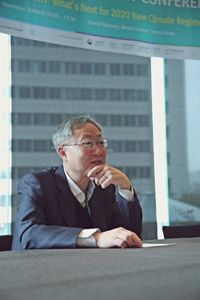
Choe Jong-woong, CEO and founder of Encored Technologies, speaks in an interview with The Korea Times in Seoul last month. / Courtesy ofSeoul Climate-Energy Conference 2016 by KAIST
Written on the glass door of the office of Choe Jong-woong, CEO of Encored Technologies, is “Synergy! Fun! Passion!”
Inside his office in southern Seoul, one wall is lined with books and a hoodie-wearing Choe was working as briskly as the cold wind outside. He had just returned from a trip to Japan and was deep into planning for his business for next year.
Encored Technologies is a big data company that aggregates energy demand data and provides information platforms and related services. The average Korean may be more familiar with EnerTalk, a small cloud-based big data device developed by the company and installed on a customer’s fuse box to measure electricity usage. The so-called “smart energy meter” is currently used in some 100,000 Korean households to measure data to the second.
“We are used to having the energy meter outside the home, but when we think about it, it’s better to have our information inside ... so that we can regulate energy usage and enjoy our other services,” Choe said in an interview with The Korea Times. “With our services, people who use energy now have a choice.”
The energy costs for homes became a sensitive issue when the soaring summer heat this year prompted households to pay exorbitant bills. In Korea, electricity is charged according to progressive categories of electricity usage. As usage increases into the next category, the rate charged also increases progressively. After the public outrage, the government lessened the number of categories down from six to three, to lessen the burden for households.
A household that purchases an EnerTalk device can download a smartphone application and learn about its electricity usage, such as how much electricity it currently uses, projected monthly usage and costs. The energy usage data is gathered via Wi-Fi, analyzed by the company and then sent back to the user. EnerTalk is a device as well as a platform that allows for the analysis as well, which is crucial to smart metering.
With the device, consumers can also identify which appliances are eating up electricity. They can also monitor their elderly parents or family members’ safety by looking at energy usage data through the app.
The company works with LG Uplus, one of its corporate clients, with the latter’s home Internet of Things services such as smart lighting and door locks, and Choe hopes to work with Japanese companies as well soon. Asked if those who think the app is cumbersome can use it another way, Choe said the company expects to further advance its services.
“In Korea, we are thinking of providing services through messaging for those who do not like apps. Also in Japan, our products can go into a wall clock to gauge not only electricity use but also earthquakes,” Choe said.
The 59-year-old has undertaken new projects throughout his career, which he spent mostly with LG group. He invented a smart meter for buildings and an industrial smart meter while working for what is now known as LSIS in the early 1990s. Choe graduated with a B.A. in mechanical engineering from Pusan National University and a master’s and a doctorate in computer science from Chungnam National University. Choe served as vice president at LG Instrument & Machinery from 1982 to 2003. In 2004, he became CTO of LSIS as well as its president of R&D and business. He served as president of LSIS in 2012. In 2013, Encored Technologies was founded in Silicon Valley in the U.S., and it has grown into corporations in Japan and Korea.
It’s interesting to note how he broke out of the safe career track he enjoyed in his 50s at the conglomerate. “I would say I went independent too late,” he said. He named the company Encored to refer to his aim of creating another encore in his life.
He said he had long wanted to work on his own, and his dream materialized when he received an 11 billion won investment from e-investment fund Quantum Strategic Funds run by George Soros, as well as investments from others including Formation 8, LG and Samsung. The upside to having foreign investors is that the firm has up to five years to perfect its services before having to make sales, Choe said.
His team consists of experts from various fields — energy specialists, mathematicians, statisticians, psychologists and web and app designers. Asked how the company is trying to persuade people who may be wary of the so-called fourth industrial revolution and the increasing role of IT in their lives, Choe said some may be unfamiliar with the interactive and the participative aspects of the fourth industrial revolution.
“I think it is hard to definitively say what the fourth industrial revolution is,” Choe said. “But inferring from the trends, the fourth industrial revolution is likely to be determined by such technologies as Internet of Things, artificial intelligence, virtual reality and augmented reality. The common fear seems to be one of losing jobs.”
However, he forecast that when these technologies advance and industries are disrupted, new jobs will appear.
Thus, he and his team pay attention to propelling more people to change habits and therefore behavior by adopting smart energy usage.
For instance, the company operates a program with the Seoul Metropolitan Government where EnerTalk users who save energy can donate refunded cash to the needy.
“It is interesting to note that when we were only refunding cash, people used only about 5 percent less energy. But when we enabled the users to donate the refunded cash in their name, energy usage decreased by 17 percent,” said Choe, explaining that people would be willing to sacrifice lifestyle extravagances for the greater good, even more than for a minor financial reward.
He envisions a more open energy grid in the future where the government supports the development and testing of innovative technologies and businesses.